Ketamine Side Effects, Body System by Body System
Zora Neuro Spa Editorial · October 17, 2026

Most of what you'll read online about ketamine side effects was written about someone who isn't you. Harm-reduction pages describe daily heavy users, anesthesia references describe surgical doses, and the two get blended into one alarming list. This guide separates them by body system — bladder, brain, heart, gut, and mood — so you can see which risks belong to supervised clinical dosing and which belong to a very different pattern of use.
Quick Answer
In a monitored clinic setting, most ketamine side effects are short-lived and predictable: dissociation (a temporary sense of detachment), mild nausea, dizziness, and a transient rise in blood pressure and heart rate that settles before you go home. These effects are tied to the dose and fade as the drug clears. The serious long-term problems reported in the literature — bladder damage and persistent memory deficits — are overwhelmingly described in people using ketamine frequently, at high doses, outside medical supervision (StatPearls, NCBI Bookshelf). For the full risk-benefit view, see the broader safety picture for ketamine therapy.
TL;DR
- Bladder: Ketamine-associated urinary damage is real but tied to frequent, high-dose, long-term use — not a standard clinical series. Read the urinary warning signs to watch for
- Brain: Attention and short-term memory dip during a dose and clear afterward; lasting deficits are reported in chronic heavy users. Compare acute vs. chronic cognitive effects
- Heart: Ketamine temporarily raises blood pressure and heart rate, which is exactly why clinics cuff you throughout. See what cardiovascular monitoring involves
- Gut: Nausea is the most common acute effect and one of the most preventable with simple pre-dose steps. Review the comfort levers clinics use
- Route matters: Esketamine nasal spray carries its own FDA-required observation and driving rules. Compare IV, nasal spray, and oral
In This Article
- Why Organize Ketamine Side Effects by Body System?
- What Happens to the Bladder and Urinary Tract?
- Does Ketamine Affect Memory and Thinking Long Term?
- What Does Ketamine Do to Blood Pressure and Heart Rate?
- Are Nausea, Dizziness, and the 'Hangover' Avoidable?
- How Is the Nasal Spray Side Effect Profile Different?
- Can Ketamine Make Mood or Anxiety Worse?
- How Do Clinics Keep Side Effects Small?
- Who Should Think Twice Before Starting?
Why Organize Ketamine Side Effects by Body System?
Because a timeline-based list hides the single most important variable: dose and frequency. Three very different populations get described under the same heading — surgical patients under anesthesia, clinic patients on sub-anesthetic doses, and people using ketamine heavily and repeatedly on their own.
Body-system framing is organizing risk by the organ affected — urinary, neurological, cardiovascular, gastrointestinal, psychiatric — rather than by how long a symptom lasts. It makes the dose question impossible to skip, because each organ responds to a different exposure pattern.
The contrast is stark. Sub-anesthetic ketamine for mood disorders is commonly described in the clinical literature at roughly 0.5 mg/kg infused slowly, with the dose calculated from your body weight (StatPearls). The urinary and cognitive problems that dominate search results are documented in people using far larger amounts, far more often, over months to years — a completely different exposure.
⚠️ Read sources in context. Symptom lists published by addiction-recovery and harm-reduction organizations describe patterns of frequent unsupervised use. They are useful public-health information, but they are not a forecast of what happens in a weight-dosed, monitored clinical series.
Key takeaway: The organ matters, but exposure pattern matters more — the same molecule produces very different risk profiles at clinical dosing versus frequent heavy use.
What Happens to the Bladder and Urinary Tract?
Ketamine can injure the bladder lining, but the documented cases are strongly dose- and frequency-dependent. The condition appears in the clinical literature in the context of chronic, heavy ketamine use rather than supervised sub-anesthetic treatment (StatPearls).
Ketamine-induced cystitis refers to inflammation and scarring of the bladder wall associated with long-term ketamine exposure. It can produce urgency, frequency, pain on urination, and in advanced cases reduced bladder capacity.
UK harm-reduction material aimed at people who use ketamine regularly describes severe abdominal and bladder pain — often called "K cramps" — as a recognized consequence of heavy or daily use (per substancemisuseresources.co.uk, as of October 2026). That guidance is written for a frequent-use population, not for people in a scheduled clinical series.
What urinary symptoms should I report?
Tell your prescriber promptly if you notice any of these, regardless of how mild they seem:
- Urgency — a sudden, hard-to-ignore need to urinate
- Frequency — going noticeably more often than your normal baseline
- Burning or pain — discomfort during or after urination
- Blood in urine — pink, red, or tea-colored urine at any point
A thorough intake should ask about your urinary history before your first session, and a good clinic will ask again at follow-ups if treatment continues over time. If you're weighing maintenance dosing, it's worth reviewing what the evidence shows after six months of treatment rather than extrapolating from chronic-use case reports.
Key takeaway: Bladder risk tracks with cumulative exposure. Report urinary symptoms early — this is the one body system where saying something sooner genuinely changes the plan.
Does Ketamine Affect Memory and Thinking Long Term?
During a dose, attention and short-term memory measurably dip, and most people feel foggy for a stretch afterward. Those acute effects resolve as the drug clears. Lasting cognitive deficits — particularly in verbal and working memory — are described in studies of frequent heavy users, a population with far greater cumulative exposure than a clinical course (StatPearls).
Dissociation is a temporary sense of detachment from your body, time, or surroundings. It's expected during ketamine dosing, it is monitored, and it typically resolves as the infusion ends. The FDA label for esketamine nasal spray lists dissociation among the most commonly reported adverse reactions (FDA prescribing information).
Researchers measure these effects with standardized tools — verbal recall lists, working-memory span tasks, and attention batteries — rather than by asking people how sharp they feel. That distinction matters when forum posts describe "brain fog" without any measurement behind it.
| Effect | During the dose | Same day | After a clinical series | Frequent heavy use |
|---|---|---|---|---|
| Short-term memory | Noticeably reduced | Usually back to baseline | No comparable lasting impairment shown in controlled therapeutic studies | Verbal and working memory deficits reported in chronic-user studies |
| Attention | Reduced; no driving | Generally clears with rest | Not an expected ongoing issue | Reported alongside memory findings |
| Dissociation | Common and expected | Resolves after the session | Not persistent | Can be prolonged or repeated with escalating use |
Source for adverse-effect categories: StatPearls and the FDA esketamine label. Individual experiences vary, and any cognitive concern should be raised with your prescriber. The deeper route-level breakdown sits in our comparison of how side effects differ by IV, nasal spray, and oral routes.
What Does Ketamine Do to Blood Pressure and Heart Rate?
Ketamine transiently raises blood pressure and heart rate through its sympathomimetic effects, which is a well-documented property of the drug (StatPearls). In practice, this is the reason clinics take a baseline reading before dosing and keep measuring throughout.
Standard cardiovascular monitoring during an infusion includes:
- A baseline blood pressure and pulse reading taken before anything starts
- An automatic cuff set to re-check at regular intervals during the session
- Pulse oximetry tracking oxygen saturation and heart rate continuously
- A recovery check before you're cleared to leave with your ride
The FDA label for esketamine nasal spray instructs that blood pressure be assessed before dosing and again after administration, and it advises against use in people for whom a blood pressure or intracranial pressure increase poses a serious risk, including those with aneurysmal vascular disease or a history of intracerebral hemorrhage (FDA prescribing information).
⚠️ Uncontrolled high blood pressure is a screening conversation, not a footnote. If your hypertension isn't well managed, or you've had a recent cardiac event, your clinician needs that history before scheduling — it's often the single deciding factor.
For how cardiovascular screening fits into overall candidacy, see the broader safety picture for ketamine therapy.
Are Nausea, Dizziness, and the 'Hangover' Avoidable?
Largely, yes. Nausea and vomiting are among the commonly reported effects of ketamine (StatPearls), and they're also the most straightforward to plan around. The levers are simple and applied at specific points in the day.
- A light-food rule before dosing — your clinic will give you a specific window
- Anti-nausea premedication such as an antiemetic given before the session, at clinician discretion
- A controlled infusion rate that can be slowed if you feel queasy or unsteady
- Low stimulation — eye mask, quiet room, calm music instead of bright light and conversation
- An unhurried recovery period before you stand up and walk out
- A required ride home — no driving for the rest of the day
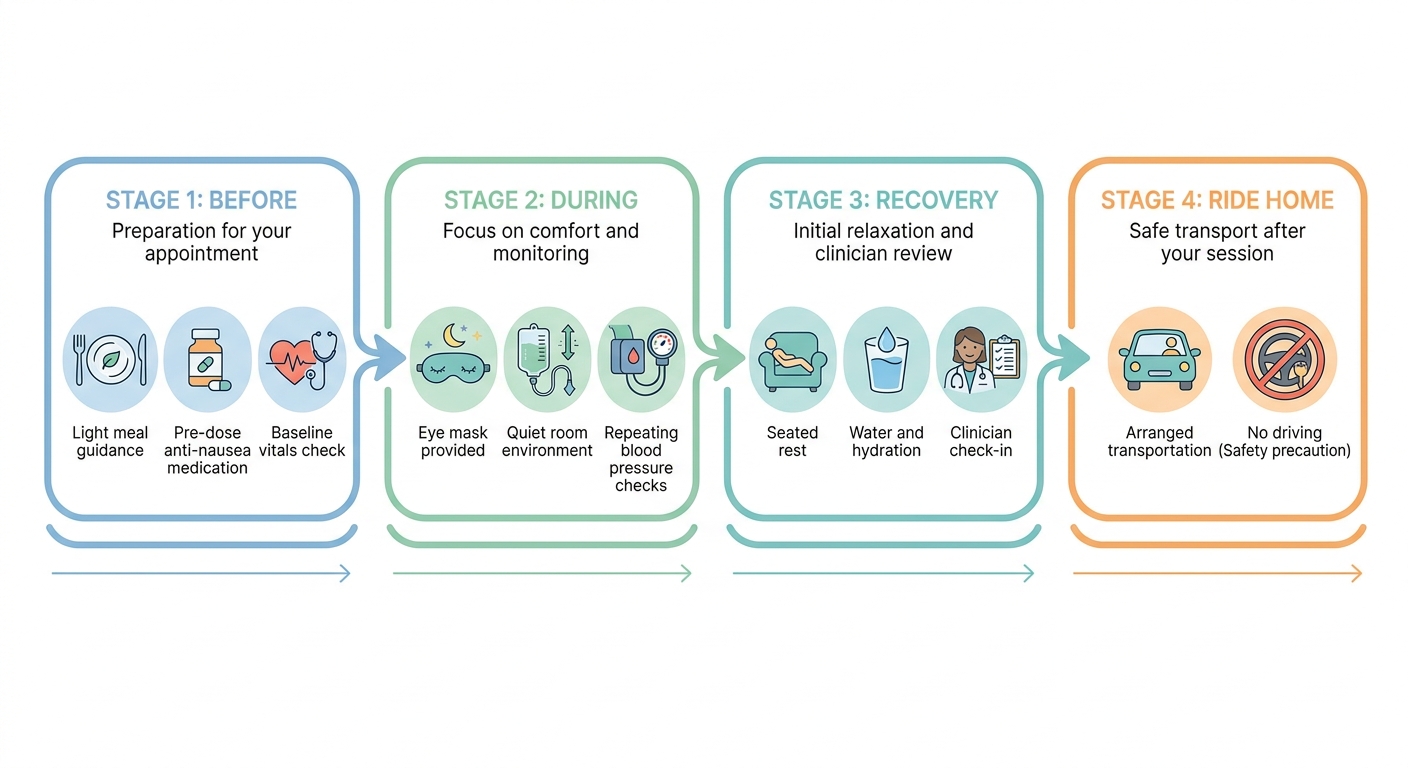
Dizziness and lightheadedness follow the same pattern — they peak during the session and ease as the drug clears. Standing up slowly and staying seated until a staff member clears you is the practical fix. Our deeper write-up covers the prevention steps clinics use in session-by-session detail.
How Is the Nasal Spray Side Effect Profile Different?
Esketamine nasal spray shares the core effects — dissociation, dizziness, nausea, and a blood pressure rise — but adds route-specific ones and a stricter regulatory wrapper. The FDA label lists dissociation, dizziness, nausea, sedation, vertigo, hypoesthesia (reduced sensation), anxiety, lethargy, increased blood pressure, vomiting, and feeling drunk among the most common adverse reactions (FDA prescribing information).
Two requirements set it apart from an IV session. The label requires administration under direct supervision of a healthcare provider with patients monitored for at least 2 hours after dosing, and the product is available only through a restricted REMS program. The label also instructs patients not to drive or operate machinery until the next day following a restful sleep.
| IV infusion | Esketamine nasal spray | Oral / at-home | |
|---|---|---|---|
| Delivery | Continuous, rate-controlled IV line | Self-administered spray under supervision | Lozenge or tablet taken at home |
| Common effects | Dissociation, dizziness, nausea, transient BP rise | Same core effects plus nasal discomfort and altered taste | Varies; dissociation and nausea commonly described |
| Monitoring | In-clinic vitals throughout the session | FDA label requires ≥2 hours of post-dose monitoring under REMS | No in-person vitals monitoring |
| Driving | Ride home required same day | Label: no driving until the next day after restful sleep | Varies by program; follow prescriber instructions |
Source: FDA prescribing information for esketamine nasal spray. For Boise and Eagle residents, that two-hour window is a scheduling reality worth planning around — it shapes your whole afternoon. The full side-by-side comparison lives in our guide to how side effects differ by IV, nasal spray, and oral routes.
Can Ketamine Make Mood or Anxiety Worse?
Some people have a difficult or anxious experience during dosing, and anxiety appears among the commonly reported adverse reactions on the esketamine label (FDA prescribing information). A smaller number describe a mood dip in the days after a session. Both are reasons that follow-up contact and integration conversations are part of a well-run program rather than an optional extra.

Emergence anxiety — feeling unsettled as the dissociative effects build or recede — is usually managed in the room with reassurance, lower stimulation, and a slower rate. Forum posts describing a post-session "crash" are worth taking seriously as lived reports, but they are individual accounts, not measured outcomes, and experiences vary widely.
Depression itself carries risk of worsening symptoms and suicidal thinking regardless of treatment (National Institute of Mental Health), which is why your clinician should give you a clear path to reach them between sessions.
⚠️ Call your prescriber right away if you notice worsening depression, new or increasing suicidal thoughts, or a mood change that frightens you. If you're in immediate danger, call or text 988 in the US. Do not wait for your next appointment.
Key takeaway: Psychological side effects are the ones most likely to show up after you've left the building — so know who to call and how, before your first session.
How Do Clinics Keep Side Effects Small?
The side effect profile you actually experience is largely a function of three things a supervised clinic controls: dose precision, screening, and real-time monitoring. Self-dosing controls none of them.
Here's how that plays out across a session.
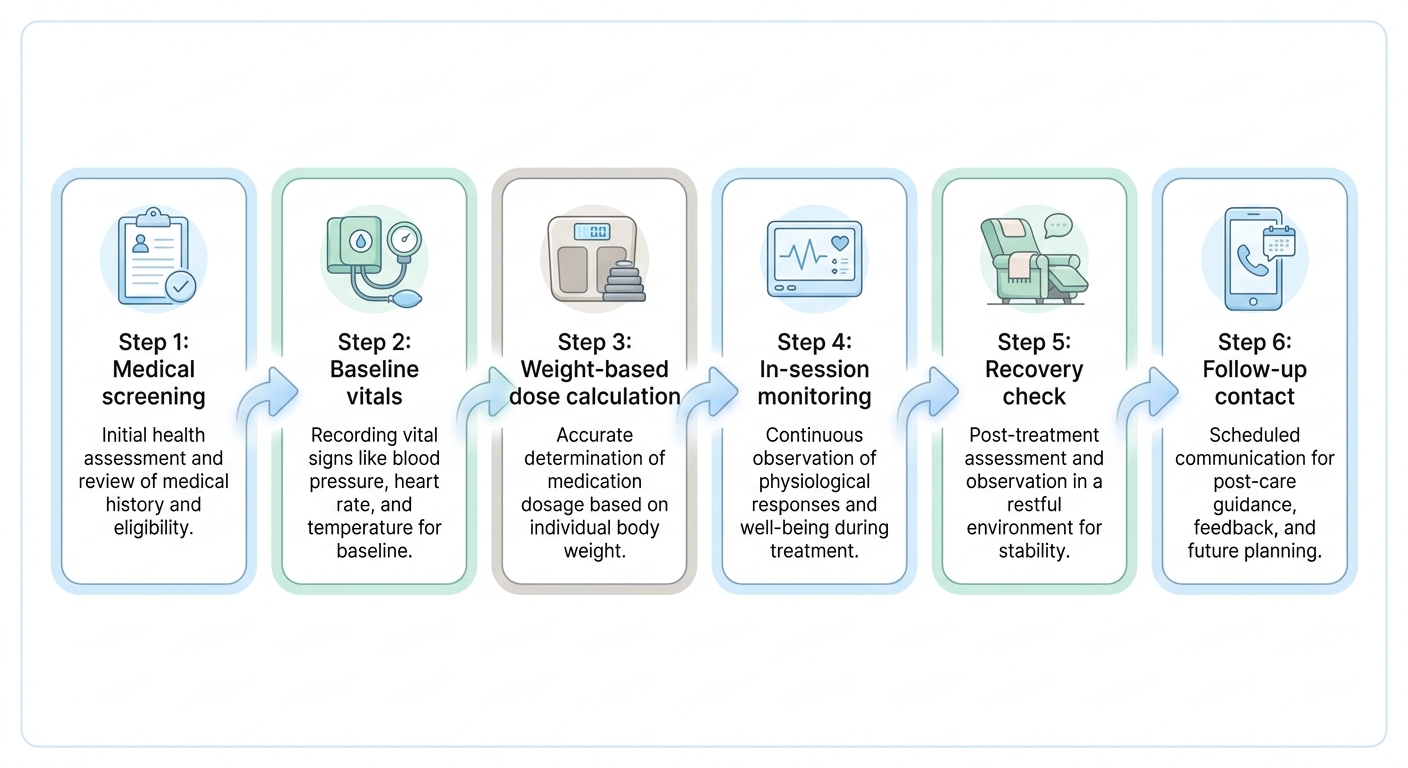
- Weight-based dosing — the amount is calculated from your body weight, not estimated
- Medical and psychiatric screening — blood pressure history, cardiac history, substance use history, urinary history
- Continuous vitals — cuff and pulse oximetry readings on a set interval
- A titratable line — an IV infusion can be slowed or stopped mid-session, which a swallowed dose cannot
- Structured follow-up — a scheduled check-in rather than hoping you call
What should I ask a clinic about monitoring?
Use these five questions on any consultation call:
- Who is in the room or immediately available during my session, and what are their credentials?
- How often are my blood pressure and oxygen levels checked?
- What happens if I feel nauseated, anxious, or unwell partway through?
- How is my dose calculated, and does it change between sessions?
- How do I reach a clinician between appointments if something feels off?
If you're comparing providers across the Treasure Valley, our page on IV ketamine therapy in Boise and Eagle explains how a supervised infusion session is structured, and the prevention steps clinics use goes deeper on monitoring protocol.
Who Should Think Twice Before Starting?
Ketamine isn't a fit for everyone, and most screening flags are "discuss it carefully" rather than "never." Your clinician weighs them against your history in a consultation — this table is for preparing that conversation, not for self-disqualifying.
| Stronger caution | Discuss with your clinician |
|---|---|
| Aneurysmal vascular disease or history of intracerebral hemorrhage (per the FDA esketamine label) | Well-controlled high blood pressure |
| Uncontrolled hypertension or unstable cardiac disease | History of urinary or bladder symptoms |
| Active substance use disorder involving ketamine | Past substance use history, now in recovery |
| Active psychosis | Bipolar disorder diagnosis |
| Pregnancy | Current medication list, including blood pressure drugs |
Bring your full medication list and any recent cardiology or urology notes to your consultation. A clinic that asks detailed questions before scheduling is doing its job; one that doesn't is skipping the step that keeps side effects small. You can see what a structured intake covers on our IV ketamine therapy in Boise and Eagle page.
Summary
Reading ketamine side effects by body system makes the picture far less frightening and far more useful. The urinary and cognitive risks that dominate headlines come from a frequent, high-dose, unsupervised pattern of use. The effects a clinic patient actually encounters — dissociation, nausea, dizziness, a temporary blood pressure rise — are short-lived, expected, and actively managed with screening, weight-based dosing, continuous vitals, and a required ride home. The questions worth bringing to a consultation are about monitoring, dosing, and who you call between sessions.
Frequently Asked Questions
How long do ketamine side effects last after an infusion?
The dissociative and dizzy sensations typically fade over the period following the end of the infusion, and most people describe feeling clear-headed by the next morning. Mild fatigue can linger into the evening. That's one reason a ride home is required rather than suggested. Individual experiences vary.
Does clinical ketamine cause bladder damage?
Documented ketamine-associated urinary damage is overwhelmingly described in the context of frequent, high-dose use over months to years, not a standard supervised series (StatPearls). Report urinary urgency, frequency, burning, or blood in urine to your prescriber right away rather than waiting for your next visit.
Is ketamine addictive at therapeutic doses?
Dependence risk is linked to frequency, self-administration, and escalating dose — the opposite of a supervised, scheduled, weight-dosed series. Clinics screen for substance use history at intake for exactly this reason, and an honest answer there protects you. Ketamine is a controlled substance, and that screening conversation is standard.
Can I drive after a ketamine session?
No. Arrange a ride home for the same day after an IV infusion. For esketamine nasal spray, the FDA label instructs patients not to drive or operate machinery until the next day following a restful sleep (FDA prescribing information).
What side effects should I call the clinic about?
Call about new or worsening suicidal thoughts, worsening depression, nausea or vomiting that persists past the same day, severe headache, blood in urine, or burning on urination. Most other effects are expected and short-lived. If you're in immediate danger, call or text 988. More questions are answered in our ketamine safety and process FAQ.
Information about third-party platforms reflects publicly available details at the time of writing and may have changed. Please verify directly with the provider. See our Terms of Use for more.