Migraine Treatment Options, From First Line to Refractory
Zora Neuro Spa Editorial · October 10, 2026

Migraine is not one problem with one fix — it's a spectrum, and migraine treatment is built in tiers that escalate as simpler options run out. This guide maps the full ladder: what stops an attack, what prevents attacks, what's available when migraines turn chronic, and where off-label options like ketamine infusions actually belong. If you've already cycled through two or three medications without relief, the back half of this article is written for you.
Quick Answer
Every migraine treatment falls into one of two buckets: acute (taken during an attack to stop it) and preventive (taken on a schedule to make attacks less frequent). Most people with frequent migraines need both. Acute options include NSAIDs, triptans, gepants, and ditans. Preventives include CGRP-targeting drugs, topiramate, propranolol, amitriptyline, and — for chronic migraine — onabotulinumtoxinA injections. When several preventives fail at a proper dose and duration, migraine is considered refractory, and procedural options including off-label ketamine infusions enter the conversation.
TL;DR
- Acute and preventive are two different jobs. Treating attacks harder does not reduce how often they come. Compare the two tracks side by side
- A preventive needs a real trial window — typically a couple of months at the target dose — before you or your clinician can call it a failure. See how preventive classes differ
- Chronic migraine has its own toolkit, including injection protocols and IV preventives that aren't used for occasional attacks. Review the chronic migraine escalation sequence
- Refractory migraine is a response definition, not a frequency one. It means adequate trials of multiple preventive classes haven't worked. Walk through the refractory decision tree
- Ketamine for migraine is off-label and late-line, with early and limited evidence — not a replacement for preventive care. See where ketamine infusions actually fit
In This Article
- What Are the Two Categories of Migraine Treatment?
- Which Acute Treatments Actually Stop an Attack?
- How Do Preventive Medications Compare?
- What Options Exist for Chronic Migraine Specifically?
- Do Neuromodulation Devices and Non-Drug Approaches Help?
- When Is Migraine Considered Refractory?
- Where Do Ketamine Infusions Fit in Migraine Care?
- What Is Medication-Overuse Headache?
- Which Headache Symptoms Mean You Should Seek Urgent Care?
- How Do You Build a Migraine Treatment Plan That Actually Progresses?
- Frequently Asked Questions
What Are the Two Categories of Migraine Treatment?
Every migraine treatment is either abortive or preventive, and the two are judged by completely different standards.
Acute migraine treatment is medication taken during an attack to stop the pain, nausea, and light sensitivity that come with it. Preventive migraine treatment is taken on a regular schedule — daily, monthly, or quarterly — to reduce how many attack days you have each month.
People often get stuck because they're using only one track. Someone taking a triptan twelve days a month doesn't have an acute medication problem; they have an unmet preventive need. The reverse is also true: a preventive that cuts attacks in half still leaves attacks that need treating.
| Acute treatment | Preventive treatment | |
|---|---|---|
| Goal | End the current attack | Reduce attack frequency and severity |
| Timing | Taken at the first sign of an attack | Taken on a fixed schedule, attack or not |
| Example classes | NSAIDs, triptans, gepants, ditans, antiemetics | CGRP antibodies, oral gepants, topiramate, beta blockers, tricyclics |
| How success is measured | Attack stopped, function restored, no rebound | Fewer monthly migraine days, less rescue medication |
| Main risk of overuse | Medication-overuse headache | Side effects and premature discontinuation |
Where that split gets personalized is a clinical visit. A clinician looks at your attack frequency, your disability level during attacks, what you've already tried, and your other medical conditions before deciding which track needs work first. That's also what happens in a migraine treatment consultation in Eagle.
Key takeaway: If you don't know which track you're actually failing — acute or preventive — the next medication change is a guess.
Which Acute Treatments Actually Stop an Attack?
The most important variable in acute treatment isn't which drug you take — it's how early you take it. Most acute migraine medications work better when taken at the first sign of an attack, before pain peaks and before nausea slows stomach emptying.
Here's the practical landscape of acute options:
| Class | Common examples | How it's used | Key cautions |
|---|---|---|---|
| NSAIDs | Naproxen, ibuprofen, diclofenac powder | Often first-line for mild to moderate attacks | Stomach, kidney, and bleeding risks with frequent use |
| Triptans | Sumatriptan, rizatriptan, eletriptan | Taken early; several formulations including injectable and nasal | Generally avoided in people with cardiovascular or cerebrovascular disease |
| Gepants (acute) | Ubrogepant, rimegepant | Oral CGRP receptor blockers | Newer class; cost and coverage are common barriers |
| Ditans | Lasmiditan | Oral; an option when triptans aren't appropriate | Driving restriction after dosing; sedation |
| Antiemetics | Metoclopramide, prochlorperazine | Added for nausea and to aid absorption | Sedation; movement-related side effects possible |
What if triptans aren't an option?
Triptans narrow blood vessels, so clinicians typically avoid them in people with coronary artery disease, prior stroke, uncontrolled hypertension, or certain vascular conditions. That's a real population, and it's one reason the newer classes matter.
- Gepants work on the CGRP pathway rather than by constricting vessels, which is why they're often considered when triptans are contraindicated.
- Ditans act on a different serotonin receptor subtype than triptans do, without the same vasoconstrictive mechanism.
- Non-drug devices (covered below) are frequently used during pregnancy or when medication options are limited.
How many days a month is too many?
This is the question most people skip, and it quietly derails treatment. Using acute medication regularly — several days every week, month after month — can set up a rebound cycle. Headache specialists call this medication-overuse headache, and no preventive will outrun it until the overuse is unwound.
A simple rule of thumb many clinicians use: if you're reaching for rescue medication often enough to worry about running out, it's time to talk about prevention instead of a stronger abortive.
Key takeaway: Take acute medication early, track how many days a month you use it, and treat a rising count as a signal to escalate prevention — not to escalate the rescue drug.
How Do Preventive Medications Compare?
Preventive success is defined as a meaningful drop in monthly migraine days — commonly framed as a meaningful reduction in monthly migraine days — not as the elimination of migraine. Setting that expectation up front prevents a lot of premature quitting.
| Class | Examples | How it's given | Practical notes |
|---|---|---|---|
| CGRP monoclonal antibodies | Erenumab, fremanezumab, galcanezumab, eptinezumab | Monthly or quarterly injection; eptinezumab is IV | Often require documented failure of older preventives first |
| Oral CGRP preventives | Atogepant, rimegepant | Daily or every-other-day oral | Convenient; cost and prior authorization are common hurdles |
| Anticonvulsants | Topiramate, valproate | Daily oral, slow titration | Cognitive and weight effects are frequent reasons for stopping |
| Beta blockers | Propranolol, metoprolol | Daily oral | Avoided in asthma and some cardiac conditions |
| Tricyclics | Amitriptyline, nortriptyline | Daily oral, usually at night | Sedation and dry mouth; may help co-existing sleep problems |
| Antihypertensives | Candesartan | Daily oral | Often used when other classes aren't tolerated |
Why do people quit preventives too early?
Because most oral preventives are titrated slowly, and the early weeks are the side-effect-heavy weeks before the benefit shows up. Topiramate and amitriptyline in particular are usually started low and raised gradually.
A fair trial generally means:
- Reaching the target dose, not just starting the medication.
- Staying at that dose for a defined window — commonly two to three months.
- Tracking monthly migraine days throughout, so the comparison is data, not memory.
- Documenting side effects honestly, because intolerance is a legitimate reason to switch.
- Reviewing with a clinician at the end of the window rather than drifting indefinitely.
Insurance adds a second layer. Step therapy — where a plan requires you to fail cheaper options before approving newer ones — is a common reason patients spend a year on older preventives before reaching a CGRP agent. Knowing that in advance lets you start documenting trials properly from day one.
Key takeaway: A preventive you abandoned at week three was never actually tested. Document the dose, the duration, and the monthly migraine day count before calling it a failure.
What Options Exist for Chronic Migraine Specifically?
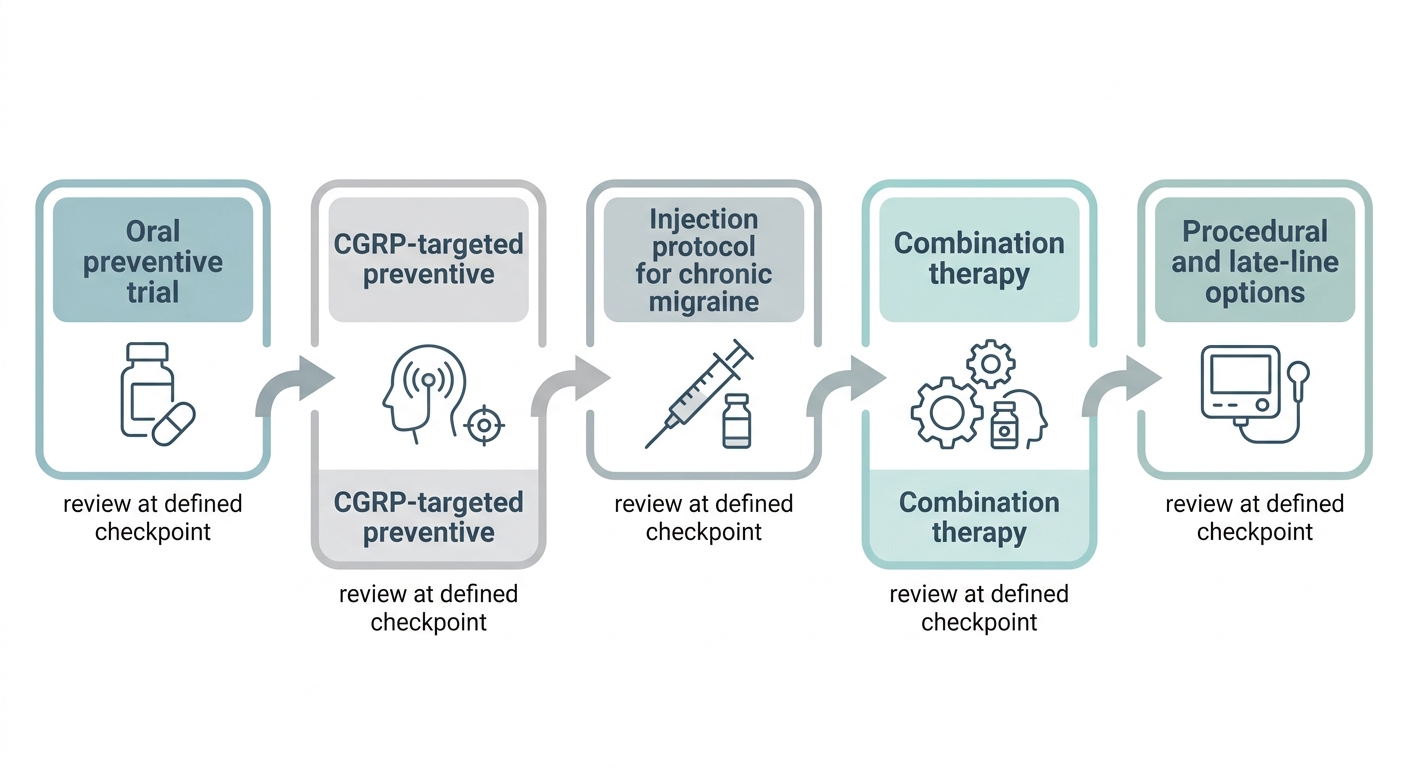
Chronic migraine is defined by frequency: 15 or more headache days per month for at least three months, with at least eight of those having migraine features. That threshold matters because it unlocks treatments that aren't used for episodic migraine.
Options clinicians consider at this stage include:
- OnabotulinumtoxinA injections — a fixed-site protocol of small injections across the forehead, temples, back of the head, neck, and shoulders, repeated on a roughly quarterly schedule. It is approved for chronic migraine specifically, not for episodic migraine.
- IV CGRP preventive therapy — eptinezumab is given as an infusion in a clinical setting on a quarterly schedule.
- Nerve blocks — greater occipital nerve blocks are used by some practices as a bridging measure during a difficult stretch.
- Combination therapy — pairing a CGRP agent with injections or an oral preventive, increasingly common in chronic migraine care though insurers often resist covering two advanced therapies at once.
Why does chronic migraine behave like a chronic pain condition?
Because, over time, the nervous system itself changes. Frequent attacks are associated with central sensitization — a state where pain-processing pathways become easier to trigger and slower to settle. It's the same mechanism that explains how persistent nerve pain becomes self-sustaining.
That overlap is why chronic migraine is often managed alongside other persistent pain conditions, and why some patients end up in a chronic pain treatment consultation rather than a purely headache-focused one.
Do Neuromodulation Devices and Non-Drug Approaches Help?
Yes — modestly, and they matter most for people who can't take or can't tolerate standard drugs: pregnancy, cardiovascular disease, severe side effects, or an active medication-overuse problem.
Neuromodulation refers to devices that use electrical or magnetic stimulation to alter nerve signaling, rather than medication. Several categories have FDA clearance for migraine, including remote electrical neuromodulation worn on the upper arm, external trigeminal nerve stimulation applied to the forehead, single-pulse transcranial magnetic stimulation, and non-invasive vagus nerve stimulation at the neck. They can be used acutely, preventively, or both, depending on the device.
Non-drug levers worth working on in your first 90 days:
- Sleep regularity — same wake time daily, including weekends. Irregular sleep is one of the most commonly reported triggers.
- Hydration and meal timing — skipped meals and dehydration are frequent, modifiable contributors.
- Behavioral therapy — CBT-based headache programs, biofeedback, and relaxation training have the strongest evidence base among behavioral approaches.
- Nutraceuticals — magnesium, riboflavin, and CoQ10 are commonly used as adjuncts. Doses vary and should be set with your clinician, since magnesium in particular causes GI side effects at higher amounts.
- Caffeine audit — daily intake that swings up and down can drive withdrawal headaches independent of migraine.
- Trigger tracking without trigger obsession — log consistently for 8 weeks, then look for patterns rather than reacting day to day.
Post-attack recovery is its own category. After a long attack with vomiting or poor intake, some people pursue fluid and micronutrient support such as Relief Reboot IV therapy to address dehydration. This is supportive care intended to help with hydration and comfort — it is not a migraine preventive, and it doesn't replace a treatment plan.

When Is Migraine Considered Refractory?
Migraine is generally considered refractory when adequate trials of multiple preventive drug classes have failed — not simply when attacks are frequent. European Headache Federation criteria published in 2020 distinguish resistant migraine (failure of several preventive classes) from refractory migraine (failure of all available classes, including injection therapy for chronic migraine), and specialists commonly use that framework when deciding whether to escalate.
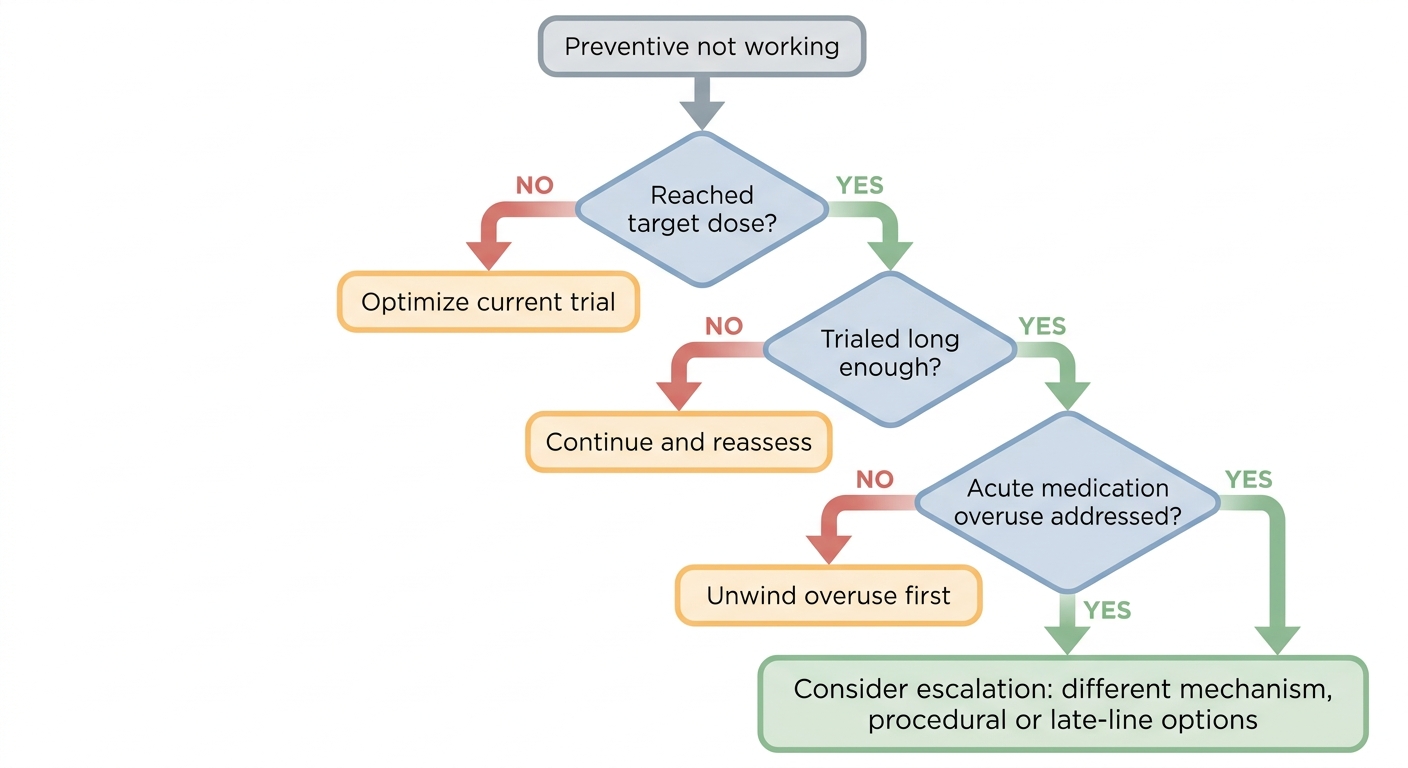
The word "adequate" is doing heavy lifting. A trial counts only if the dose reached target and the duration was long enough to judge. Half of what gets labeled "treatment-resistant" is actually under-trialed.
Ask these questions before concluding you're refractory:
- Did each preventive reach its target dose? Stopping at the starter dose doesn't count.
- Did each trial last long enough? Typically two to three months at that dose.
- Has medication-overuse headache been ruled out or treated?
- Have you tried more than one mechanism? Three drugs in the same class isn't three trials.
- Were co-existing conditions addressed? Sleep apnea, depression, anxiety, and neck pathology all affect headache load.
⚠️ Being told "there's nothing left to try" is common and frequently inaccurate. Before accepting it, get a written list of exactly which classes were tried, at what dose, and for how long. That document is what determines the next step — and what insurers require.
Where Do Ketamine Infusions Fit in Migraine Care?
Ketamine is an off-label, late-line option for refractory migraine and status migrainosus — never a first or second step. It is FDA-approved as an anesthetic agent, and its use in headache and chronic pain settings falls outside that approved indication, which is legal and common in medicine but means the evidence base is thinner than for approved migraine drugs.
The rationale is mechanistic. Ketamine is an NMDA receptor antagonist, meaning it blocks a glutamate receptor involved in how the nervous system transmits and amplifies pain signals (StatPearls, NCBI Bookshelf). Because central sensitization in chronic headache is thought to involve that same amplification process, NMDA blockade is a biologically plausible target in patients who have exhausted conventional options.
What the evidence currently looks like, stated plainly:
- Published experience in migraine comes largely from small case series, inpatient protocols, and retrospective cohorts rather than large randomized trials.
- Results reported in those settings vary considerably between individuals, and no outcome should be presented as expected or typical.
- Ketamine is used in headache care as an adjunct within a broader plan — it does not replace preventives, and it is not described as a cure.
Safety and monitoring are not optional details. StatPearls documents ketamine's recognized adverse effects — including dissociative and psychotomimetic experiences, blood pressure and heart rate elevation, nausea, and the need for appropriate monitoring during administration (StatPearls). That's precisely why infusion-based ketamine therapy is given in a clinical setting with vitals monitoring and a supervising clinician, not at home.
If you want the mechanism-level detail — dosing context, session structure, what the infusion itself involves — we've covered how off-label ketamine infusions for migraine work in a dedicated companion article.
Who is this conversation actually for?
It's for the person who has reached the end of the standard ladder and been told to "manage expectations." That reader usually has a specific, concrete burden: they've failed multiple preventives, they're still losing days every month, and no one has laid out what remains.
A consultation at that stage is not a sales pitch for an infusion. It's a structured review: which classes have genuinely been trialed, whether medication overuse is in play, whether co-existing conditions are driving headache load, and whether off-label options are clinically appropriate at all. Suitability is decided in that consultation — individual results vary, and some people are not candidates.
Key takeaway: Ketamine belongs at the end of the ladder, in a monitored clinical setting, for people whose refractory status has been properly established — not as a shortcut past preventive care.
What Is Medication-Overuse Headache, and Could It Be Sabotaging Treatment?
Medication-overuse headache is a secondary headache caused by frequent, regular use of acute headache medication. It can convert episodic migraine into a near-daily headache pattern, and while it's present, preventive medications often appear to fail when the real problem is the rebound cycle.
Risk thresholds differ by drug class. Triptans, opioids, butalbital-containing products, and combination analgesics are associated with a lower threshold than simple NSAIDs — meaning fewer days of use per month can trigger the cycle. Opioids and butalbital combinations are the most strongly associated and are generally discouraged in routine migraine care.
Unwinding it typically involves:
- Identifying the culprit medication and its true frequency of use — most people underestimate this without a diary.
- A withdrawal period supervised by a clinician, during which headaches commonly worsen before improving. This stretch is measured in weeks, not days.
- A bridging strategy — clinicians may use a short course of an alternative agent to make withdrawal tolerable.
- Starting or restarting a preventive, which has a much fairer chance once the rebound loop is broken.
Newer acute CGRP-targeting agents have attracted interest partly because they have not been associated with the same rebound pattern in the way older classes have, though prescribing decisions should be made with your clinician based on your full history.
⚠️ Do not stop a butalbital- or opioid-containing medication abruptly on your own. Withdrawal from those specific classes can be medically risky and should be supervised.
If you're weighing whether a treatment change makes sense, our common questions about treatment and safety page covers process, monitoring, and what a first visit involves.
Which Headache Symptoms Mean You Should Seek Urgent Care?
New or different is the warning sign. A headache that doesn't match your usual pattern — in onset, character, or accompanying symptoms — needs evaluation, not a migraine medication.
| Typical migraine feature | Red-flag feature | What to do |
|---|---|---|
| Builds over minutes to hours | Thunderclap — maximum intensity within seconds | Emergency care now |
| Light and sound sensitivity | Fever with neck stiffness or confusion | Emergency care now |
| Familiar pattern you recognize | First severe headache after age 50 | Urgent medical evaluation |
| Aura that resolves fully | Weakness, numbness, speech trouble, or vision loss that persists | Emergency care now |
| Worse with activity, better lying still | Clearly worse with position change, coughing, or straining | Urgent medical evaluation |
| Stable history over years | New headache with cancer, HIV, or immunosuppression history | Urgent medical evaluation |
| No seizure activity | Headache with a seizure | Emergency care now |
These belong in an emergency department, not a clinic appointment. If you're in crisis or facing a medical emergency, call 911 or go to your nearest emergency room — a specialty consultation is for ongoing care, not acute emergencies.
How Do You Build a Migraine Treatment Plan That Actually Progresses?
Change one thing at a time, give it a defined trial window, and track a single primary metric: monthly migraine days. Everything else — severity scores, trigger theories, supplement experiments — is secondary data.
Define success as more than "no headaches." Useful secondary measures include:
- Rescue medication days per month — the clearest early signal that prevention is working.
- Function on attack days — did you work, parent, drive?
- Sleep quality and consistency.
- Attack duration, which often shortens before frequency drops.
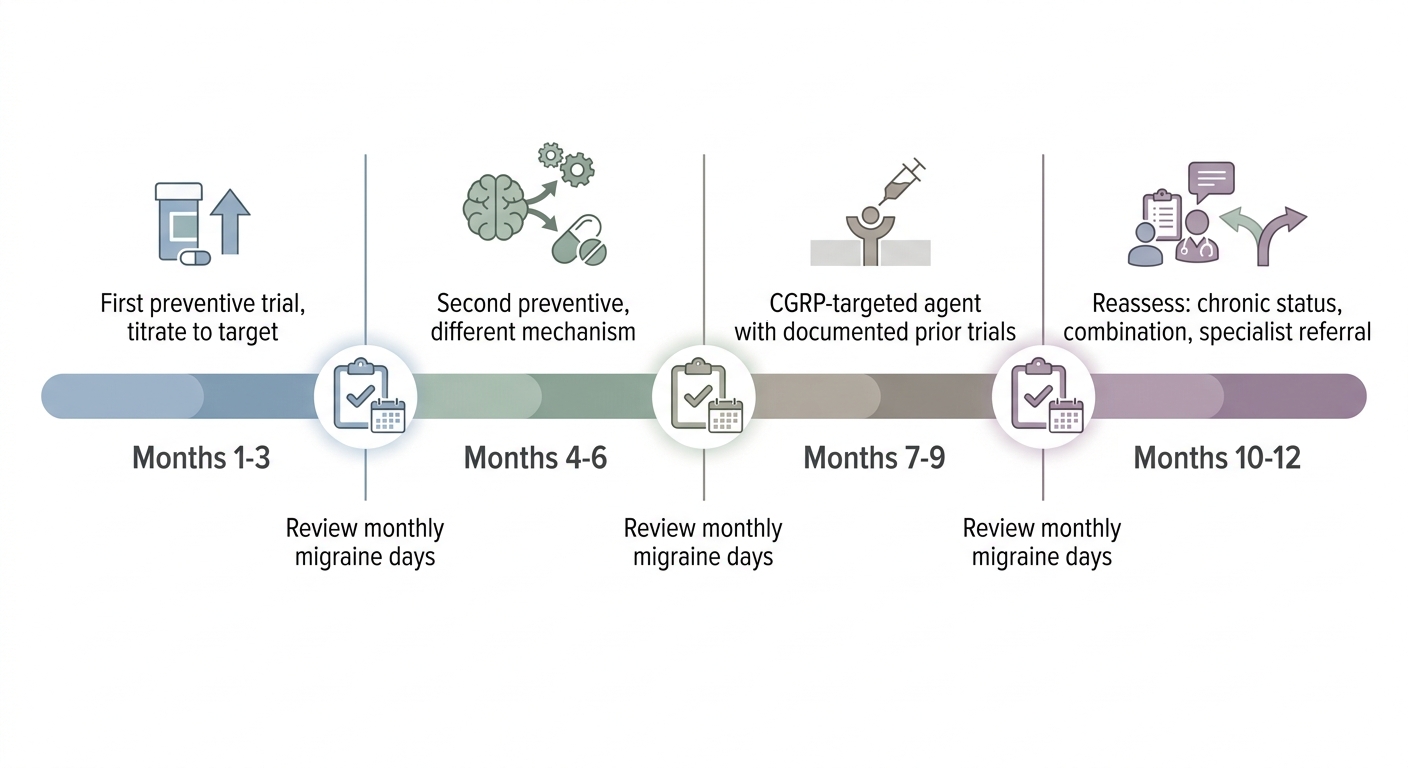
A realistic 12-month sequence for someone starting from scratch might look like this: months 1–3, a first oral preventive titrated to target with a diary running; months 4–6, a second preventive from a different class if the first failed or wasn't tolerated; months 7–9, escalation to a CGRP-targeted agent with documented prior failures supporting authorization; months 10–12, reassessment for chronic migraine status, combination therapy, or specialist referral.
For a diary, any consistent format works — a paper log, a notes app, or a dedicated headache tracker. What matters is recording the same fields daily: headache yes/no, severity, medication taken, and function.
Where a clinician-led consultation adds value is in compressing that loop. Instead of discovering at month ten that two of your earlier trials didn't count because the dose never reached target, a structured review catches it on day one. That review also looks at comorbidities — sleep, mood, and other pain conditions — which is part of the conditions we evaluate for patients across Boise and Eagle.
Key takeaway: Progress comes from disciplined trials with hard stop-dates, not from stacking more treatments on an undocumented history.
Frequently Asked Questions
More process and safety detail lives on our common questions about treatment and safety page.
How long should I give a new migraine preventive before giving up?
Most headache clinicians use a trial window of roughly two to three months at the target dose — not from the first pill. Topiramate and amitriptyline are usually titrated slowly, so reaching target can itself take several weeks. CGRP monoclonal antibodies like erenumab or galcanezumab are typically assessed sooner because there's no titration period. Track monthly migraine days throughout so the decision rests on data rather than recall.
Is ketamine FDA-approved for migraine?
No. Ketamine is FDA-approved as an anesthetic agent, and its use in migraine and chronic pain is off-label — legal and common, but supported by less rigorous evidence than approved migraine drugs (StatPearls). Esketamine, marketed as SPRAVATO, is approved for treatment-resistant depression and depressive symptoms in adults with major depressive disorder with acute suicidal ideation or behavior — not for migraine (FDA prescribing information).
Can Botox and CGRP medications be used together?
Yes — combination therapy using onabotulinumtoxinA injections alongside a CGRP-targeted preventive such as fremanezumab or erenumab is used in chronic migraine care, and clinicians increasingly consider it when either alone is insufficient. The schedules don't conflict: injections follow a quarterly cycle, while CGRP antibodies are monthly or quarterly. The practical obstacle is usually insurance, since many plans resist covering two advanced therapies simultaneously.
Does insurance usually cover migraine treatments?
Generic acute medications like sumatriptan and naproxen, and older preventives like propranolol and topiramate, are typically covered. CGRP agents and onabotulinumtoxinA commonly require step therapy — documented failure of two or more cheaper preventives — before approval. Off-label infusion therapy, including ketamine therapy for pain indications, is generally self-pay. Coverage varies by plan, so verify specifics with your insurer and the clinic directly before scheduling.
What's the difference between chronic migraine and refractory migraine?
Chronic migraine is a frequency definition: 15 or more headache days per month for at least three months, with at least eight migrainous. Refractory migraine is a response definition: adequate trials of multiple preventive classes haven't worked. You can have one without the other — someone with eight attack days a month who has failed four preventives is refractory but not chronic.
Summary
Migraine treatment is a ladder, and most people get stuck because they skip rungs or abandon them too early. Start by separating the two jobs — stopping attacks and preventing them — and make sure each preventive trial reaches target dose for a real duration before calling it a failure. If attacks cross into chronic territory, injection protocols, IV preventives, and combination therapy open up. If multiple adequate trials fail, you've reached refractory status, where procedural and off-label options including ketamine infusions become a legitimate conversation.
Two things prevent wasted years: honest documentation of what's actually been tried, and a clinician willing to review that record and tell you plainly what remains. If you're in Boise or Eagle and you've already cycled through preventives without relief, that review is where to start.
Information about third-party platforms reflects publicly available details at the time of writing and may have changed. Please verify directly with the provider. See our Terms of Use for more.