Immunity IV Therapy: What's in the Bag and What It Does
Zora Neuro Spa Editorial · October 18, 2026

Immunity IV therapy has moved from hospital hallways to wellness menus across the Treasure Valley, and most listings tell you almost nothing about what's actually in the bag. This guide breaks down each common ingredient, what it's there for, what the evidence does and doesn't support, and how to tell a medically supervised clinic from a pop-up drip bar.
Quick Answer
Immunity IV therapy is a clinician-ordered infusion that delivers vitamin C, zinc, B vitamins, magnesium, and sometimes glutathione in a sterile saline base directly into a vein. Because the fluid enters your bloodstream instead of your stomach, it skips digestion entirely. It's best understood as nutritional and hydration support — not protection against getting sick. The strongest case for it is poor oral intake, dehydration, or a documented absorption problem.
TL;DR
- A standard immunity drip is saline plus vitamin C, zinc, B-complex, magnesium, and often glutathione. See the full ingredient breakdown
- IV delivery bypasses the gut, which is a mechanism difference — not a promise of better results. Compare the IV and oral routes
- The realistic wins are rehydration and correcting a genuine shortfall. Preventing infection is not an established benefit. Read the honest benefits-and-limits breakdown
- Kidney disease, heart failure, G6PD deficiency, and pregnancy all need clinician clearance first. Check the candidacy and screening list
- The single biggest safety variable is whether a licensed clinician reviewed your history before the needle. Use the provider vetting checklist
In This Article
- What Is Immunity IV Therapy?
- What's Actually in an Immunity IV?
- Why Get Nutrients by IV Instead of a Pill?
- What Are the Realistic Benefits — and the Limits?
- Who Is a Good Candidate — and Who Should Skip It?
- How Does an Immunity IV Appointment Actually Work?
- Immunity IV vs Other Drip Formulas
- What Are the Side Effects and Safety Risks?
- How Do You Choose a Safe Immunity IV Provider?
What Is Immunity IV Therapy?
Immunity IV therapy is an elective infusion in which a licensed clinician delivers a blend of immune-supportive micronutrients, dissolved in sterile fluid, into a vein through a small catheter. A session usually runs under an hour. It is a wellness service, not a treatment for any diagnosed infection.
Two things separate it from other drips on a typical menu:
- Hydration-only drips contain fluid and electrolytes, with no added vitamins.
- Myers' cocktail is an older, fixed formula built around magnesium, B vitamins, and vitamin C, used broadly rather than aimed at immune support specifically.
- Immunity formulas lean harder on vitamin C and zinc, and often add glutathione.
The part that matters most isn't the recipe — it's who's behind it. Any infusion is a prescription-level procedure. A nurse practitioner, physician assistant, or physician should review your health history, order the formula, and remain reachable during your session.
⚠️ "Immune boost" is marketing language, not a medical claim. No infusion makes your immune system stronger in a way that's been measured and verified. What these drips can reasonably do is supply fluid and nutrients your body uses, which is a much narrower promise.
Clinics in Boise, Eagle, and smaller Treasure Valley towns advertise these drips under a dozen different names. The branding varies far more than the contents do.
What's Actually in an Immunity IV?
Most immunity formulas are built from five or six components in a saline carrier. Here's what each one is and why clinics include it.
| Ingredient | What it is | Why clinics include it | What to keep in mind |
|---|---|---|---|
| Vitamin C (ascorbic acid) | A water-soluble vitamin and antioxidant | Supports normal immune cell function; the signature ingredient in immunity drips | High doses are not appropriate for everyone, including people with kidney disease or G6PD deficiency |
| Zinc | An essential trace mineral | Involved in immune cell development and wound healing | The body has no large storage pool; excess intake over time can interfere with copper |
| B-complex / B12 | A group of water-soluble vitamins | Involved in energy metabolism and red blood cell production | Often described as an "energy" ingredient, though effects are most relevant when someone is genuinely low |
| Magnesium | An essential mineral | Involved in hundreds of enzyme reactions; may be included for muscle comfort | Can cause a warm, flushing sensation when infused quickly |
| Glutathione | An antioxidant your cells produce naturally | Added for antioxidant support; sometimes pushed separately at the end | Often marketed for skin; evidence for infused glutathione is still limited |
| Normal saline | Sterile salt water matched to body fluid | Carries the nutrients and rehydrates | Volume matters for anyone with heart or kidney limits |
Normal saline is a sterile solution of sodium chloride in water, formulated to be compatible with blood. It's the base of nearly every drip on the menu, and for a dehydrated person it may be the most useful part.
A few honest notes on the evidence. Vitamin C and zinc are both genuinely required for normal immune function — that's established nutrition science. What's far less settled is whether giving extra amounts to someone who already has enough changes anything. Research on vitamin C and the common cold has generally looked at oral supplementation, and reviewers describe the effects on symptom duration as modest rather than dramatic. Infused versions haven't been studied the same way.
Glutathione sits even further out on the evidence curve. It's commonly offered as an add-on, and some people report liking how they feel afterward, but the clinical literature on infused glutathione for general wellness remains thin. Results vary between individuals.
When you book our immunity IV nutrition drip, you should be able to see the ingredient list before you sit down. Any clinic that won't tell you what's in the bag — or what dose — isn't giving you enough to consent to.
Key takeaway: The ingredients in an immunity IV are real nutrients with real roles in immune function, but "necessary for health" and "beneficial in extra amounts" are two different claims.
Why Get Nutrients by IV Instead of a Pill?
Because the two routes work differently, not because one is automatically better. Bioavailability is the share of a dose that actually reaches your bloodstream. An oral supplement has to survive stomach acid, cross the intestinal wall, and pass through the liver first. An intravenous dose enters circulation directly.
That difference is largest for nutrients the gut absorbs through transporters. Vitamin C is the classic example — intestinal absorption is generally described as saturable, meaning the gut's uptake system can only move so much at once no matter how large the tablet.

Where IV delivery is clearly useful:
- Malabsorption — conditions like celiac disease, Crohn's, or post-bariatric anatomy that limit what the gut can take up
- Poor oral intake — nausea, vomiting, or a GI bug that makes swallowing pills unrealistic
- Dehydration — fluid and electrolytes replaced directly
Here's the counterpoint that most drip marketing skips: higher blood levels do not automatically mean better outcomes. Water-soluble vitamins are cleared by the kidneys, so much of a large dose may simply be filtered out. Having more of something in circulation for a few hours is a pharmacology fact, not a health result.
For most healthy people eating a reasonable diet, a well-chosen oral supplement covers the same nutritional ground at a fraction of the cost. If you want the deeper mechanical explanation, we break down how IV bioavailability compares to oral supplements in a dedicated guide.
What Are the Realistic Benefits — and the Limits?
Most of what people notice after immunity IV therapy comes from rehydration and from correcting a real shortfall — not from a measurable change in immune strength. Sorting the claims into tiers makes the decision easier.
Well supported:
- Replacing fluid and electrolytes when you're genuinely dehydrated
- Delivering nutrients when the gut can't absorb them reliably
- Repleting a documented deficiency identified through lab work and a clinician's assessment
Plausible but modest:
- Feeling more comfortable during recovery from a cold or stomach bug, largely through hydration
- A short-term sense of alertness after B vitamins, which some people report and others don't
Not established:
- Preventing infection or stopping a cold before it starts
- "Detoxing" the body — your liver and kidneys already do this continuously
- Antioxidant mega-dosing producing long-term health gains
Individual results vary, and none of the above should be read as a promised outcome. We cover the patterns in more depth in our breakdown of benefits people report from immunity drips.
⚠️ If you're seeking an infusion because you feel exhausted all the time, get labs first. Persistent fatigue can point to anemia, thyroid problems, sleep apnea, or depression — none of which a vitamin drip addresses.
Key takeaway: Treat an immunity IV as nutritional and hydration support with a short runway, not as insurance against getting sick.
Who Is a Good Candidate — and Who Should Skip It?
Good candidates are people with a specific, short-term reason — not people shopping for general wellness insurance.
Often reasonable candidates:
- Frequent travelers facing long flights and dry cabin air
- People recovering from a cold or GI illness with poor appetite and low fluid intake
- Shift workers with disrupted eating patterns
- People with malabsorption from celiac disease, Crohn's disease, or bariatric surgery
- Anyone with a deficiency confirmed by lab testing and clinician review
Needs clearance or should skip:
- Kidney disease — both fluid volume and the oxalate load from high-dose vitamin C are concerns
- Congestive heart failure — extra IV volume can be a problem
- G6PD deficiency — high-dose vitamin C carries a risk of red blood cell breakdown, which is why reputable clinics screen for it
- Hemochromatosis or iron overload — vitamin C affects iron handling
- Pregnancy or breastfeeding — get OB clearance before any elective infusion
- Active fever or suspected bacterial infection — you need evaluation, not a wellness drip
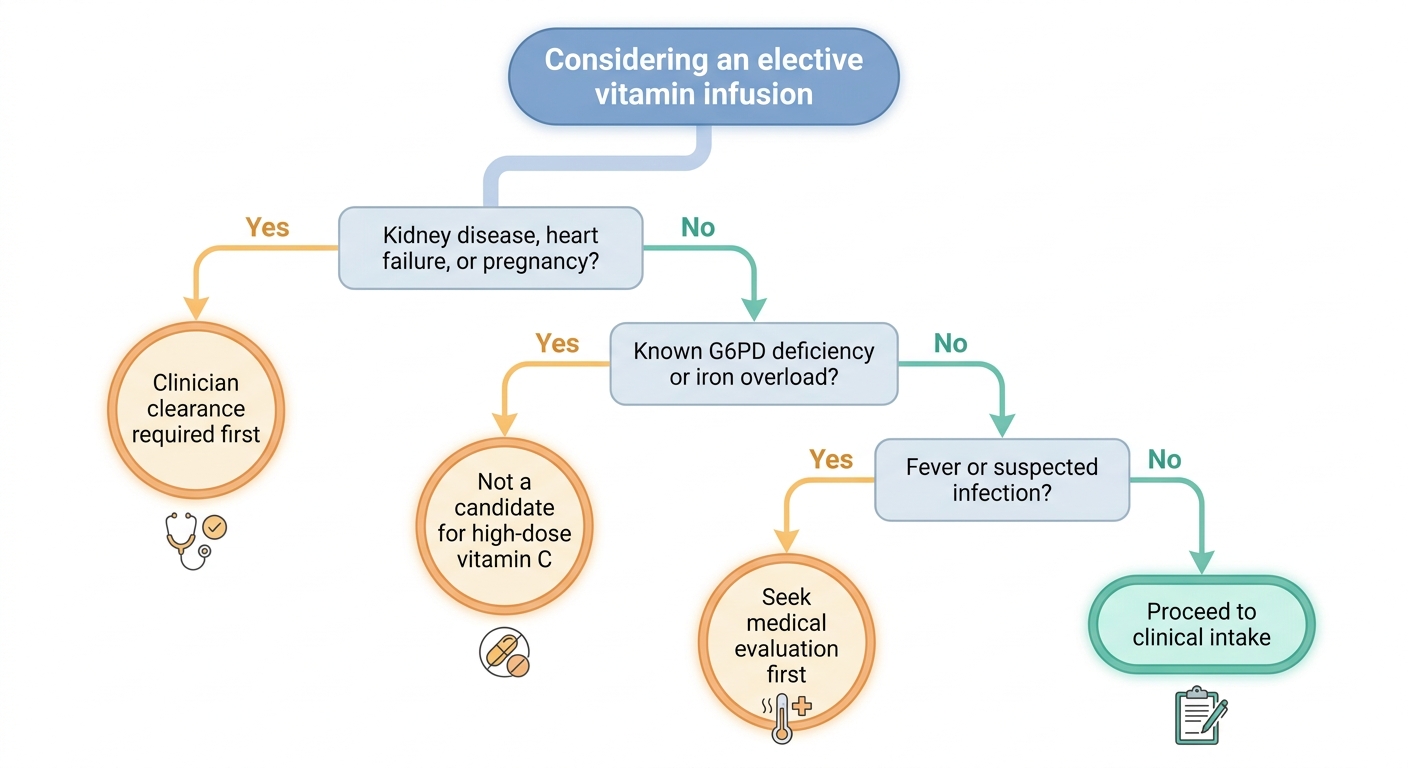
A clinic doing this properly will ask about kidney and heart history, current medications, allergies, prior reactions to infusions, pregnancy status, and whether you've ever been told you have G6PD deficiency. If nobody asks, that's your answer about the quality of the oversight.
How Does an Immunity IV Appointment Actually Work?
The sequence is short and predictable. Most of the visit is sitting still.
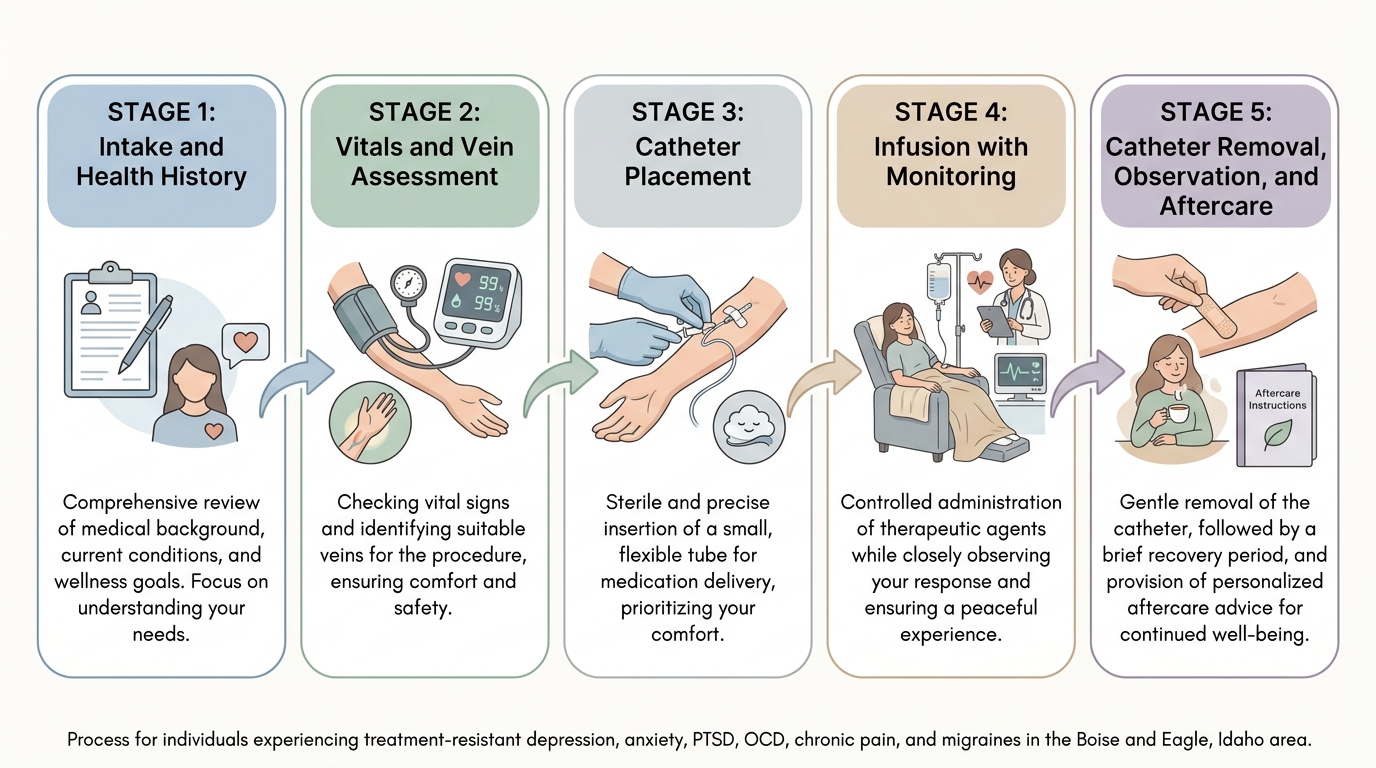
- Intake and health history — you complete a medical questionnaire, and a clinician reviews it and orders the formula
- Vitals and vein assessment — blood pressure, heart rate, and a look at which vein will work best
- Catheter placement — a small flexible catheter goes into a vein, usually in the forearm or back of the hand
- The infusion — the bag runs while staff monitor how you're doing; a smaller immunity bag often takes around 30 to 45 minutes, and a full liter typically runs closer to 45 to 60
- Removal and observation — the catheter comes out, pressure is held, and you're observed briefly before you leave
Before you come in:
- Eat a normal meal — infusions on an empty stomach are a common cause of lightheadedness
- Drink water beforehand; well-hydrated veins are easier to access
- Wear short sleeves or something that rolls up past the elbow
- Bring a current medication and supplement list

Afterward, most people go straight back to their day. You may have a small bandage and occasionally a bruise at the site. Staff should give you a number to call if anything looks wrong at the insertion point over the next day or two.
Immunity IV vs Other Drip Formulas
The difference between drip types is which nutrients get added to the same saline base — and what problem each one is aimed at.
| Drip type | Core components | Typically chosen for | Session length |
|---|---|---|---|
| Immunity | Saline, vitamin C, zinc, B vitamins, often glutathione | Travel, run-down periods, recovery from illness | Roughly 30–60 minutes |
| Hydration | Saline and electrolytes only | Fluid replacement after heat, illness, or exertion | Roughly 30–45 minutes |
| Energy / B-complex | Saline with B vitamins, sometimes amino acids | Low energy, demanding schedules | Roughly 30–45 minutes |
| Myers' cocktail | Saline, magnesium, calcium, B vitamins, vitamin C | A general-purpose, long-established blend | Roughly 30–60 minutes |
| Glutathione / beauty | Saline with glutathione, sometimes vitamin C | Antioxidant and skin-related goals | Often shorter, or added to another drip |
Pricing for elective infusions is self-pay and varies widely by clinic, formula, and region, so ask for the specific cost before booking rather than relying on an advertised starting price.
Formulas also overlap more than the names suggest. An immunity drip and a Myers' cocktail may share most of their ingredients, differing mainly in emphasis. If you want to see how a targeted formula is constructed around a different goal, our guide to how other drip formulas are built walks through the reasoning.
What Are the Side Effects and Safety Risks?
Most side effects are minor and local. The uncommon ones are the reason clinical oversight matters.
Common and usually brief:
- Bruising or tenderness at the insertion site
- A cool sensation traveling up the arm as fluid runs
- A metallic or vitamin-like taste, often from B vitamins
- Lightheadedness, especially if you skipped a meal
- Brighter yellow urine after B vitamins
Less common and more serious:
- Infiltration — fluid leaking into surrounding tissue instead of the vein, causing swelling
- Phlebitis — irritation or inflammation of the vein
- Infection at the insertion site
- Electrolyte shifts, particularly relevant with kidney or heart conditions
- Allergic reaction to a component of the formula
⚠️ The biggest real-world risk isn't the vitamins — it's the setting. Pop-up and mobile IV services operating without physician oversight, screening, or an emergency plan put the burden of safety on the customer. An infusion started in a hotel room or a festival tent still carries every risk listed above, with fewer resources if something goes wrong.
Federal regulators have repeatedly warned marketers against promoting unapproved IV vitamin products with disease-treatment claims. If a provider's advertising says a drip treats, cures, or prevents an illness, that language is a red flag about the business, regardless of what's in the bag.
How Do You Choose a Safe Immunity IV Provider?
Start with one filter: a licensed clinician must review your medical history and order the infusion before anyone touches a vein. Everything else is secondary to that.
Run through this checklist before booking:
- A named medical director — you should be able to find out who holds clinical responsibility
- Licensed staff administering — an RN, NP, PA, or physician, not an unlicensed technician
- Ingredients compounded by a licensed pharmacy, with lot tracking and expiration dates
- A written ingredient list and doses disclosed before you consent
- Screening questions about kidney disease, heart failure, pregnancy, allergies, and G6PD deficiency
- An emergency protocol and crash kit on site, with staff trained to use them
- A clear aftercare contact for problems in the following 24–48 hours
- No disease-treatment claims in the clinic's marketing
Our 7-point checklist for vetting an IV clinic expands each of these into specific questions you can ask over the phone.
For readers in the Treasure Valley — including those driving in from Boise, Meridian, Kuna, or an Emmett IV search that turned up mobile-only options — a fixed clinical location with on-site supervision gives you something a mobile van can't: continuity, records, and a clinician who knows your history. You can see how we structure immunity IV therapy in Eagle, Idaho and what the intake covers.
Key takeaway: Judge an IV provider on its screening and supervision, not on its menu names or its photography.
Frequently Asked Questions
How often should you get an immunity IV?
There's no established medical schedule. Many clinics suggest either monthly or situational use — before long travel, during recovery from illness, or through a demanding stretch at work. No research supports a routine high-dose vitamin C schedule for prevention, so frequency should be a conversation with your clinician rather than a subscription you set and forget.
Does immunity IV therapy actually prevent getting sick?
No. There's no evidence that IV vitamin infusions prevent infection. Research on oral vitamin C and the common cold has generally found modest effects on how long symptoms last in the general population, not on whether people catch colds. Treat an immunity drip as nutritional and hydration support, not as a shield.
How long does an immunity IV take to feel?
Hydration effects are often noticed during the session or within a few hours, mostly because fluid is being replaced. Any change in alertness from B vitamins tends to show up the same day and fade over the following days. Some people notice little difference at all, which is a normal outcome.
Does insurance cover immunity IV therapy?
Almost never. Elective wellness infusions are self-pay at essentially every clinic. Infusions that are medically necessary for a documented deficiency may be billable when ordered with a diagnosis, but that's a different service with different requirements. HSA and FSA eligibility varies by plan, so check with your administrator first.
Can you get an immunity IV while you're already sick?
Many clinics will treat mild illness after screening. But fever, a suspected bacterial infection, severe vomiting, or dehydration serious enough to need evaluation should send you to urgent care or your primary doctor instead. A wellness clinic is not set up to diagnose or treat an active infection.
Putting It Together: Is an Immunity IV Worth It for You?
The case for immunity IV therapy is strongest when it's specific. If you're dehydrated, recovering from an illness that wrecked your appetite, facing back-to-back travel, or dealing with a real absorption problem, an infusion gives your body fluid and nutrients in a form your gut doesn't have to process.
The case is weakest when it's vague. If you're healthy, eating well, and hoping to make yourself harder to infect, the evidence isn't there — and a drip won't explain away fatigue that deserves lab work.
Either way, the decision should start with a clinician who reviews your history, asks about your kidneys, heart, and medications, and tells you exactly what's going into the bag and why. That conversation costs you one appointment and tells you more than any menu will.