IV Hydration Therapy: How It Works and Who It Helps
Zora Neuro Spa Editorial · November 2, 2026

Typing "IV hydration near me" into your phone turns up mobile vans, med spas, and medical clinics — all offering different bags, different prices, and very different levels of supervision. This guide explains what IV hydration and IV vitamin therapy actually do in the body, which benefits are well established versus oversold, who should avoid elective infusions, and the five questions that separate a safe clinic from a risky one.
Quick Answer
IV hydration therapy delivers sterile fluid — and sometimes vitamins and minerals — straight into a vein through a small catheter, bypassing the digestive tract. The most clearly established uses are restoring fluid volume when someone can't drink enough and correcting nutrient deficiencies confirmed by lab work. Most wellness sessions are scheduled for roughly 30 to 60 minutes in a recliner. If you're searching "IV hydration near me," the deciding factor should be medical oversight, not the name printed on the drip menu.
TL;DR
- IV delivery bypasses the gut, so absorption isn't limited by digestion the way oral supplements are. See how IV hydration moves through the body
- Rehydration and correcting documented deficiencies are the strongest uses. Energy, immunity, and "detox" claims rest on much thinner ground. Compare the evidence tiers
- Drip menus look fancier than they are — most are a saline or electrolyte base with different add-ins. See the drip-by-drip breakdown
- Some people should skip elective IV fluids entirely, including those with heart failure or advanced kidney disease. Check the candidacy and contraindication list
- Supervision matters more than the formula. Ask who writes the order and who places the line. Review the five clinic screening questions
In This Article
- What Is IV Vitamin Therapy, Exactly?
- How Does IV Hydration Work in the Body?
- What Are the Real Benefits of IV Hydration Therapy?
- Which IV Drip Should You Choose?
- Who Is a Good Candidate — and Who Should Skip It?
- What Are the Risks and Side Effects?
- How Do You Find Safe IV Hydration Near You?
- What Does a Session Actually Look Like?
- How Often Should You Get IV Therapy?
- Frequently Asked Questions
What Is IV Vitamin Therapy, Exactly?
IV vitamin therapy is the infusion of a sterile fluid base plus water-soluble vitamins and minerals directly into a peripheral vein under clinical supervision. It's the same delivery route used in hospitals, applied in an outpatient wellness setting.
Strip away the branding and every bag has the same three parts:
- Carrier fluid — usually 0.9% sodium chloride ("normal saline") or lactated Ringer's, an electrolyte solution that also contains potassium, calcium, and lactate.
- Electrolytes — minerals like magnesium that influence nerve and muscle function.
- Additives — vitamins such as B-complex, B12, or vitamin C, or compounds like glutathione.
The Myers' Cocktail is the best-known formula on most menus. It's a long-used blend commonly described as containing B-complex vitamins, B12, vitamin C, magnesium, and calcium in a saline base, named for the physician credited with popularizing the approach decades ago.
An important distinction most menus don't explain: the vitamins in a wellness drip are compounded preparations, mixed by licensed compounding pharmacies, rather than FDA-approved drugs tested for a specific wellness indication. That's not inherently unsafe — compounding is a regulated practice — but it does mean the formula itself hasn't gone through the approval process a prescription medication does.
⚠️ Worth knowing: A drip's name tells you about marketing, not about regulation. Ask your provider what's in the bag, where it was compounded, and why that combination was chosen for you.
If you'd like to see how a clinically supervised menu is structured, our IV nutrition therapy menu in Eagle, Idaho lists each formula and its ingredients, which makes it easier to compare like for like with other providers in Boise, Meridian, and Star, Idaho.
How Does IV Hydration Work in the Body?
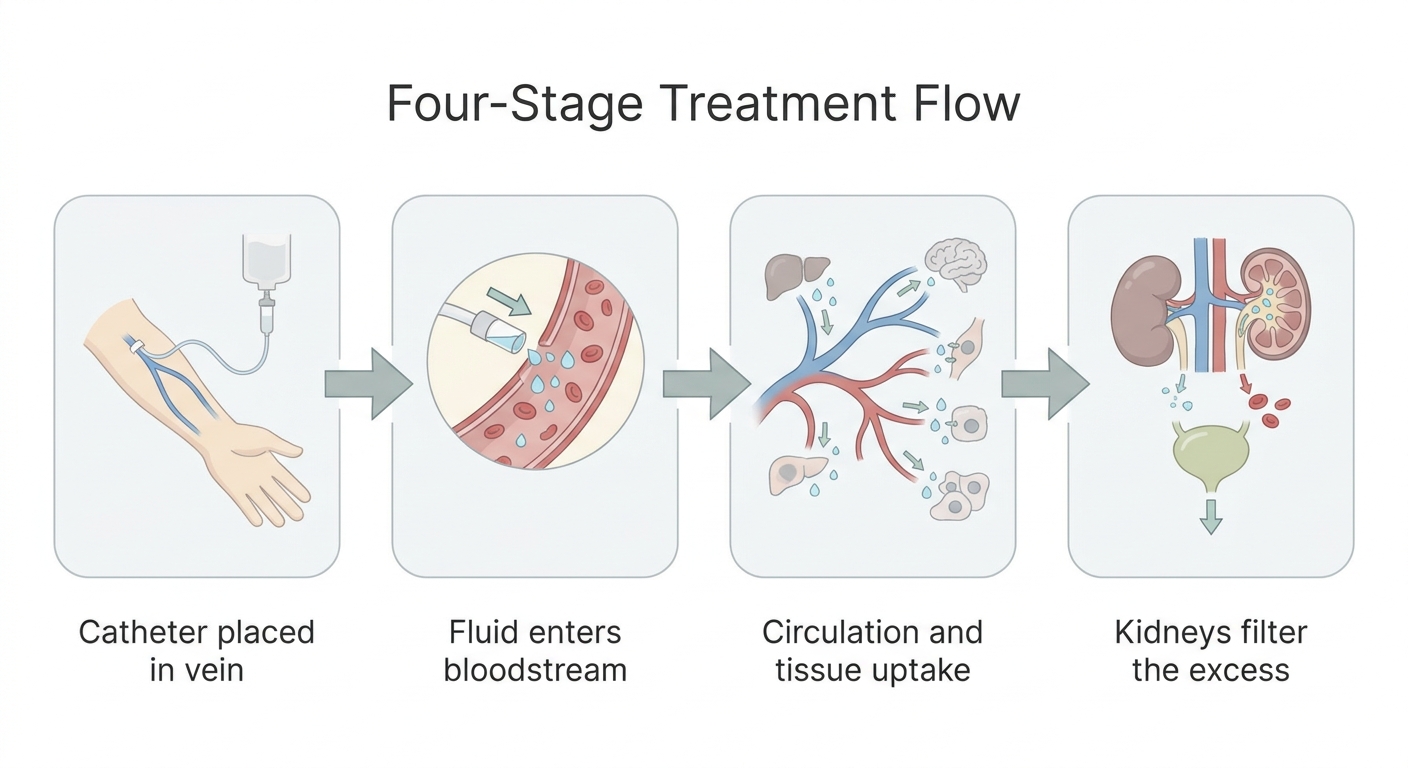
Fluid delivered through an IV enters the venous circulation and begins distributing through the bloodstream right away, while fluid you drink must first pass through the stomach and small intestine before any of it reaches circulation. That difference in route — not any magic in the ingredients — is the real mechanism behind IV therapy.
Here's the sequence:
- Cannulation — a small, flexible catheter is placed into a vein, usually in the forearm or the back of the hand.
- Controlled infusion — the bag empties by gravity or an infusion pump, at a rate the clinician sets based on the fluid and your health history.
- Circulation and uptake — the fluid expands plasma volume and the dissolved nutrients circulate to tissues.
- Renal clearance — the kidneys filter what the body doesn't retain, which is why water-soluble vitamins given in excess are largely excreted.
Why does the digestive route matter for vitamins?
Oral absorption of water-soluble vitamins is limited by intestinal transporters, which can only move so much at a time. Beyond a certain intake, a larger dose doesn't produce a proportionally larger blood level — the surplus passes through. Intravenous delivery sidesteps that intestinal step entirely, which is the single strongest mechanistic argument for the IV route.
That mechanism is real. What it does not automatically prove is that higher blood levels of a vitamin produce better health outcomes in someone who isn't deficient. Those are two separate questions, and the second one is where most wellness marketing gets ahead of the evidence.
Key takeaway: IV therapy changes how nutrients get in, not what they do once they're there. A route advantage is only useful when you actually need more of the nutrient.
How long any of this lasts depends on what's in the bag and your baseline status — we break that down in detail in our guide to how long IV vitamin infusions last.
What Are the Real Benefits of IV Hydration Therapy?
The clearest IV hydration therapy benefits are fast fluid volume restoration and reliable repletion of a confirmed deficiency. Claims about energy, immunity, and hangover recovery are plausible but far less settled, and claims about detoxification or curing disease are not supported.
Key takeaway: Sort every claim you read into three buckets — well established, promising but under-studied, and marketing. The table below does that sorting for the most common ones.
Benefits with solid clinical support
Intravenous fluid is standard medical care for a reason. The uses with the strongest footing include:
- Acute dehydration — when vomiting, diarrhea, heat illness, or prolonged exertion makes oral intake impractical, IV fluid restores circulating volume without relying on the gut.
- Documented nutrient deficiency — confirmed low B12, iron, or magnesium is treated intravenously in conventional medicine when oral routes are inadequate or poorly tolerated.
- Specific inpatient and clinic protocols — IV magnesium with fluids is used in some headache and migraine protocols under physician direction.
The common thread: all three start with a measured problem. Someone is visibly volume-depleted, or a lab value is below range. The infusion is a correction, not a supplement.
For people in the Treasure Valley managing chronic conditions, that distinction matters practically. A drip ordered after an intake and vitals check is a clinical decision. A drip chosen off a menu board is a purchase.
Benefits that are promising but under-studied
Several popular formulas have a reasonable mechanistic rationale and limited human research behind them. That's not the same as "proven," and a good clinic will say so.
| Claim | Evidence strength | What's actually established |
|---|---|---|
| B-complex drips increase energy | Limited | Correcting a diagnosed B12 deficiency is standard care; benefit in people with normal levels is not well demonstrated |
| High-dose vitamin C supports immune function | Limited | Vitamin C has a defined role in immune cell function; IV dosing for wellness is still under study |
| Glutathione improves skin tone and oxidative stress | Limited | Glutathione is a naturally occurring antioxidant; cosmetic outcomes from IV dosing are not firmly established |
| NAD+ supports cellular energy and aging | Early-stage | NAD+ is central to cellular metabolism; clinical outcome data in healthy adults remains preliminary |
| IV fluids shorten hangover symptoms | Mixed | Rehydration addresses fluid loss; broader symptom relief is not consistently demonstrated |
Research on infusion-based wellness protocols also runs into a persistent problem: placebo-controlled trials in this area have sometimes found improvement in both the infusion group and the placebo group. Sitting still in a recliner for an hour with a clinician checking on you is, itself, an intervention.
If you're curious about the vitamin C and zinc formulas specifically, we cover what goes into them in our overview of immunity IV therapy in Eagle.
What IV therapy will not do
Some things need stating plainly:
- It will not "detox" your organs. Your liver and kidneys already do that work continuously. No consumer drip improves on them.
- It will not replace a diet. Food delivers fiber, protein, fat, and compounds no bag contains.
- It will not treat or cure disease. Marketing IV infusions as treatments or cures for serious illnesses is not supported by evidence and would be inconsistent with FDA and FTC requirements for disease claims.
⚠️ Red flag: If a provider implies a drip treats cancer, autoimmune disease, long COVID, or any named condition, walk away. That's a regulatory problem, not a bold clinical philosophy.
Which IV Drip Should You Choose?
Choose by the problem you're trying to solve, not the name on the menu. Nearly every option is the same sterile fluid base with different additives, so the honest question is: what do you actually need added? Most of the menus you'll turn up searching "IV hydration near me" across Boise, Eagle, Meridian, and Star, Idaho are built from the same handful of base formulas under different brand names.
| Drip type | Core ingredients | Often chosen for | Typical session | Notes |
|---|---|---|---|---|
| Pure hydration | Saline or lactated Ringer's | Fluid loss from illness, heat, or exertion | Shortest | Simplest and usually least expensive — see hydration IV therapy in Eagle |
| Myers' Cocktail | B-complex, B12, vitamin C, magnesium, calcium | General wellness and repletion | Around an hour | The most widely used blended formula |
| Immunity | Vitamin C, zinc, B-complex | Seasonal support | Around an hour | Mechanistically reasonable; outcome data limited |
| Glutathione | Glutathione, often added to a base | Antioxidant and skin interest | Short add-on | Read what glutathione drips actually do for skin before booking |
| Inner beauty | Biotin, vitamin C, B-complex | Hair, skin, and nail support | Around an hour | Marketed cosmetically; expectations should stay modest |
| NAD+ | NAD+ in a fluid base | Cellular energy interest | Longest — often multiple hours | Infused slowly; commonly priced well above other drips |
| Recovery / athletic | Fluids, electrolytes, amino acids, B vitamins | Post-exertion fluid replacement | Around an hour | Hydration component is the best-supported part |
What's actually in an inner beauty drip?
An inner beauty drip is typically a saline base with cosmetically marketed additives — most often biotin, vitamin C, and B-complex. It's worth unpacking what each part is doing:
- Biotin — a B vitamin involved in keratin production. Supplementation is well established for diagnosed biotin deficiency, which is uncommon in people eating a varied diet.
- Vitamin C — a cofactor in collagen synthesis, which is the usual rationale for including it in an inner beauty formula.
- B-complex — included for general metabolic support rather than any specific cosmetic outcome.
Two practical notes before you book one. First, biotin can interfere with certain lab assays, including some thyroid and cardiac tests — tell any clinic drawing your blood that you've had a biotin-containing infusion. Second, visible changes to hair and nails follow growth cycles measured in months, so judging an inner beauty drip after a single session isn't a fair test of it.
How should I compare prices?
Pricing varies widely between mobile services, med spas, and medical clinics, and it changes over time — so ask for a current written price list rather than trusting an aggregate figure you read online. Three things to clarify before you book:
- What's included — is the base fluid priced separately from add-ins?
- Who administers it — a registered nurse working under a physician's order costs more than an unsupervised model, and that difference is the point.
- Coverage — elective wellness infusions are generally treated as out-of-pocket services. Confirm with your insurer rather than assuming.
Key takeaway: The cheapest bag and the most expensive bag often contain nearly identical fluid. You're mostly paying for the additives and the level of medical oversight.
Who Is a Good Candidate — and Who Should Skip It?
Reasonable candidates are generally healthy adults who are dehydrated, recovering from a short illness, or have a deficiency confirmed by lab work. Elective IV fluids are not appropriate for everyone, and a responsible clinic screens before it sells.
Conditions that typically require a physician's clearance — or rule out elective infusion altogether — include:
- Congestive heart failure — the heart may not tolerate added fluid volume.
- Advanced chronic kidney disease — impaired filtration changes how fluid and electrolytes are handled.
- G6PD deficiency — an inherited enzyme condition that clinicians screen for before high-dose vitamin C.
- Pregnancy — not an automatic no, but it needs obstetric sign-off first.
- Uncontrolled hypertension or fluid-restricted conditions — require physician review.
- Known allergy or sensitivity to any component of the formula.
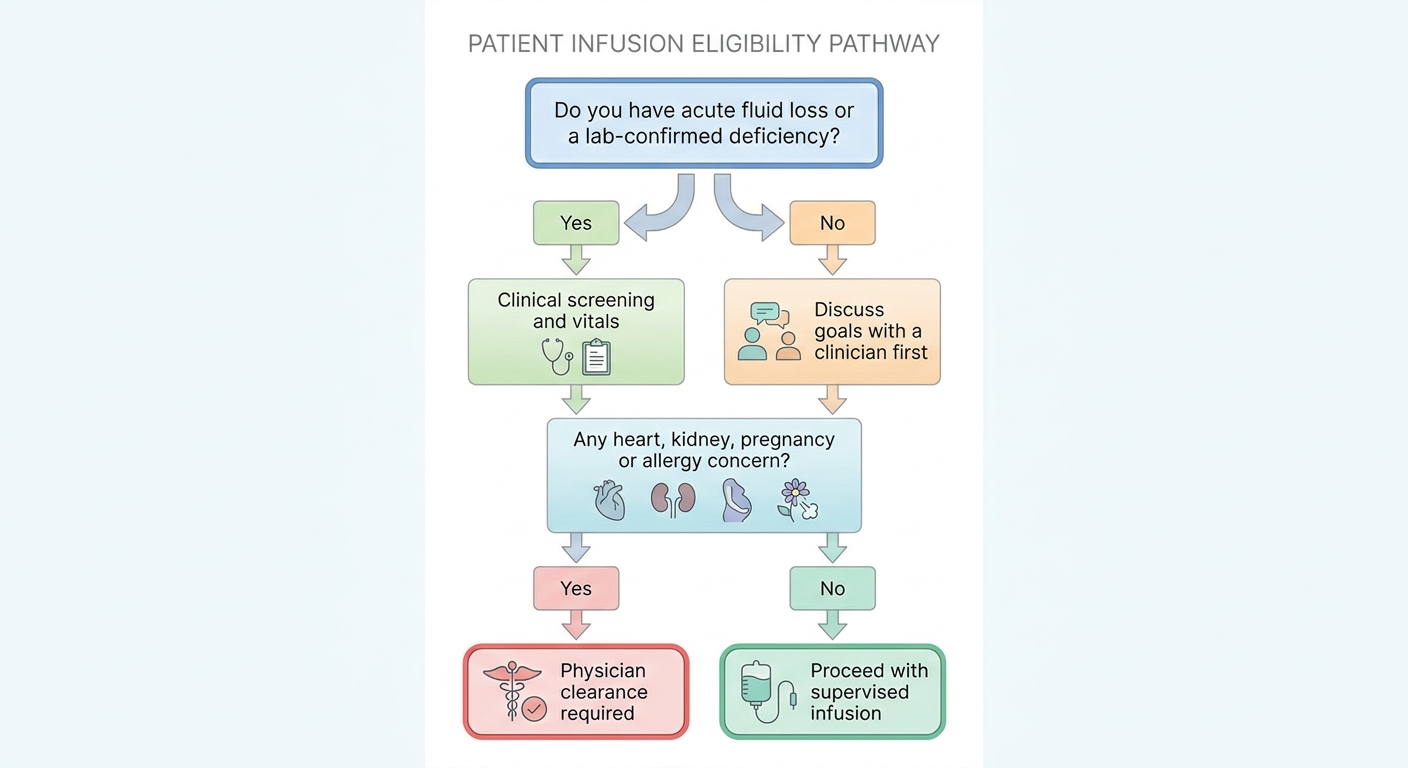
What do good and poor candidacy look like in practice?
Abstract criteria are easier to apply with concrete scenarios. Three illustrative examples:
- A reasonable fit. An adult recovering from a 24-hour stomach bug, still struggling to keep water down, with no cardiac or kidney history. A short hydration bag addresses a real, measurable fluid deficit.
- A conditional fit. Someone with persistent fatigue and a lab-confirmed low B12, already working with a prescriber. IV repletion may help — but so might an oral or intramuscular route, and the lab value should drive the decision, not the menu.
- A poor fit. A person with congestive heart failure booking a weekly wellness drip online with no intake. Added fluid volume is the specific thing their condition can't accommodate, and no formula change makes that safer.
What should I do before my first appointment?
A short checklist makes the visit smoother and safer:
- Bring a current medication and supplement list, including anything prescribed by another clinic.
- Bring recent labs if you have them — a basic metabolic panel, serum B12, or ferritin result turns guesswork into a plan.
- Eat something beforehand. Arriving on an empty stomach makes lightheadedness more likely.
- Drink water that morning. Well-hydrated veins are easier to access.
- Wear short sleeves or something you can push up above the elbow.
Our walkthrough of what to expect from an IV nutrition visit covers the intake process in more detail, including the health history questions you'll be asked.
What Are the Risks and Side Effects?
Most side effects are mild and local: bruising at the insertion site, a cool sensation traveling up the arm, or a brief metallic or vitamin-like taste as certain additives circulate. Real complications are less common but are the reason supervision matters.
Risks worth understanding before you consent:
- Infiltration — fluid leaks into surrounding tissue instead of the vein, causing swelling and discomfort. Usually resolved by stopping and re-siting the line.
- Phlebitis — irritation or inflammation of the vein, sometimes from the infusion rate or the additive concentration.
- Infection — any break in the skin is a potential entry point. Sterile technique is non-negotiable.
- Fluid or electrolyte imbalance — over-infusion is a genuine risk in people with cardiac or renal limitations, which is exactly why screening exists.
- Allergic or sensitivity reaction — uncommon, but the clinic needs an emergency protocol and the staff trained to run it.
Infection risks are more likely when infusion services are delivered outside properly controlled clinical settings with trained staff and sterile technique. The common failure points are predictable: unsupervised compounding, reused equipment, and missing emergency readiness.
⚠️ The decisive factor is not the formula — it's the setting. A standard saline bag placed by a registered nurse under a physician's order in a clinic is a different proposition from the identical bag placed in a hotel room with no vitals check.
When should I call the clinic afterward?
Contact your provider promptly if you notice spreading redness, warmth, or swelling at the IV site, a fever, worsening pain along the vein, shortness of breath, or any rash. These are uncommon, but they're the signs that warrant a same-day conversation rather than a wait-and-see approach.
How Do You Find Safe IV Hydration Near You?
Start with a local search, then screen the shortlist on clinical questions before you look at price or packaging. In the Boise area you'll find both mobile services that come to you and clinic-based providers in Eagle, Meridian, and Star, Idaho — the trade-off is convenience against on-site medical infrastructure.

Five questions to ask when you search "IV hydration near me"
- Who writes the order? A physician, nurse practitioner, or physician assistant should authorize the infusion after reviewing your history — not a receptionist taking a menu selection.
- Who places the line? Ask whether a licensed registered nurse or paramedic performs cannulation, and how often they do it.
- Where do the compounded ingredients come from? A clinic should be able to name its licensed compounding pharmacy without hesitating.
- Is there a real intake and vitals check? Blood pressure, heart rate, allergy review, and a medication list should happen every visit, not just the first.
- What's the emergency protocol? Ask what happens if someone reacts. A confident, specific answer is a good sign; a vague one is a reason to leave.
A sixth question is worth adding if you're already under care elsewhere: will this clinic coordinate with my other providers? That matters most for patients managing depression, anxiety, PTSD, or chronic pain alongside wellness care.
| Model | Convenience | On-site clinical support | Best fit |
|---|---|---|---|
| Mobile IV service | High — comes to you | Varies by provider | Simple hydration for healthy adults |
| Clinic-based | Lower — you travel | Full facility, vitals, emergency equipment | Anyone with a medical history or ongoing treatment |
You can review formulas, ingredients, and the supervision model on our IV nutrition therapy menu in Eagle, Idaho and use it as a benchmark when comparing other options.
What Does a Session Actually Look Like?
Plan for roughly 45 to 75 minutes door to door for a standard wellness drip at most clinics, though scheduled times vary by formula and provider, so confirm when you book. Longer infusions like NAD+ are scheduled separately because they're delivered at a slower rate.
The sequence is consistent at a well-run clinic:
- Intake and health history — medications, allergies, conditions, and your goals for the visit.
- Vitals — blood pressure, heart rate, and a brief assessment.
- Vein assessment and cannulation — a nurse selects a site, cleans it, and places the catheter.
- Infusion — you sit in a recliner while the bag runs. Most people read, work, or nap.
- Removal and brief observation — the catheter comes out, pressure is applied, and staff check in before you leave.
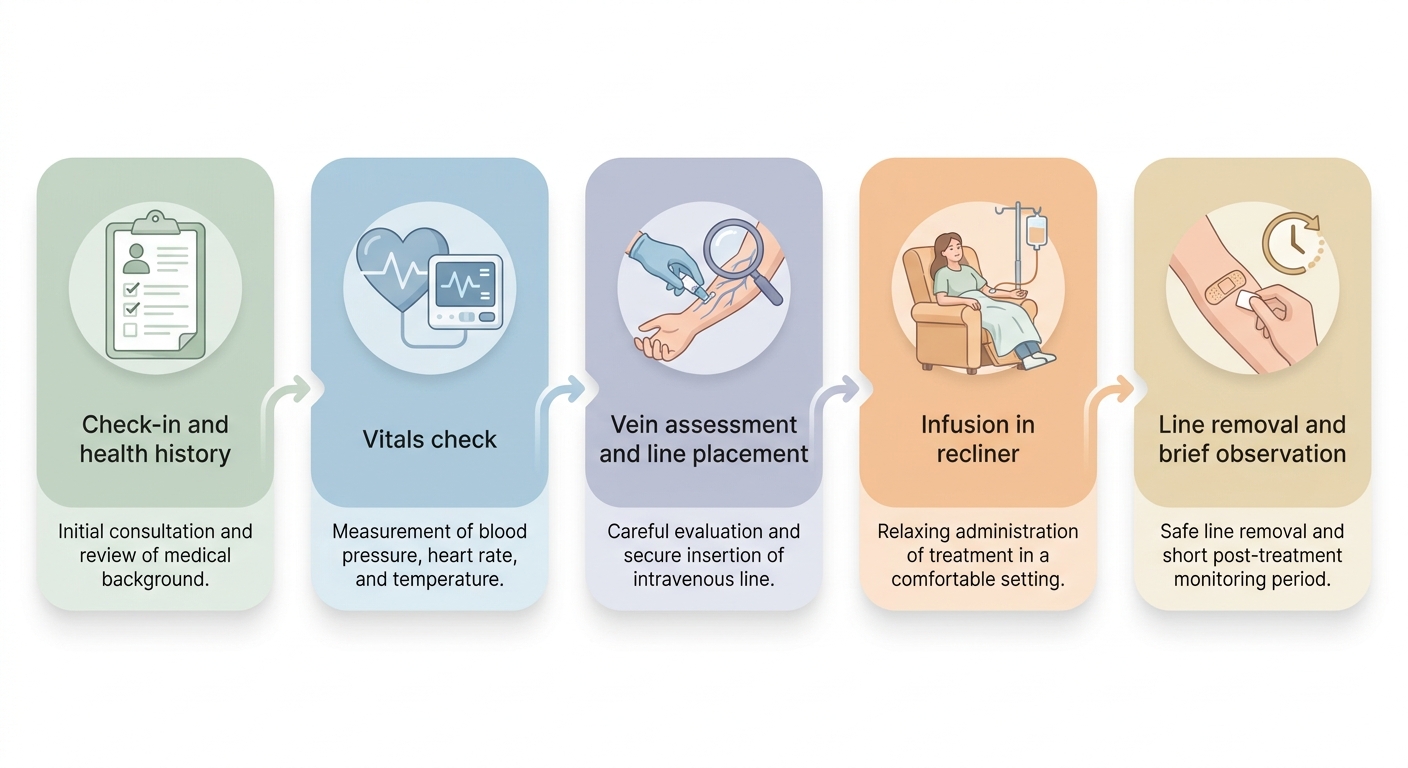
Practical details that make the visit easier: drink water the morning of your appointment, since well-hydrated veins are easier to access. Wear short sleeves. Eat beforehand. And tell the nurse if you've had trouble with blood draws in the past — there are techniques for difficult veins, but only if they know in advance.
Afterward, most people return to normal activity the same day. Our full what to expect from an IV nutrition visit page covers aftercare and the small things worth planning around.
How Often Should You Get IV Therapy?
There's no universal schedule for elective IV therapy. For general wellness, spacing drips out rather than stacking them weekly is the more conservative approach, and the interval should come from your prescriber's judgment — not a subscription plan designed around billing cycles. For a documented deficiency, frequency should follow your lab values and the plan your clinician sets.
Labs worth checking before you commit to any ongoing series:
- Serum B12 — before assuming a B12 drip addresses your fatigue.
- Ferritin — the better marker of iron stores than hemoglobin alone.
- 25-OH vitamin D — commonly low during Idaho winters.
- Basic metabolic panel — kidney function and electrolytes, which also informs whether elective fluids are safe for you.
Key takeaway: Testing first turns IV therapy from a guess into a plan, and often shows that an oral supplement would do the same job for less.
How long the effects last varies by what you received — fluid effects are short-lived, while repletion of a stored nutrient can persist much longer. We explore that timing in how long IV vitamin infusions last.
Summary
IV hydration therapy works by delivering sterile fluid and nutrients through a vein, bypassing the digestive tract. Its best-supported uses are restoring fluid volume and correcting measured deficiencies; broader wellness claims are plausible in places and unproven in others, and anything framed as a cure should be treated as a red flag. Before you book from a list of results for IV hydration near me, screen your options on medical oversight: who orders it, who places the line, who's watching your vitals, and what happens if something goes wrong. Whether you end up at a clinic in Eagle, Boise, Meridian, or Star, Idaho, that screening matters more than the drip name. Results vary between individuals, and whether IV therapy suits you is a decision best made in a clinical consultation.
Frequently Asked Questions
Does IV hydration therapy work better than drinking water?
For mild dehydration, no. Oral rehydration is effective, far less expensive, and carries no needle risk. The IV route becomes genuinely useful when you can't keep fluids down, when fluid losses outpace what you can drink, or when a clinician needs to restore circulating volume quickly. For everyday hydration, a water bottle is the better tool.
How much does IV vitamin therapy cost?
Pricing varies substantially by clinic, formula, and region, and longer infusions like NAD+ are typically priced well above standard drips. Ask each provider for a current written price list that separates the base fluid from any add-ins, and confirm whether the quoted price includes the clinical assessment. Elective wellness infusions are generally out-of-pocket services, so check with your insurer rather than assuming coverage.
What should I look for when searching "IV hydration near me" in Boise or Star, Idaho?
Look past the drip names and screen on supervision. The short version:
- A licensed prescriber writes the order after reviewing your history.
- A registered nurse or paramedic places the line.
- Vitals and an allergy review happen every visit.
- The clinic can name its compounding pharmacy.
- There's a specific, rehearsed emergency protocol.
If a provider can't answer those five clearly, keep looking — it's a short drive between Boise, Eagle, Meridian, and Star, Idaho.
Is a mobile IV service as safe as a clinic?
It depends entirely on the provider's staffing and protocols, not the vehicle. Mobile services can be a reasonable choice for simple hydration in otherwise healthy adults. If you have a cardiac, kidney, or pregnancy consideration — or you're managing an ongoing condition like treatment-resistant depression or chronic pain — a clinic setting with on-site vitals monitoring and emergency equipment is the safer default.
Can I get IV therapy if I take prescription medications?
Often yes, but it has to be reviewed first. Bring a complete list of prescriptions and supplements to every visit, including psychiatric medications, blood thinners, and anything from another clinic. Some additives interact with medications or with lab testing — biotin in an inner beauty formula, for example, can interfere with certain blood assays. Disclosure is what makes the review useful.
Does an inner beauty drip actually improve hair and skin?
Expectations should stay modest. An inner beauty drip supplies nutrients involved in keratin and collagen pathways, but cosmetic outcomes from IV dosing aren't firmly established, and hair and nail changes follow growth cycles measured in months. If your interest is primarily cosmetic, ask the clinic what realistic timeline and outcome they'd describe before you buy a package.
How soon will I feel something after an infusion?
Many people notice the fluid effect — less thirst, less lightheadedness — fairly quickly, because volume restoration is immediate. Any benefit tied to correcting a nutrient deficiency unfolds over a longer window and depends on how depleted you were to begin with. If you feel nothing at all, that's often a sign you weren't deficient or dehydrated in the first place.