Ketamine Therapy for Depression When Nothing Else Worked
Zora Neuro Spa Editorial · October 15, 2026

Two antidepressants down, maybe more, and you still feel like you're carrying a weighted vest through your day. If that's where you are, ketamine therapy for depression is probably a phrase you've typed into a search bar at 11 p.m. and never fully trusted. This guide walks through what treatment resistance actually means, how ketamine and ketamine-assisted psychotherapy differ from the pills you've already tried, who qualifies, and what an honest conversation about results sounds like.
Quick Answer
Ketamine therapy for depression is an in-clinic treatment used when standard antidepressants haven't helped. Rather than adjusting serotonin levels over weeks like an SSRI, ketamine acts as an NMDA receptor antagonist — a different pharmacological pathway entirely, as described in the clinical monograph on ketamine in StatPearls. Most clinics plan a short series of supervised sessions rather than a single visit, with symptoms tracked between appointments. Ketamine-assisted psychotherapy (KAP) adds structured talk therapy around those sessions. Suitability is always decided in a medical consultation, and results vary from person to person.
TL;DR
- Treatment-resistant depression generally means two or more antidepressant trials at an adequate dose and duration didn't bring relief. See how clinicians define treatment resistance
- Ketamine works through glutamate signaling, not serotonin reuptake — a genuinely different mechanism from an SSRI. Compare the two mechanisms side by side
- Ketamine-assisted psychotherapy pairs a supervised dosing session with preparation and integration therapy. Walk through the three KAP phases
- A typical course is a short induction series over two to three weeks, then maintenance decisions based on symptom tracking. See the full course timeline
- Not everyone qualifies — blood pressure, psychosis history, and substance use are all screened first. Check the candidacy criteria
In This Article
- What Counts as Treatment-Resistant Depression?
- How Does Ketamine Work Differently Than an SSRI?
- How Does Ketamine-Assisted Psychotherapy Work?
- What Does a Full Ketamine Course Look Like?
- Who Is a Good Candidate — and Who Isn't?
- How Well Does Ketamine Therapy for Depression Actually Work?
- IV Ketamine, Spravato, or KAP — Which Path Fits You?
- What Should You Ask Before Booking a Consultation?
What Counts as Treatment-Resistant Depression?
Treatment-resistant depression (TRD) refers to major depressive disorder that has not improved after at least two antidepressant trials taken at an adequate dose for an adequate length of time — commonly six to eight weeks each. The phrase describes a treatment history, not a character flaw and not a permanent sentence.
Two details matter when you count your own trials. Adequate dose means you reached the therapeutic range your prescriber intended, not just the starter dose. Adequate duration means you stayed on it long enough for a fair test, rather than stopping at week two because of side effects.
Plenty of people assume they've "failed" four medications when, clinically, they've had one real trial and three interrupted ones. That distinction changes what your prescriber recommends next. The National Institute of Mental Health's overview of depression describes treatment as an ongoing process of adjustment rather than a single correct prescription.
If the clinical language feels cold compared to your actual experience, you may find it useful to read what treatment-resistant depression actually feels like from the inside — the flatness, the appointment fatigue, the quiet embarrassment of explaining your med list again.
Key takeaway: "Treatment-resistant" is a label for what you've already tried, not a prediction about what comes next.
How Does Ketamine Work Differently Than an SSRI?
They act on different chemical systems. An SSRI or SNRI increases the availability of serotonin or norepinephrine and is taken daily at home. Ketamine is an NMDA receptor antagonist, meaning it blocks a specific glutamate receptor in the brain, and it is given in a supervised clinical setting (StatPearls).
Glutamate is the brain's main excitatory messenger. Research interest in ketamine for mood disorders grew out of that glutamate pathway, which sits well outside the serotonin model that has guided antidepressant prescribing for decades.
Neuroplasticity is the brain's ability to form and reorganize connections between neurons in response to experience. Laboratory research has explored how glutamate-targeting compounds influence synaptic signaling, and that line of work is the reason the field exists at all. For the deeper neuroscience, our explainer on how ketamine works on the brain unpacks it step by step.
| Oral antidepressant (SSRI/SNRI) | Ketamine / esketamine | |
|---|---|---|
| Primary target | Serotonin or norepinephrine reuptake | NMDA glutamate receptor (StatPearls) |
| How it's taken | Daily pill at home | Supervised IV infusion or nasal spray on a set schedule |
| Where | Anywhere | Certified clinical setting with monitoring |
| Monitoring | Routine follow-up visits | Vital signs during and after each session |
| Regulatory status for TRD | Multiple approved options | Esketamine nasal spray is FDA-approved for TRD in adults alongside an oral antidepressant (FDA label); IV ketamine is used off-label |
That last row is the one people in Boise and Eagle ask about most. "Off-label" doesn't mean unregulated — it means a licensed prescriber is using an approved medication for a purpose outside its original labeling, which is legal and common across medicine.
Key takeaway: The meaningful difference isn't that one is stronger. It's that ketamine engages a different receptor system, in a monitored setting, on a scheduled course.
How Does Ketamine-Assisted Psychotherapy Work?
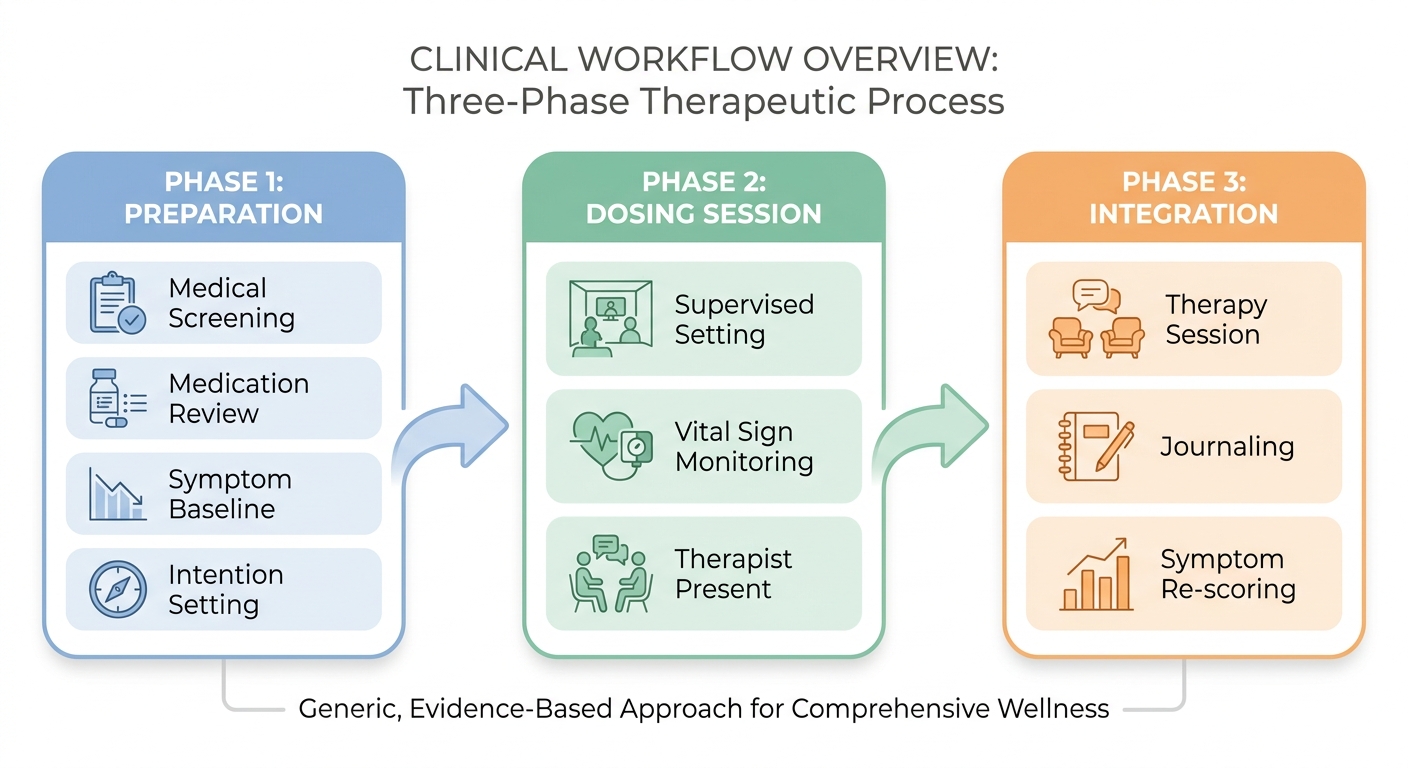
Ketamine-assisted psychotherapy (KAP) combines a supervised sub-anesthetic ketamine session with structured therapy before and after it. The medicine is only one-third of the protocol. The other two-thirds are preparation and integration — the conversations that give the experience somewhere to land.
The working theory behind KAP is that the period following a dosing session is a useful moment for therapeutic work. Our companion piece on why ketamine-assisted psychotherapy works covers the proposed mechanism in more depth. Here, we'll focus on what each phase actually involves.
Preparation: what happens before the first dose?
Preparation is a clinical intake plus a therapeutic one. Your prescriber reviews your full history; your therapist helps you name what you're hoping to work on. A reasonable preparation visit covers:
- Medical screening — cardiovascular history, blood pressure, and any conditions listed as contraindications on the esketamine prescribing information, including aneurysmal vascular disease and prior intracerebral hemorrhage.
- Psychiatric history — including any history of psychosis or mania, which changes the plan.
- Medication review — certain medications are discussed and sometimes re-timed around sessions; that's a prescriber decision, never a self-directed one.
- Symptom baseline — standardized questionnaires such as the PHQ-9 and GAD-7, so progress is measured rather than guessed at.
- Logistics — arranging a driver, clearing the afternoon, planning a quiet evening.
- Intention setting — a short conversation about what you want to pay attention to.
The dosing session: what the therapist is actually doing
The therapist is present, mostly quiet, and watching. Their job during a KAP session isn't to run a conventional talk therapy hour. It's to hold a steady, predictable environment so you don't have to manage anything.
Practically, that looks like this: the room is dimmed, eyeshades and curated music are offered, and a clinician monitors your vital signs throughout. Blood pressure is checked because increases are a documented effect in the FDA labeling for esketamine, and the same attention applies to IV sessions.
The therapist speaks rarely. If distress rises, they offer grounding — a hand on the forearm if you've consented to that, a short orienting sentence, a reminder of where you are and that the session has an end point. If you're calm, they stay out of your way.
Afterward, they stay with you through the recovery period and jot down what you report while it's fresh. That record becomes the raw material for the integration session.
Integration: why the week after matters most
Integration is the therapy work done in the days after a dosing session, where you translate what came up into concrete changes in how you think and behave. It's the phase people skip, and it's the phase most protocols treat as essential.
Integration sessions are typically scheduled within the week following a dose. Typical work includes:
- Reviewing notes or voice memos from the session
- Journaling prompts tied to the intention you set
- Small behavioral assignments — a walk, a text to a friend, one postponed task
- Re-scoring the PHQ-9 so change is tracked with numbers, not vibes
⚠️ Skipping integration is the most commonly cited reason people feel the work doesn't stick. If a clinic offers dosing with no therapeutic follow-up, ask what their plan is for the weeks in between.
What Does a Full Ketamine Course Look Like?
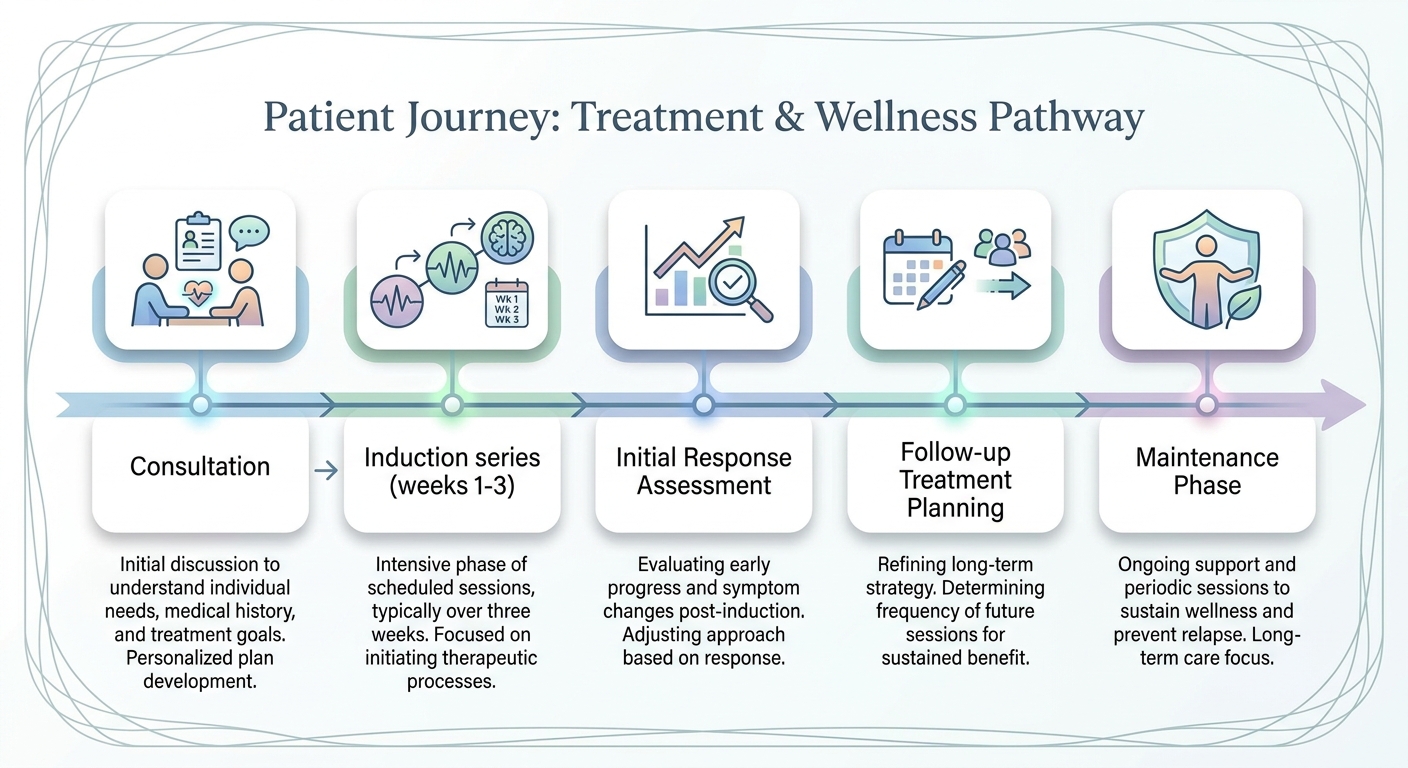
A standard approach is an induction series of several supervised sessions over two to three weeks, followed by a reassessment and a maintenance discussion. The schedule is planned up front so you know what you're committing to before session one.
Here's how a course is commonly sequenced at a Boise-area clinic:
- Consultation — medical and psychiatric history, medication review, candidacy decision, cost and scheduling.
- Induction series — a set number of sessions, usually clustered over two to three weeks, with vitals monitored each time.
- Mid-course check-in — symptom scores reviewed; dose or spacing adjusted by the prescriber.
- Post-induction reassessment — a structured conversation about whether to continue, pause, or change routes.
- Maintenance — booster sessions scheduled at intervals based on your tracked symptoms, not a fixed calendar.
Sessions themselves are a few hours door to door once you include check-in, the infusion or nasal spray administration, and the required recovery period. For esketamine specifically, the FDA label requires administration in a certified healthcare setting with direct observation and at least two hours of monitoring before discharge.
You will not drive yourself home. Plan for a ride and a low-demand evening after each appointment. Patients traveling in from Middleton, Meridian, or Nampa often batch appointments earlier in the day to make the drive easier.
Our page on IV ketamine therapy in Boise and Eagle lays out how the induction series and maintenance schedule are handled locally, including what each visit covers.
Key takeaway: Ketamine therapy is a planned course with checkpoints, not a one-off appointment you decide about afterward.
Who Is a Good Candidate — and Who Isn't?
Candidacy comes down to three things: a documented history of depression that hasn't responded to standard treatment, a cardiovascular system that can tolerate a temporary blood pressure rise, and no active condition that the medication could worsen. A prescriber makes that call in person — nothing on this page substitutes for that visit.
| Likely a fit | Needs more screening first |
|---|---|
| Unipolar depression with two or more adequate medication trials behind you | Active psychosis or current manic episode |
| Bipolar depression under psychiatric management — see ketamine and bipolar depression screening | Uncontrolled or unmonitored high blood pressure |
| Stable, controlled blood pressure | Aneurysmal vascular disease, arteriovenous malformation, or prior intracerebral hemorrhage — listed as contraindications on the esketamine label |
| Willing to arrange transportation and attend the full series | Untreated substance use disorder, including prior ketamine misuse |
| Able to participate in follow-up and symptom tracking | Pregnancy or breastfeeding |
Two of these deserve a note. Bipolar depression isn't an automatic no — it's a reason for careful psychiatric coordination, because anything that lifts mood needs to be managed against the risk of a manic swing.
A substance use history isn't an automatic no either. Ketamine is a controlled substance with known misuse potential (StatPearls), so an honest conversation about your history helps your prescriber build a safer plan — including who holds the schedule and how closely you're monitored.
⚠️ Be fully honest during screening, including about supplements, alcohol, and anything you've taken recreationally. Incomplete history is the single biggest safety risk in this process, and nobody in the room is there to judge you.
How Well Does Ketamine Therapy for Depression Actually Work?
Honestly: it helps some people and not others, and the research base is younger than the one behind SSRIs. The most concrete regulatory marker is that the FDA approved esketamine nasal spray for treatment-resistant depression in adults, used together with an oral antidepressant, under a restricted REMS program (prescribing information, 2019).

Here's what's fair to say and what isn't:
- Fair: ketamine is described in peer-reviewed clinical references as having a role in treatment-resistant depression, and clinics track outcomes with standardized scales.
- Fair: the medication's effects, benefits and adverse reactions alike, are documented in the FDA label and in clinical monographs.
- Not fair: promising you a timeline, a percentage, or a specific improvement in your mood, sleep, or work life. Individual results vary, and no clinic can predict yours.
- Still open: long-term controlled data beyond the first several months remains limited compared with decades-old antidepressant research.
What you can reasonably evaluate is whether a clinic measures anything. A provider who scores your PHQ-9 at baseline, mid-course, and after the induction series can tell you something specific about your own trajectory. A provider who only asks "how are you feeling?" cannot.
Be skeptical of any ketamine clinic in Boise — or anywhere — that advertises a success rate without naming the study behind it. The sites that rank for these searches are often directory listings with pricing and little else. Pricing transparency is genuinely useful; it just isn't evidence.
Key takeaway: Judge a clinic on how it measures outcomes and screens patients, not on the numbers in its marketing.
IV Ketamine, Spravato, or KAP — Which Path Fits You?
These are three delivery routes, not three different medicines competing for your business. The right one depends on your insurance situation, your schedule, and whether you want therapy built into the process.
| IV ketamine | Spravato (esketamine) | Ketamine-assisted psychotherapy | |
|---|---|---|---|
| Route | Intravenous infusion | Nasal spray, self-administered under supervision | Either route, plus therapy |
| FDA status for TRD | Off-label use of an approved medication | FDA-approved for adults with TRD alongside an oral antidepressant (label) | Therapy framework layered on either |
| In-clinic time | Infusion plus a monitored recovery period | At least two hours of post-dose monitoring required by the label | Dosing time plus separate prep and integration visits |
| Insurance | Commonly self-pay | More often submitted to insurance, typically with prior authorization | Varies; therapy and medication may be billed separately |
| Therapy included | Not by default | Not by default | Yes — that's the defining feature |
If insurance coverage is the deciding factor, start by asking about esketamine. Our guide to esketamine for treatment-resistant depression covers how the REMS requirements shape scheduling for Spravato in Boise and Eagle.
If you've done years of talk therapy that felt useful but stalled, KAP is the route worth asking about. If you want precise, prescriber-controlled dosing and flexibility, IV is usually the conversation. Many people start on one route and move to another after reassessment — that's a normal outcome, not a failure.
What Should You Ask Before Booking a Consultation?
Ask about credentials, monitoring, therapy, and measurement. Those four areas separate a well-run ketamine clinic from a storefront. Screenshot this list and bring it to the phone call:
- Who prescribes and who monitors? Ask for the specific licenses of the person in the room with you.
- Is ACLS-certified staff on site during sessions? Advanced cardiac life support training matters when blood pressure is being monitored.
- What monitoring equipment is used? Continuous vital sign monitoring should be standard, not optional.
- Is integration therapy included or referred out? Either answer can be fine — no answer is not.
- How are outcomes measured? Listen for PHQ-9, GAD-7, or another validated scale at set intervals.
- What's the total cost of the full course? Ask about the induction series and boosters, not just a per-session price.
- What happens if I don't respond? A good clinic has a plan for that conversation before you start.
For a deeper walkthrough of vetting local providers, see how to choose a ketamine clinic in Boise, which covers the same questions with more context on what good answers sound like.
Frequently Asked Questions
How fast does ketamine work for depression?
No one can promise you a timeline, and anyone who does is overselling. Ketamine acts through a different receptor system than standard antidepressants (StatPearls), which is why it's studied in treatment-resistant cases. Clinics plan a series of sessions rather than a single visit precisely because individual responses differ and are assessed over the course.
Is ketamine therapy for depression covered by insurance in Idaho?
Coverage differs by route. IV ketamine for depression is an off-label use and is commonly handled as self-pay. Esketamine nasal spray is FDA-approved for treatment-resistant depression in adults (label), so it's more often submitted to insurance, usually with prior authorization. Verify specifics with your plan and the clinic's billing team before you schedule.
Do I have to stop my antidepressant to try ketamine?
Usually not. The FDA labeling for esketamine describes it as being used in conjunction with an oral antidepressant. Some other medications may be discussed, re-timed, or adjusted around sessions. That is strictly a prescriber decision — never stop or change a psychiatric medication on your own.
How long do the benefits last after the first course?
This varies between individuals and can't be predicted in advance. That's exactly why maintenance sessions exist and why symptom tracking continues after the induction series ends. Your prescriber uses your scores and your reports to decide whether, and how often, boosters make sense.
What's the Next Step if You've Run Out of Options?
The next step is a consultation, not a commitment. A prescriber reviews your medication history, screens for the conditions in the candidacy table above, and tells you honestly whether IV ketamine, Spravato, or ketamine-assisted psychotherapy fits your situation — or whether something else should come first.
Three things to carry with you: "treatment-resistant" describes your history, not your ceiling; ketamine therapy for depression works through a different mechanism than the pills you've already tried; and the quality of the clinic — screening, monitoring, integration, measurement — matters as much as the medicine itself.
If you're in Boise, Eagle, Middleton, or anywhere in the Treasure Valley and you've genuinely run the antidepressant gauntlet, a single conversation costs you an hour. You've already spent years.
Information about third-party platforms reflects publicly available details at the time of writing and may have changed. Please verify directly with the provider. See our Terms of Use for more.