Ketamine Therapy for Depression: What the Evidence Shows
Zora Neuro Spa Editorial · October 22, 2026

Depression that hasn't budged after two or three medication trials can feel like a closed door. Ketamine therapy for depression has become one of the most discussed options behind that door — and also one of the most over-promised. This guide walks through what the published, regulated evidence actually supports, how ketamine-assisted psychotherapy is structured phase by phase, and how to tell whether you're a reasonable candidate.
Quick Answer
Ketamine therapy for depression is the medically supervised use of a sub-anesthetic dose of ketamine for people whose depression hasn't improved on standard antidepressants. One form — esketamine nasal spray — is FDA-approved for treatment-resistant depression in adults, used together with an oral antidepressant. IV ketamine is prescribed off-label. Ketamine-assisted psychotherapy (KAP) adds preparation, a supervised dosing session, and integration therapy. Results vary between individuals, and suitability is decided in a clinical consultation.
TL;DR
- Two different medicines sit under one word: generic IV ketamine (off-label) and esketamine nasal spray (FDA-approved for TRD). See how the two forms compare
- "Response" and "remission" mean different things, and clinics that quote one number rarely say which. Understand response vs. remission
- KAP runs in three phases — preparation, dosing, integration — not a single appointment. Walk through the three phases
- Maintenance sessions are planned from the start; they're part of the design, not a sign of failure. See why maintenance is built in
- Screening matters: blood pressure, psychiatric history, and medication list all shape eligibility. Check the candidacy criteria
In This Article
- What Is Ketamine Therapy for Depression?
- What Does the Evidence Actually Show?
- Why Does Ketamine Therapy Include Maintenance Sessions?
- How Does Ketamine-Assisted Psychotherapy Work, Phase by Phase?
- KAP vs. Infusion Alone: Which Fits You?
- Who Is a Good Candidate — and Who Isn't?
- What Does a Full Course Involve in the Treasure Valley?
What Is Ketamine Therapy for Depression?
Ketamine therapy for depression is the supervised clinical use of ketamine at a dose far below the level used for surgical anesthesia, given to adults whose depressive symptoms have not improved adequately with standard antidepressants. Ketamine is an NMDA receptor antagonist originally developed and still widely used as an anesthetic, as described in the clinical monograph on ketamine in StatPearls.
Two distinct products get grouped under the same umbrella, and the difference matters when you're comparing clinics or calling your insurer.
- IV racemic ketamine — the generic anesthetic medication, delivered by slow infusion in a monitored setting. Its use for depression is off-label, meaning the FDA has approved the drug but not specifically for this indication. This is the model behind IV ketamine therapy in Boise and Eagle.
- Esketamine (SPRAVATO) nasal spray — a related molecule that carries FDA approval for treatment-resistant depression in adults, prescribed in conjunction with an oral antidepressant, per its prescribing information.
Esketamine is regulated tightly. The label states it is available only through a restricted distribution program under a Risk Evaluation and Mitigation Strategy (REMS), must be administered under the direct supervision of a healthcare provider, and requires that patients be monitored for at least two hours after each dose.
⚠️ "Off-label" does not mean "unstudied." It means the manufacturer never filed for that specific approval — common for older generic drugs with no patent incentive. It does mean the protocol varies between clinics, so ask any provider to describe their dosing approach, monitoring, and emergency plan in plain language.
What Does the Evidence Actually Show?
The strongest single piece of regulatory evidence is the FDA's approval of esketamine nasal spray for treatment-resistant depression in adults when used alongside an oral antidepressant, documented in its prescribing information. That approval reflects review of clinical trial data by the regulator — a bar that most off-label depression treatments have never been tested against.
Two terms show up constantly in that literature, and clinics use them loosely.
Response refers to a meaningful reduction in symptom scores on a standardized depression scale — improvement, not absence of illness. Remission refers to symptom scores falling into a range considered non-depressed. A treatment can produce response in many more people than it produces remission in, which is why a single headline percentage tells you very little without knowing which measure it describes.
Be cautious with any clinic — ours included — that advertises a success rate without naming the study, the population, and the measure behind it. For a study-by-study breakdown, see what the research says about ketamine for depression.
| IV ketamine | Esketamine nasal spray | |
|---|---|---|
| Regulatory status for depression | Off-label use of an approved anesthetic | FDA-approved for treatment-resistant depression in adults, with an oral antidepressant |
| Route | Intravenous infusion | Self-administered nasal spray under supervision |
| Supervision | Clinic-based, medically monitored | Restricted REMS program; direct healthcare provider supervision required |
| Post-dose monitoring | Set by clinic protocol | At least two hours per the FDA label |
| Insurance | Commonly billed as self-pay | More often reviewed for coverage when TRD criteria are documented |
The honest summary: the evidence base supports ketamine-class treatment as an option for depression that hasn't responded to standard care, while leaving real open questions about ideal dosing, ideal spacing, and who benefits most. Depression itself is a treatable medical condition with several evidence-based options, as the National Institute of Mental Health outlines — ketamine is one path among them, not a replacement for the rest.
Key takeaway: Ask providers which measure their claims use and where the data came from. A clinic that can answer that question clearly is telling you something about how it practices.
Why Does Ketamine Therapy Include Maintenance Sessions?
Maintenance sessions are planned into ketamine protocols from the beginning because a dosing series is designed as a treatment course, not a one-time procedure. Nobody should be surprised at session six that more sessions are on the table — that's how the model is built.
The neuroplasticity window refers to a period researchers have proposed after dosing, during which the brain's synaptic signaling may be more adaptable than usual. Ketamine's action at NMDA receptors is well documented in the StatPearls clinical monograph; exactly how that translates into mood effects is still an active research question, and you should treat confident mechanistic explanations with some skepticism.
What this framing explains is why the therapy half exists. If dosing opens a window of cognitive flexibility, then filling that window with structured therapeutic work — rather than driving home and returning to the same routines — is the logic behind pairing medicine with psychotherapy. For a deeper look at the proposed brain mechanisms, read how ketamine works on the brain.
Practically, this means three things when you're planning:
- Budget for a course, not a session. Ask what the induction series and maintenance cadence look like before you start.
- Expect tracking. Clinicians typically re-administer standardized questionnaires across the series rather than judging progress session by session.
- Plan the therapy side early. Booking integration after you've already dosed usually means a longer gap than intended.
How Does Ketamine-Assisted Psychotherapy Work, Phase by Phase?
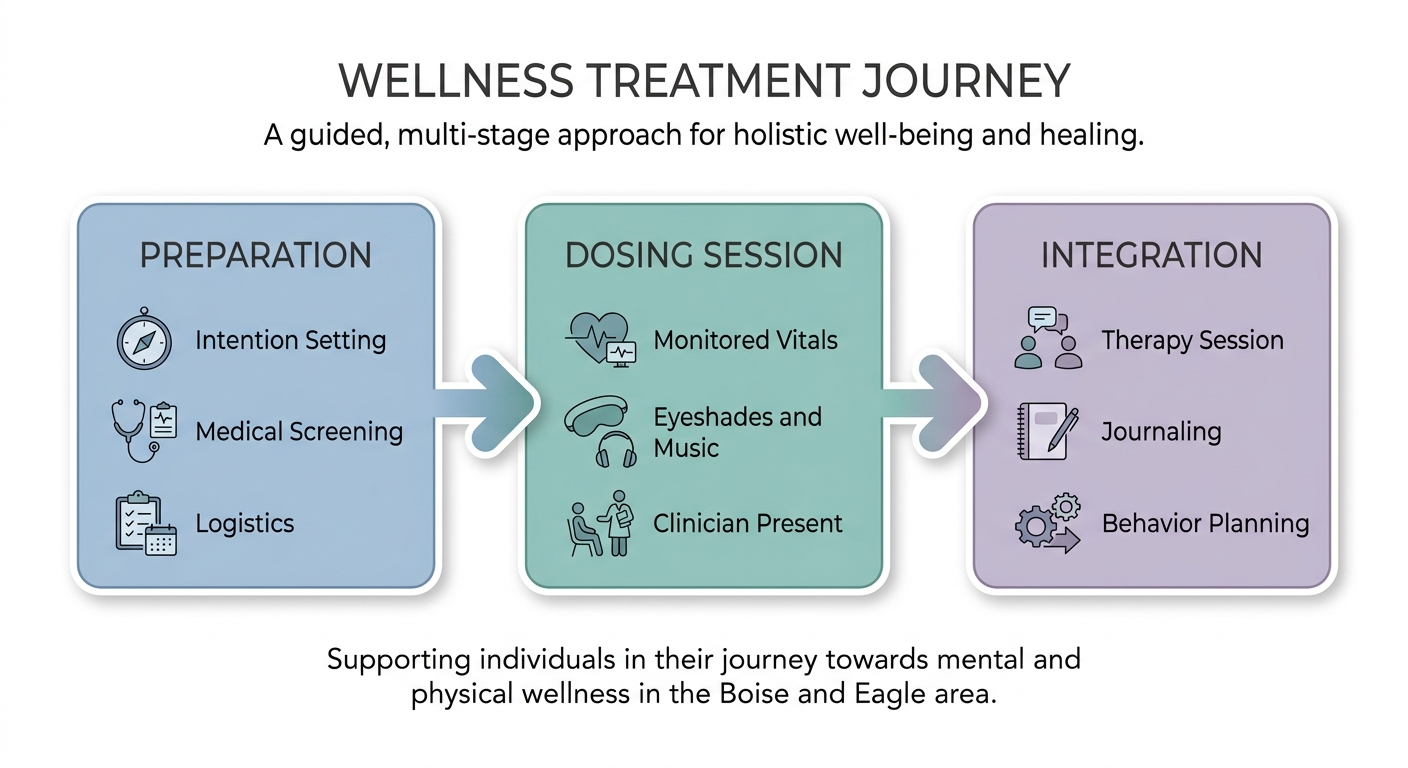
Ketamine-assisted psychotherapy (KAP) is a protocol that pairs a supervised sub-anesthetic ketamine dose with a trained therapist's support before, sometimes during, and after the medicine session. It runs in three phases: preparation, dosing, and integration.
The structure exists so the medicine and the therapy reinforce each other. Preparation sets intention and reduces anxiety about the experience. The dosing session is monitored and supported. Integration converts whatever surfaced into concrete changes. For a session-level walkthrough, see what a KAP session involves.
What Happens in Preparation?
Preparation is one or two standard-length therapy sessions before any medicine is given. The goal is to make the dosing session predictable rather than disorienting.
A typical preparation phase covers:
- Medical screening — blood pressure history, cardiac history, current medications, substance use history, and psychiatric diagnoses.
- Baseline measurement — standardized questionnaires such as the PHQ-9 for depression and GAD-7 for anxiety, so change across the series can be tracked against a starting point.
- Intention setting — naming what you want to work on, which gives the integration phase something concrete to return to.
- Expectation setting about dissociation — ketamine can produce dissociative effects, and the esketamine label lists dissociation among its adverse reactions. Knowing this in advance is the single biggest factor in whether the experience feels manageable.
- Logistics — fasting instructions before the session, no driving afterward for the remainder of the day, and arranging a ride home in advance.
That last point trips people up more than anything clinical. Clinics will not discharge you to drive yourself. Line up a ride before your first appointment, not the morning of.
What Happens During the Dosing Session?
The dosing session is a monitored appointment in a quiet room, usually with eyeshades and a curated music playlist, with vital signs checked throughout and a clinician present or immediately nearby.

Standard monitoring includes a blood pressure cuff and pulse oximetry. Blood pressure monitoring is not incidental — the esketamine prescribing information notes increases in blood pressure as a known effect requiring monitoring, and the same caution applies to IV protocols.
The experience has a shape. Effects begin, build toward a peak, and then taper as the dose clears, with re-orientation happening before discharge. Many people describe altered sense of time, body, or perspective. Some find it interesting, some find it uncomfortable, and most find the discomfort easier to sit with when a clinician is in the room and they were told what to expect.
What you should not expect is a dramatic revelation on cue. The session is one component, and the following day's work usually matters more than the session itself.
Why Is Integration the Part People Skip?
Integration is a therapy session scheduled soon after dosing, where whatever surfaced during the medicine session gets examined and turned into specific behavior changes. It is the phase most commonly dropped — because it costs additional time, often isn't bundled, and feels optional once symptoms ease.
Concretely, integration looks like:
- A structured session with your therapist, not a casual check-in.
- Journaling prompts completed in the hours after dosing, while impressions are still fresh.
- One or two behavioral commitments — a conversation to have, a boundary to set, a routine to restart — rather than general resolutions.
- A scheduled date booked before the infusion, not after.
⚠️ Book integration sessions at the same time you book dosing sessions. If you wait, the gap tends to stretch, and the phase that converts the experience into change quietly disappears from the plan.
Key takeaway: When people say ketamine "stopped working," the missing piece is often the integration phase — the structured therapy that was supposed to follow the medicine but never got scheduled.
KAP vs. Infusion Alone: Which Fits You?
Infusion alone generally suits people whose main goal is symptom relief and who already have an established therapist elsewhere. KAP generally suits people with trauma history, entrenched rumination, or a pattern of relapsing after symptoms ease. Neither is universally better; they solve different problems.
| Infusion alone | Ketamine-assisted psychotherapy | |
|---|---|---|
| Therapist involvement | Medical staff monitor; therapy happens elsewhere, if at all | Trained therapist before, sometimes during, and after dosing |
| Time per treatment day | Dosing plus recovery and monitoring | Dosing plus a separate therapy session |
| Cost structure | Per-session medical fee | Medical fee plus therapy hours, often billed separately |
| Insurance likelihood | IV ketamine commonly self-pay | Therapy hours may bill under standard psychotherapy codes |
| Best-fit profile | Established outside therapy, primary goal is symptom relief | Trauma, rumination, or relapse after prior symptom relief |
| Main risk | Window passes without structured follow-up | Higher coordination and scheduling demand |
A middle path exists and is common: infusions at a clinic, with integration sessions scheduled with your existing therapist. That works well as long as your therapist knows the schedule and is willing to hold sessions in the days following dosing.
For a fuller side-by-side, read ketamine-assisted psychotherapy vs. infusion alone.
The question worth asking yourself: when you've felt better in the past, what caused it to slip? If the answer is "life circumstances I never addressed," the therapy component is probably not optional for you.
Who Is a Good Candidate — and Who Isn't?
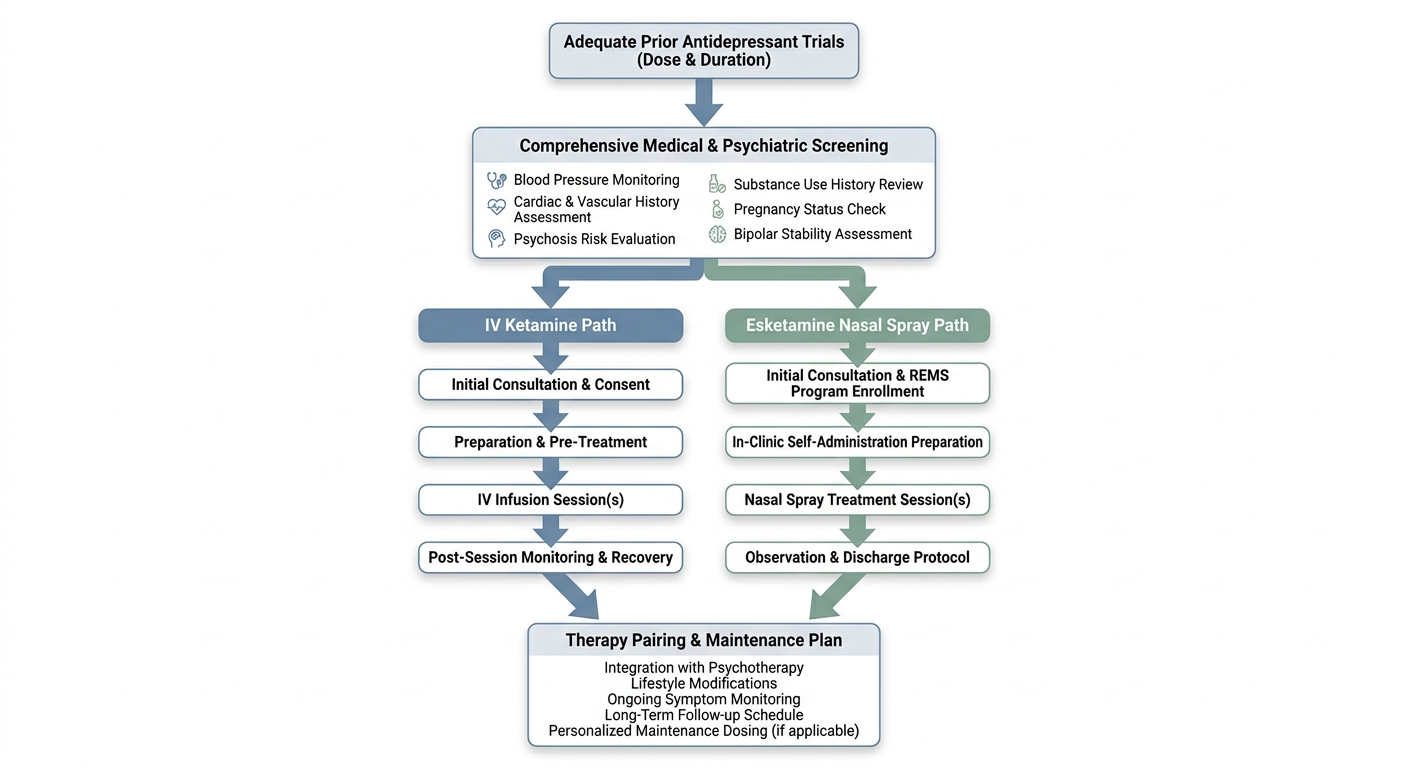
The common clinical threshold is an inadequate response to two or more adequate antidepressant trials — meaning a sufficient dose for a sufficient duration, not a few weeks abandoned early. If you're still earlier in that process, it's worth reviewing alternatives to SSRIs for depression with your prescriber first.
Screening then narrows the field further. Factors clinicians review include:
- Cardiovascular status — uncontrolled high blood pressure is a central concern, given documented blood pressure effects.
- Vascular contraindications — the esketamine label lists aneurysmal vascular disease, arteriovenous malformation, and history of intracerebral hemorrhage as contraindications.
- Psychosis history — active psychotic symptoms generally require a different treatment path.
- Substance use history — the label identifies risk of abuse and misuse; prior dissociative misuse is a specific screening point.
- Pregnancy — reviewed carefully with the prescribing clinician.
- Bipolar disorder — stability and current medications shape whether and how to proceed.
⚠️ Your medication list matters. Benzodiazepines and some mood stabilizers are routinely discussed during screening because of possible interactions with treatment response. Never stop or change a prescribed medication on your own — that is a decision for your prescriber.
Screening is also where expectations get set. A good consultation will tell you if you're not a strong candidate. That conversation is more valuable than a quick yes.
What Does a Full Course Involve in the Treasure Valley?
A course of ketamine therapy for depression is structured as an initial series of sessions spread across roughly two to three weeks, followed by individualized maintenance sessions. The specific number, spacing, and route are set during consultation, not from an article. For the cost and protocol details, see ketamine infusion therapy costs and protocols.
The underrated burden is logistics. A typical Boise or Eagle patient is coordinating:
- Multiple clinic visits inside a two-to-three-week stretch
- A ride home after every dosing session
- Therapy sessions with a separate provider, ideally soon after dosing
- Time away from work for appointments plus recovery
- Insurance questions that differ depending on which medication you're using
Each of those is manageable alone. Stacked during a depressive episode, they're the reason people start a series and don't finish it.
That's the practical argument for having screening, dosing, and integration coordinated through one clinic rather than assembled across three. One intake, one schedule, one team that knows your plan. At Zora Neuro Spa, candidacy review, treatment, and follow-up planning for Boise and Eagle patients are handled in the same place — which removes a layer of coordination you'd otherwise be managing yourself.
Frequently Asked Questions
How quickly does ketamine work for depression?
Timing varies between individuals, and no clinic can responsibly promise a timeframe. Clinicians generally track change using standardized questionnaires across the full series rather than judging from a single session. Your provider will set expectations at screening based on your history and the protocol being used.
Is ketamine-assisted psychotherapy covered by insurance?
Coverage differs by medication. IV racemic ketamine for depression is off-label and is commonly handled as self-pay. Esketamine, which is FDA-approved for treatment-resistant depression, is more often reviewed for coverage when TRD criteria are documented. Therapy hours may bill separately under standard psychotherapy codes. Verify specifics directly with your plan.
How many ketamine sessions are needed for depression?
There's no universal number. Protocols typically begin with an initial series over roughly two to three weeks, followed by maintenance sessions scheduled according to individual response. Your clinician determines the plan during consultation and adjusts it as treatment progresses.
Can I stay on my antidepressant during ketamine therapy?
Usually yes — and with esketamine, an oral antidepressant is part of the FDA-approved regimen, per its prescribing information. Clinicians do review the full medication list, including benzodiazepines and mood stabilizers, before starting. Any change to a prescription is a decision for your prescriber, never something to adjust independently.
What's the Next Step if You're Considering Ketamine Therapy?
The case for ketamine therapy for depression rests on a regulator-reviewed approval for esketamine in treatment-resistant depression and a growing body of research on ketamine more broadly — paired with real, open questions about dosing and durability. It is a legitimate option for people whose depression hasn't responded to standard care. It is not a cure, and the clinics that describe it that way are overselling.
If there's one practical takeaway: the medicine and the therapy are designed to work together. Plan the integration sessions when you plan the dosing sessions.
The next step is a screening consultation, which is an assessment — not a commitment to treat. You'll review your antidepressant history, medical history, and current medications, and leave knowing whether you're a candidate and what a plan would look like. If you'd rather read first, the ketamine therapy cost, safety and process FAQ covers the practical questions in detail.
Individual results vary, and suitability is always determined in a clinical consultation.