How Ketamine Quiets Chronic Pain Signals
Zora Neuro Spa Editorial · November 12, 2026
Chronic pain that has outlived every scan, injection, and prescription bottle is a different animal than ordinary pain — and it responds to a different kind of medicine. Ketamine is one of the few treatments that targets the amplification itself rather than the injury, which is why Treasure Valley pain patients keep asking about it. Below: how it works, what a session involves, what drives the cost, and which ketamine infusion side effects actually show up when the protocol is built for pain rather than depression.
Quick Answer
Ketamine blocks the NMDA receptor, a glutamate channel in the spinal cord and brain that drives repetitive pain-signal amplification. Dampening that channel is a different strategy than opioids or gabapentinoids use — it aims at the sensitized nervous system rather than the painful tissue. Pain protocols typically use low, sub-anesthetic doses given slowly over a longer session than mood protocols. Most ketamine infusion side effects — dissociation, dizziness, nausea, a temporary rise in blood pressure — occur during the session and fade in recovery.
TL;DR
- Mechanism: Ketamine is an NMDA receptor antagonist, which is why it's studied for centrally sensitized pain rather than acute injury pain. See how the wind-up process works
- Different lane than opioids: It doesn't act on mu-opioid receptors or calcium channels, so it's often considered after those options disappoint. Compare ketamine, opioids and gabapentinoids side by side
- Pain protocols run longer than depression protocols, at lower dose per minute, usually as a series. Walk through an infusion day
- Cost is cash-pay for most pain patients because IV ketamine for pain is off-label. Review what drives the price
- Side effects cluster inside the session, not after it. Read the pain-protocol side effect profile
In This Article
- How Does Ketamine Actually Help Chronic Pain?
- Why Is Ketamine Different From Opioids and Gabapentin?
- Which Pain Conditions Respond Best?
- What Does a Chronic Pain Infusion Protocol Look Like?
- What Does a Ketamine Infusion Cost for Chronic Pain?
- What Ketamine Infusion Side Effects Should Pain Patients Expect?
- Are You a Good Candidate? A Screening Checklist
- What Questions Should You Ask a Boise or Eagle Clinic?
How Does Ketamine Actually Help Chronic Pain?
Ketamine works on pain by blocking the NMDA receptor. According to the clinical monograph on ketamine published on NCBI Bookshelf, ketamine acts primarily as an NMDA receptor antagonist, and the drug is used at low doses in pain management settings as well as for anesthesia.
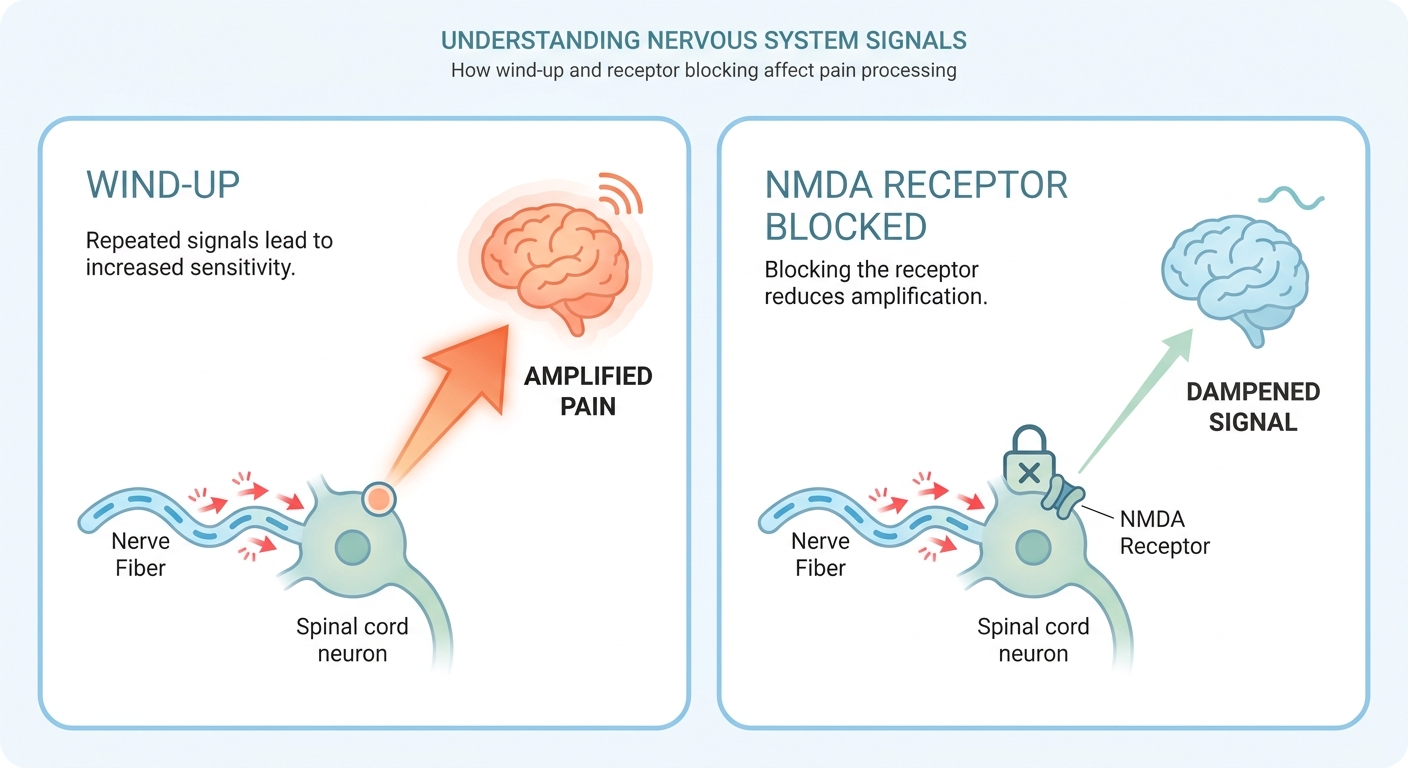
That receptor matters because of a process clinicians call wind-up.
Central sensitization is when the spinal cord and brain amplify incoming pain signals so persistently that light touch, temperature change, or ordinary movement can register as pain. The original injury may be long healed. The alarm system stays switched on.
Wind-up refers to the way repeated signaling at the NMDA receptor makes spinal neurons progressively more responsive to the same input — the volume knob turning itself up.
Blocking the NMDA receptor interrupts that loop. Rather than masking the signal the way a painkiller does, the aim is to quiet the amplifier that keeps generating it. That's the reason ketamine shows up in conversations about nerve pain and widespread pain syndromes, and almost never in conversations about a sprained ankle.
Two honest caveats belong next to that explanation.
First, ketamine is approved by the FDA as an anesthetic agent; its use for chronic pain is off-label, meaning a clinician prescribes it outside the labeled indication based on published evidence and clinical judgment. Off-label prescribing is legal and common, but it changes how insurance treats the bill.
Second, blocking a receptor in a diagram is tidier than changing a human nervous system. Response varies between individuals, some people get little benefit, and candidacy is determined in a medical consultation — not by a symptom list on a website.
If you want the condition-by-condition view rather than the biology, our breakdown of which chronic pain conditions respond to ketamine covers that ground in detail.
Key takeaway: Ketamine is aimed at the sensitized nervous system itself, which is why it's typically considered for nerve-driven and centrally amplified pain rather than ordinary tissue pain.
Why Is Ketamine Different From Opioids and Gabapentin?
Each of these medications targets a different part of the pain pathway, which is the practical reason a pain specialist might rotate between them. Opioids such as morphine act at mu-opioid receptors. Gabapentinoids such as gabapentin (Neurontin) and pregabalin (Lyrica) act on calcium channels in nerve cells. Ketamine works on the glutamate/NMDA pathway described above.
| IV ketamine | Opioids (e.g., morphine) | Gabapentinoids (gabapentin, pregabalin) | |
|---|---|---|---|
| Primary target | NMDA receptor (glutamate) | Mu-opioid receptors | Voltage-gated calcium channels |
| Delivery | Supervised IV infusion in clinic | Oral, patch, injectable | Oral, daily |
| Dosing pattern | Series of sessions, then boosters as needed | Ongoing daily dosing | Ongoing daily dosing |
| FDA status for chronic pain | Off-label | Approved for certain pain indications | Approved for certain neuropathic indications |
| Common side effects | Dissociation, dizziness, nausea, transient blood pressure rise | Sedation, constipation, respiratory depression risk | Drowsiness, dizziness, swelling |
| Take-home supply | None in a clinic infusion model | Yes | Yes |
The side effect entries for ketamine reflect the adverse effects described in the NCBI ketamine monograph, which lists dissociation, cardiovascular stimulation, and nausea among the recognized effects of the drug.
Two structural differences stand out for someone who has already cycled through pills.
There is no take-home supply with clinic-based infusions. Dosing happens under monitoring, on a schedule, in a medical setting. That changes the risk conversation considerably compared with a daily bottle at home.
It is episodic rather than continuous. You are not adding another every-morning tablet to the stack. You are completing a series, then reassessing.
None of that makes ketamine a replacement for the rest of your plan. Most people doing well with pain use several tools at once — movement, sleep repair, interventional procedures, mental health support. Our overview of modern chronic pain management options in Boise puts those pieces in order.
Which Pain Conditions Respond Best?
The strongest published interest centers on neuropathic and centrally sensitized conditions. Pain medicine literature discusses IV ketamine most often for complex regional pain syndrome (CRPS), with additional study in fibromyalgia, spinal cord injury pain, phantom limb pain, and post-herpetic neuralgia. Mechanical low back pain and degenerative joint pain are generally considered weaker candidates, because the driver is structural rather than a sensitized signal.
Conditions clinicians most often evaluate for an analgesic infusion:
- CRPS — burning pain, color and temperature changes, and extreme sensitivity to touch in a limb
- Fibromyalgia — widespread pain with sleep disruption and fatigue
- Neuropathic pain — nerve injury, post-surgical nerve pain, post-herpetic neuralgia
- Central pain after spinal cord injury
- Refractory migraine — a separate protocol from body pain, with its own evaluation

Be skeptical of any clinic — in Boise, Caldwell, Kuna, or anywhere else — that implies a uniform outcome. Published results in these conditions vary widely between studies and between patients, and a meaningful share of people see little change. A credible evaluation tells you where the evidence is strongest, where it's thin, and what would make you a poor fit.
For the fibromyalgia-specific picture, including what realistic expectations look like, see our deeper read on ketamine for fibromyalgia.
What Does a Chronic Pain Infusion Protocol Look Like?
Pain protocols are built differently than depression protocols: lower dose delivered per minute, a longer total run time, and usually a series rather than a single visit. Analgesic infusions are generally described as running longer than typical mood infusions, though exact durations vary by clinic and protocol. The theory behind the longer run is cumulative exposure at the receptor — not a bigger dose all at once.
A booster infusion is a single maintenance session scheduled when earlier relief begins to fade, rather than a restart of the full series.
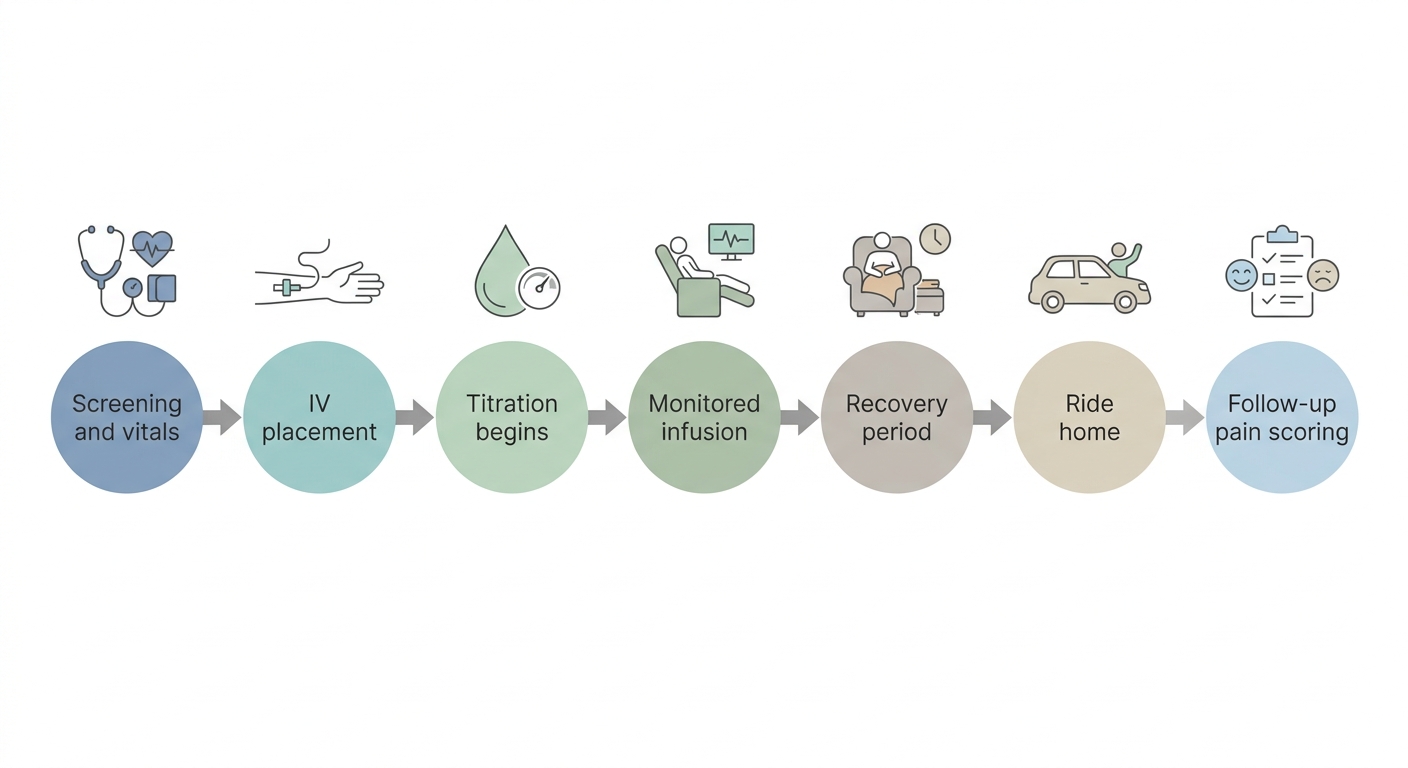
Here's what a session day generally includes:
- Screening and consent — medical history, blood pressure check, medication review, pain scoring
- IV placement — a peripheral IV, started by clinical staff
- Titration — the infusion begins low and is adjusted by the supervising clinician
- Monitoring — blood pressure, heart rate, oxygen saturation, and comfort checked throughout
- Recovery — a quiet period until you're steady on your feet
- Ride home — arranged in advance; you will not be driving
- Follow-up scoring — pain and function re-measured before the next session
The coordination burden is the part patients underestimate. Dosing decisions, vital-sign monitoring, nausea management, recovery space, and follow-up measurement all have to line up — and splitting those across separate providers is how people end up repeating intake paperwork and guessing at their own progress. Our IV ketamine therapy in Boise and Eagle program keeps the screening, infusion, monitoring, and follow-up under one roof in Eagle, a short drive from Boise, Meridian, Caldwell, and Kuna.
Dosing for CRPS in particular follows its own pattern; we break that down in CRPS infusion protocols and dosing.
Key takeaway: A pain protocol is a slower, longer, repeated process — plan your schedule and transportation around a series, not a single appointment.
What Does a Ketamine Infusion Cost for Chronic Pain?
Expect cash-pay. Because IV ketamine for chronic pain is an off-label use, it is rarely billed to insurance the way an approved therapy would be, and most Treasure Valley clinics quote a per-session price directly to the patient. When people ask how much does ketamine infusion cost, the honest answer is that it depends on session length and the monitoring model — which is exactly why you should ask for the total series price in writing before you start.
| Line item | What it covers | What drives the range | Insurance likelihood |
|---|---|---|---|
| Initial consultation | Medical screening, history, candidacy decision | Clinician type, length of visit | Sometimes billable as an office visit |
| Single analgesic infusion | Medication, nursing time, monitoring, recovery | Infusion length and body-weight dosing | Unlikely — off-label use |
| Full series | Multiple sessions over several weeks | Number of sessions planned | Unlikely |
| Booster infusion | One maintenance session later | Same per-session factors | Unlikely |
| Follow-up visits | Pain scoring, plan adjustment | Frequency of re-assessment | Sometimes billable |
Because analgesic infusions run longer than mood infusions, they generally sit at the higher end of a clinic's per-session pricing — more chair time, more nursing time, more monitoring.
Esketamine follows a completely different coverage path. The FDA prescribing information for SPRAVATO (esketamine) nasal spray describes an approved indication in treatment-resistant depression and in depressive symptoms in adults with major depressive disorder with acute suicidal ideation or behavior — administered under a restricted REMS program with post-dose monitoring. It is not an approved chronic pain treatment. That distinction is why a Spravato Boise patient and an IV pain patient can have entirely different billing experiences; we explain how esketamine insurance coverage differs in detail.
Practical cost steps before you commit:
- Ask for a written per-session and full-series quote, including monitoring
- Ask whether HSA or FSA funds are accepted
- Request a superbill you can submit yourself
- Confirm whether consultation and follow-up visits are billed separately
What Ketamine Infusion Side Effects Should Pain Patients Expect?
Most effects happen during the infusion and resolve in recovery. The NCBI ketamine monograph lists dissociation and perceptual changes, cardiovascular stimulation such as increased blood pressure and heart rate, nausea and vomiting, and dizziness among the drug's recognized adverse effects — and notes that monitoring is part of safe administration.
The pain-protocol wrinkle is duration. A longer infusion means a longer window during which you may feel disconnected, floaty, or unsteady, and a longer tail of grogginess afterward. That's the single biggest practical difference between an analgesic session and a shorter mood session.
What clinics typically manage proactively:
- Nausea — anti-nausea medication is often given before or during the infusion
- Blood pressure and heart rate — checked on a set schedule throughout
- Dissociation — a quiet room, dim lighting, and staff within reach
- Unsteadiness — a supervised recovery period before discharge
⚠️ Call your clinic if you have chest pain, a severe headache that won't settle, vomiting you can't keep ahead of, confusion lasting into the next day, new or worsening urinary urgency or pain, or any symptom that frightens you. Do not wait for your next scheduled session.
Longer-horizon concerns deserve plain mention rather than burial. Urinary and bladder symptoms and liver enzyme changes are discussed in the ketamine literature primarily in the context of frequent, high-dose, or non-medical use — a very different exposure pattern than a supervised clinical series. A thorough clinic screens for bladder symptoms at baseline and asks about them at follow-up.
For a longer companion piece scoped to this population, read side effects chronic pain patients report.
Are You a Good Candidate? A Screening Checklist
The strongest candidates have neuropathic or centrally sensitized pain that hasn't responded to at least two prior approaches, stable cardiovascular status, and no untreated psychosis or active substance misuse. Final candidacy is a clinical decision, not a self-assessment — but this checklist tells you what the consultation will cover.
- Prior treatments — what you've tried, for how long, and what happened
- Pain type — nerve-driven or widespread versus purely structural
- Blood pressure and heart history — ketamine temporarily raises both
- Liver function — relevant with repeated dosing
- Bladder symptoms — baseline urinary urgency, frequency, or pain
- Psychiatric history — including psychosis and bipolar disorder
- Pregnancy or breastfeeding
- Substance use history — honest disclosure protects you
- Transportation — a confirmed ride home for every session
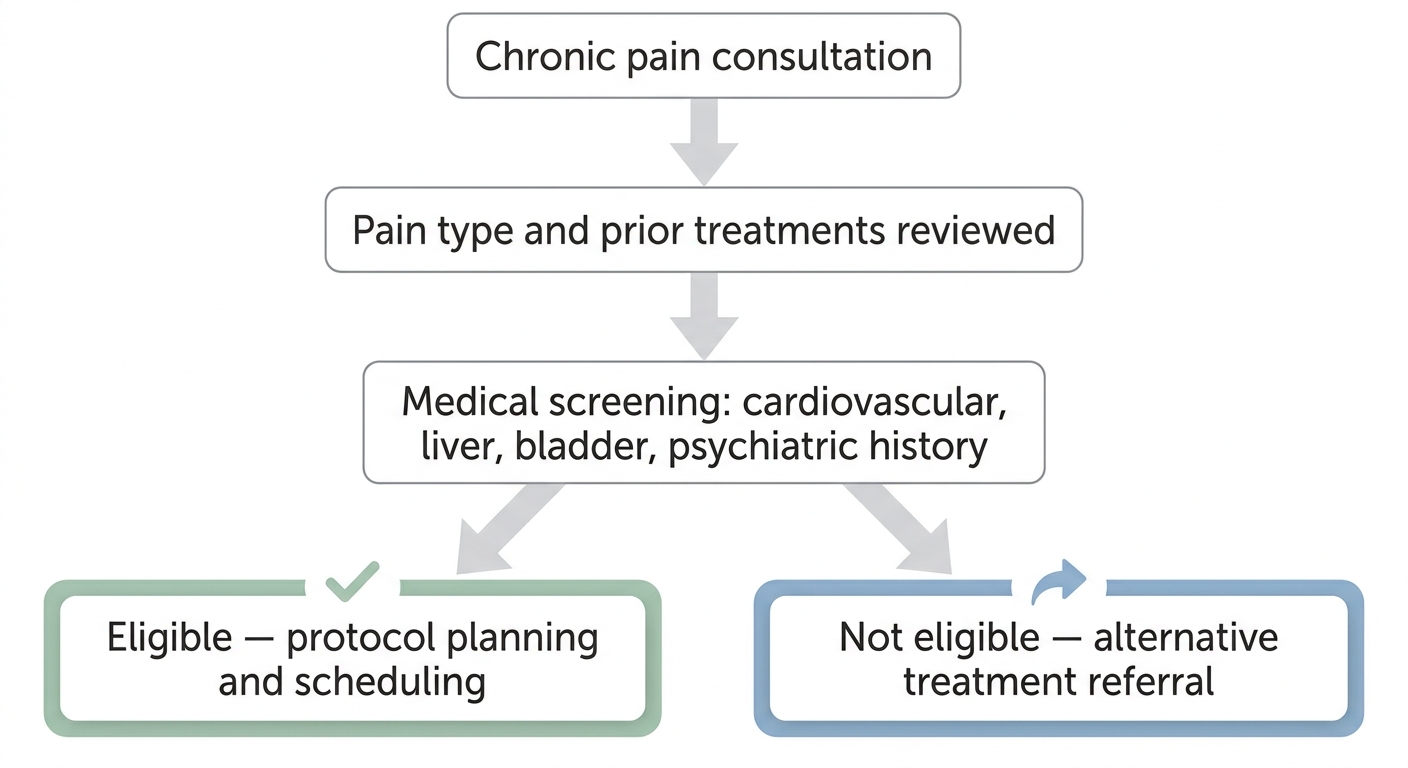
Key takeaway: A clinic that says yes before reviewing your cardiovascular, bladder, and psychiatric history is skipping the part that keeps you safe.
If CRPS is your diagnosis specifically, our page on ketamine for CRPS and who it helps covers the candidacy nuances in that condition.
What Questions Should You Ask a Boise or Eagle Clinic?
Ask who is in the room, what dose and duration they use for pain specifically, how they monitor you, and what the full series costs in writing. Those four answers separate a pain-capable ketamine clinic in Boise from one that simply runs the same mood protocol for everyone.

Bring this list:
- Who supervises the infusion — is there anesthesia or pain-trained clinical oversight on site?
- What's your pain protocol? — dose approach, session length, number of sessions planned
- How do you monitor vitals? — what's checked, how often, and what triggers a pause
- Do you use a validated pain score? — a numeric rating scale (0–10) or Brief Pain Inventory at every visit
- What does the full series cost? — per session, total, boosters, follow-ups
- What happens if it doesn't work? — when do you stop and refer out?
- How do you handle emergencies? — on-site protocol and after-hours contact
A clinic that answers the "what if it doesn't work" question comfortably is usually the one worth booking. Our guide to how to choose a ketamine clinic in Boise expands each of these into what a good answer sounds like.
Summary
Ketamine addresses chronic pain by blocking the NMDA receptor and interrupting the wind-up process behind central sensitization — a different target than opioids or gabapentinoids. Pain protocols use low, sub-anesthetic doses over longer sessions, delivered as a series with boosters. The cost is usually cash-pay because the use is off-label, and ketamine infusion side effects in this setting are mostly in-session events — dissociation, dizziness, nausea, a temporary rise in blood pressure — managed through monitoring and a supervised recovery. Results vary between individuals, and suitability is decided in a clinical consultation.
Frequently Asked Questions
How long does pain relief from a ketamine infusion last?
Duration varies widely between individuals, and some people experience little change at all. Clinicians generally track relief with repeat pain scoring after a completed series and schedule a booster infusion if benefit fades. Some pain medicine literature has explored how infusion time and cumulative dose may relate to how long benefit lasts, as discussed in the NCBI ketamine monograph, though these remain study-level observations rather than a promise about individual results. — but those are study-level observations, not a promise about your case.
Does insurance cover ketamine infusions for chronic pain in Idaho?
Usually not for IV ketamine, because the use is off-label. Some plans reimburse the office-visit component or part of the facility charge even when the infusion itself isn't covered. Ask your clinic for a superbill you can submit yourself, and check whether HSA or FSA funds apply. Coverage for esketamine follows a separate path tied to its approved depression indication.
Is ketamine addictive when used for pain treatment?
In a clinic model there is no take-home supply, dosing is scheduled and supervised, and the amount given is controlled by the clinician. The documented harms associated with ketamine — including bladder and urinary problems — appear in the literature largely in the context of frequent non-medical use. Any history of substance misuse should be disclosed during screening so it can be factored into the decision.
Can you drive home after a chronic pain infusion?
No. Arrange a ride before your appointment and plan to take the rest of the day off. Because analgesic infusions run longer than typical mood infusions, grogginess and unsteadiness can linger well past the recovery period. Most clinics will not discharge you to drive yourself, and that rule exists for good reason.
Information about third-party platforms reflects publicly available details at the time of writing and may have changed. Please verify directly with the provider. See our Terms of Use for more.