Recovery IV Drip Near Me: Boise & Eagle Options
Zora Neuro Spa Editorial · October 29, 2026

If you've typed "recovery IV drip near me" after a hot long run in the Boise Foothills or a weekend race, you've probably found a short list of Treasure Valley clinics and a very long list of big promises. This guide covers what's actually in the bag, where the evidence is solid and where it isn't, what to ask about price, and how to tell a carefully run clinic from a pop-up.
Quick Answer
A recovery IV drip is a provider-supervised infusion that delivers fluids, electrolytes and vitamins directly into the bloodstream, usually after hard training, an endurance event, travel or illness. Searches for a "recovery IV drip near me" in the Treasure Valley turn up medical IV clinics in Boise, Eagle and Meridian. Appointments are short, almost always cash-pay, and the formula should be chosen after someone reviews your health history — not off a menu board.
TL;DR
- Most recovery bags start with sterile fluid and add B-complex, B12, magnesium and vitamin C. See the ingredient breakdown
- IV fluid is a well-established way to replace fluid when drinking isn't working; claims about faster muscle repair are much thinner. Read the honest evidence section
- A drip makes the most sense after real fluid loss — an endurance event, a heat day, a GI bug — not routine gym fatigue. Check whether you're a good candidate
- Wellness IVs are elective, so plan on paying out of pocket and asking for an all-in quote. Compare cost factors before you book
- Supervision, screening and ingredient transparency separate a clinic from a pop-up. Use the clinic vetting checklist
In This Article
- What Is a Recovery IV Drip, and What's Actually in the Bag?
- Does IV Recovery Actually Work? What the Evidence Shows
- Who Is a Recovery IV Drip Actually For?
- Recovery IV vs Oral Rehydration vs Other Drip Types
- What Does a Recovery IV Drip Cost Near Boise and Eagle?
- How Does a Recovery IV Appointment Work, Step by Step?
- How Do You Vet a Recovery IV Drip Near Me?
- When Should You Skip the IV? Risks and Red Flags
What Is a Recovery IV Drip, and What's Actually in the Bag?
A recovery drip is a sterile fluid base plus a short list of additives chosen for post-exertion use. The base does most of the work. The additives are what clinics use to differentiate their menus.
Lactated Ringer's is a sterile solution containing sodium, chloride, potassium, calcium and lactate, used in medicine to replace fluid and electrolytes. B-complex refers to a group of water-soluble B vitamins — including B1, B2, B3, B5 and B6 — that the body uses in normal energy metabolism.
| Common ingredient | What it is | Why clinics include it | Honest framing |
|---|---|---|---|
| Normal saline or lactated Ringer's | Sterile fluid with electrolytes | Replaces fluid lost through sweat | Well established for fluid replacement |
| B-complex | Water-soluble B vitamins | Involved in normal energy metabolism | Benefit is clearest when intake is low |
| Vitamin B12 | Water-soluble vitamin | Supports normal red blood cell formation | Most useful if you're deficient |
| Magnesium | Mineral given as magnesium sulfate | Involved in muscle and nerve function | Often felt as warmth during infusion |
| Vitamin C | Water-soluble antioxidant vitamin | Added to many wellness formulas | Not a proven performance aid |
| Glutathione or amino blends | Optional add-ons | Marketed for recovery and skin | Evidence in healthy athletes is limited |
Many menus trace back to the Myers' cocktail, a vitamin-and-mineral infusion template named after physician John Myers. The practical appeal of IV delivery is that it bypasses digestion entirely, which matters most when your stomach is unhappy — a point covered in more depth in our explainer on how IV nutrition bioavailability actually works.
Key takeaway: The fluid is the part with the strongest track record; the vitamins are an add-on, not a guarantee.
Does IV Recovery Actually Work? What the Evidence Shows
IV fluid reliably replaces fluid in people who are dehydrated — that's established clinical practice. The weaker claims are the downstream ones: faster muscle repair, less soreness, better performance next week. Those are marketing language more often than measured outcomes.
Here's the distinction worth holding onto:
- Where IV genuinely helps — when oral intake is impaired by vomiting, nausea, severe dehydration or a short turnaround between events.
- Where oral usually wins — when you can drink, keep fluids down and eat a meal. Sports medicine guidance generally favors drinking first.
- Where evidence is thin — vitamin megadoses as a performance aid in people who already eat a balanced diet.
Be skeptical of any clinic that promises a specific result. Wellness and performance IVs are offered as elective services, not as approved treatments for athletic performance, and individual responses vary. A clinic that explains the limits is a better sign than one that doesn't. If you're unsure whether a drip fits your situation, a short screening conversation with a provider is the right first step.
⚠️ Watch for this: Phrases like "flushes toxins," "boosts immunity" or "guarantees faster recovery" outrun what published evidence supports. Clear ingredient lists beat bold adjectives.
Who Is a Recovery IV Drip Actually For?
The best fit is someone with real fluid loss or a stomach that won't cooperate. Euhydration means being in normal fluid balance — and if you're euhydrated and eating normally, a drip has much less to offer.

You're probably a reasonable candidate if:
- You just finished an endurance event — a marathon, century ride or triathlon with hours of sweat loss.
- You trained hard in heat — an August long run in the Foothills with limited fluid access.
- You're recovering from a GI illness — vomiting or diarrhea made drinking difficult.
- You cut weight for competition — combat sports and wrestling make rapid rehydration a real issue.
- You're traveling or at altitude — dry air plus a packed schedule limited your intake.
Skip it if your only symptom is ordinary post-gym tiredness. Water, sodium, carbohydrate and sleep handle that far more cheaply. If your goal is seasonal wellness support rather than exercise recovery, immunity IV therapy in Eagle, Idaho is a different formula with a different purpose.
Recovery IV vs Oral Rehydration vs Other Drip Types: How Do They Compare?
IV delivery wins on speed and on certainty of absorption. Oral rehydration wins on cost, convenience and safety. Different drip formulas serve genuinely different goals, so matching the bag to the need matters more than picking the longest ingredient list.
| Option | Primary use | Typical setting | Best for |
|---|---|---|---|
| Recovery / athletic drip | Fluid, electrolytes, B vitamins after exertion | In-clinic, supervised | Post-event or heat-day fluid loss |
| Hydration-only drip | Fluid replacement without additives | In-clinic, supervised | Simple dehydration, illness recovery |
| Myers' cocktail | Classic vitamin-and-mineral blend | In-clinic, supervised | General wellness support |
| Immunity formula | Vitamin C, zinc, B vitamins | In-clinic, supervised | Seasonal or travel wellness support |
| NAD+ drip | Coenzyme infusion, slower drip rate | In-clinic, longer session | Cellular-health goals, not acute rehydration |
| Oral electrolyte mix | Sodium, glucose, fluid | Anywhere | Mild to moderate dehydration in healthy people |
NAD+ sits apart from the rest — it's infused differently and chosen for different reasons, which we unpack in our guide to NAD+ IV therapy in Eagle.
Key takeaway: If you can drink it, drink it. Reserve the IV for the situations where drinking isn't realistic or fast enough.
What Does a Recovery IV Drip Cost Near Boise and Eagle?
Expect to pay out of pocket. Wellness and performance infusions are treated as elective, so insurance rarely covers them, and HSA or FSA eligibility varies and often requires a letter of medical necessity from a clinician.
Pricing across Treasure Valley clinics varies with three things:
- The base bag — fluid volume and whether it's saline or lactated Ringer's.
- The core formula — how many vitamins and minerals are included as standard.
- Add-ons and packages — extras like glutathione, or multi-session bundles that reduce the per-visit rate.
When you call a clinic offering a recovery IV drip near me searches surfaced, ask for one number that includes nurse time, the bag, the additives and any facility fee. You can see what's included at each tier on our IV nutrition menu and pricing, and compare the variables in our full IV therapy price breakdown.
Key takeaway: A quoted price should cover the consult, the line placement, the bag and the ingredients — surprise add-on fees at checkout are a red flag.
How Does a Recovery IV Appointment Work, Step by Step?
A recovery appointment follows a predictable sequence: intake and vitals, formula selection with a provider, IV placement, the infusion itself, then a brief observation and aftercare note.
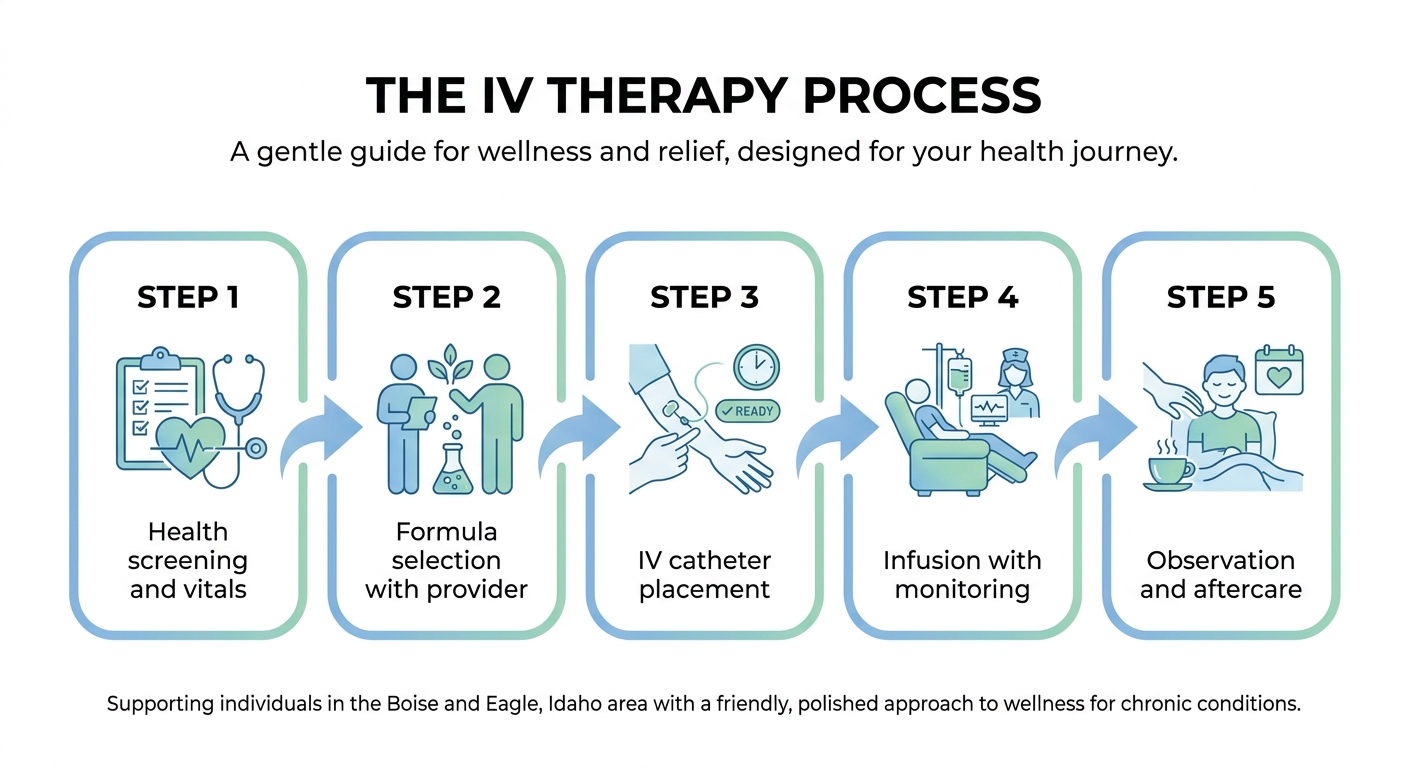
What each step involves:
- Screening — blood pressure, heart rate, medications, allergies, medical history and pregnancy status.
- Formula selection — a licensed provider reviews your goals and history before approving the bag and any add-ons.
- IV placement — a small catheter goes into a forearm or hand vein. A brief sting, then it should be comfortable.
- Infusion — you sit in a recliner while the fluid runs. Staff should check on you and adjust the drip rate.
- Aftercare — the line comes out, the site is bandaged, and you get instructions for the rest of the day.
A few sensations are normal and worth expecting. B vitamins can produce a warm, slightly metallic taste. Magnesium often feels like warmth spreading through the chest or limbs. Riboflavin can turn urine bright yellow for the rest of the day — harmless, and not a sign anything went wrong.
Tell staff immediately if you feel burning, swelling or tightness at the IV site. That's a fixable problem, and a good clinic wants to hear about it right away. Book a screening appointment if you'd like the sequence walked through before you commit.
How Do You Vet a Recovery IV Drip Near Me? A Clinic Checklist
Check three things: who supervises the care, where the ingredients come from, and whether anyone screens your health history before the needle goes in. A clinic that skips screening is cutting the step that protects you.
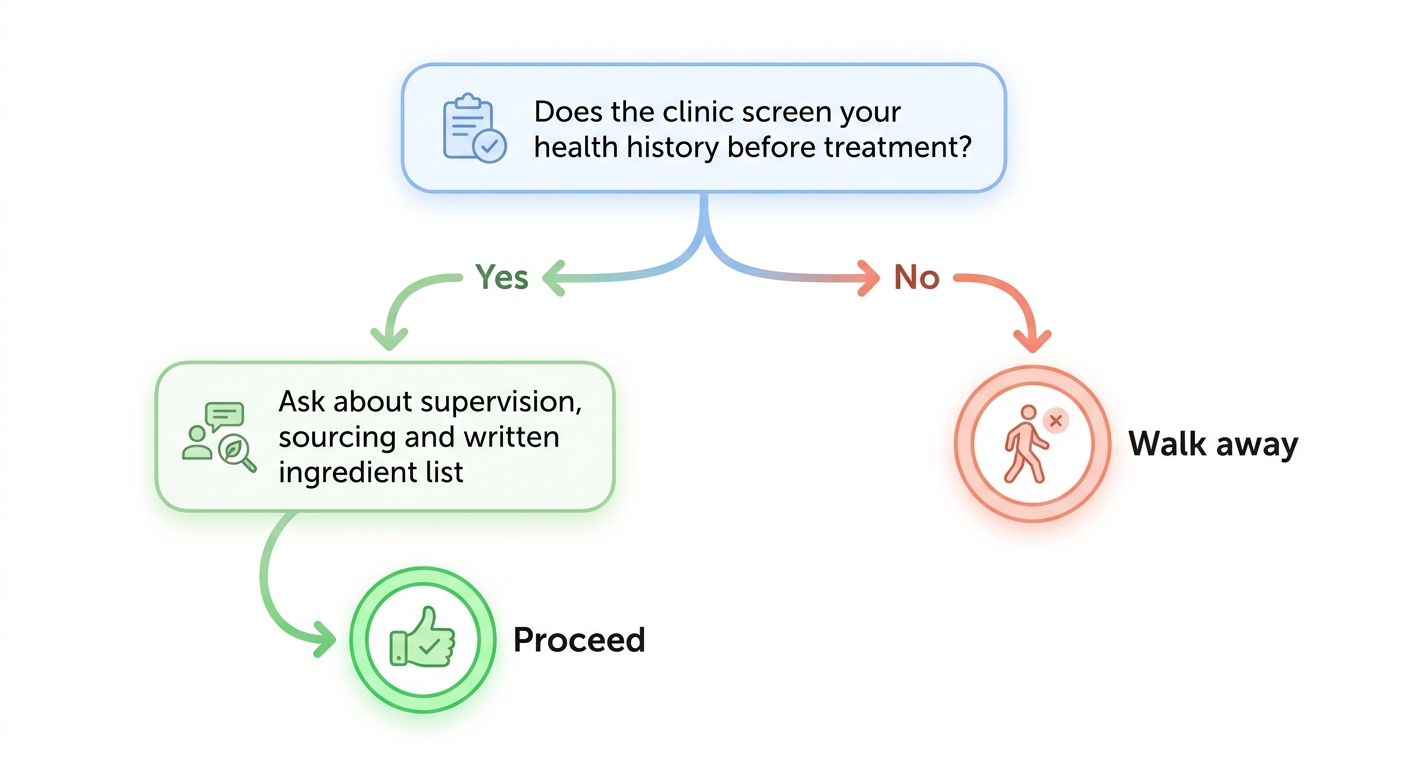
Run this checklist before you book:
- Medical oversight — is there a named medical director or prescribing clinician responsible for the protocols?
- Who places the line — an RN, paramedic or other licensed clinician, not an unlicensed technician.
- Ingredient sourcing — ingredients obtained through a licensed compounding pharmacy or outsourcing facility.
- Sterile technique — single-use supplies, visible hand hygiene, proper sharps disposal.
- Emergency readiness — a written protocol for allergic reactions and the staff and supplies to act on it.
- Written ingredient list — what's in the bag, in writing, before you consent.
- No pressure — a clinic that pushes packages at the door before assessing you is selling, not screening.
For a deeper walkthrough, use our 7-point checklist for choosing a safe IV provider. The same logic applies to any infusion service: supervision first, menu second.
When Should You Skip the IV? Risks and Red Flags
Some conditions make extra IV fluid a genuinely bad idea. Get cleared by your own physician first if you have congestive heart failure, kidney disease, uncontrolled high blood pressure, a history of fluid overload, G6PD deficiency, or if you're pregnant or breastfeeding.
Real risks of any infusion include:
- Infiltration — fluid leaking into tissue around the vein, causing swelling and discomfort.
- Phlebitis or bruising — irritation of the vein or a bruise at the insertion site.
- Infection — uncommon with sterile technique, but never zero.
- Electrolyte disturbance — a reason volume and additives should be chosen by a clinician, not a menu.
⚠️ Important: High-dose intravenous vitamin C can be dangerous for people with G6PD deficiency, an inherited enzyme condition. Disclose it during screening, and disclose every medication and supplement you take.
Results vary between individuals, and whether any infusion is appropriate for you is a clinical decision made in consultation. If you have a chronic condition, bring your medication list to the screening conversation.
Frequently Asked Questions
How often can you get a recovery IV drip?
Most clinics treat wellness drips as occasional rather than routine — often event-based, around a race or a heavy training block. More isn't better: the kidneys clear excess water-soluble vitamins, and repeated unnecessary fluid loading carries risk without added benefit. Ask your provider what cadence fits your health history.
How long do the effects of a recovery IV last?
The hydration effect is immediate, and how long it holds depends on your fluid losses afterward. Water-soluble vitamins like C and the B group are cleared relatively quickly, while B12 is stored in the body for longer. Nobody should promise you a specific duration of benefit.
Does insurance cover a recovery IV drip in Idaho?
Almost never. Wellness and performance infusions are considered elective, so expect cash-pay. HSA and FSA eligibility varies by plan and usually requires a letter of medical necessity. Medically indicated infusions ordered for a diagnosed condition are handled differently from menu-based wellness drips.
Is a recovery IV better than just drinking water?
Not for most people, most of the time. An IV is better when oral intake is impaired — vomiting, severe dehydration, or no realistic window between events. Otherwise a sodium-containing oral drink plus a meal is cheaper, safer and generally sufficient for exercise recovery.
Can I get a recovery IV drip the same day in Boise or Eagle?
Often yes. Many Treasure Valley IV clinics accommodate same-day or next-day appointments, though race weekends and holidays fill faster. Call ahead for a short screening conversation so the provider can confirm the formula is appropriate before you arrive.
Booking a Recovery Drip in the Treasure Valley
Choosing a recovery IV drip near me comes down to three decision points: do you have a real fluid-loss need, does the clinic tell you exactly what's in the bag, and is a licensed clinician screening you before treatment? Get those three right and the rest is logistics.
If you're in Boise, Eagle, Meridian or anywhere in the valley and you're not sure whether IV therapy fits your situation, start with a conversation rather than a menu. A short screening call sorts out whether a recovery IV makes sense for you, or whether fluids, food and sleep will do the job.
Book your screening consult with our Eagle clinic and we'll match the formula to what your body actually lost.