Esketamine Cost Without Insurance: Cash-Pay Numbers
Zora Neuro Spa Editorial · October 27, 2026
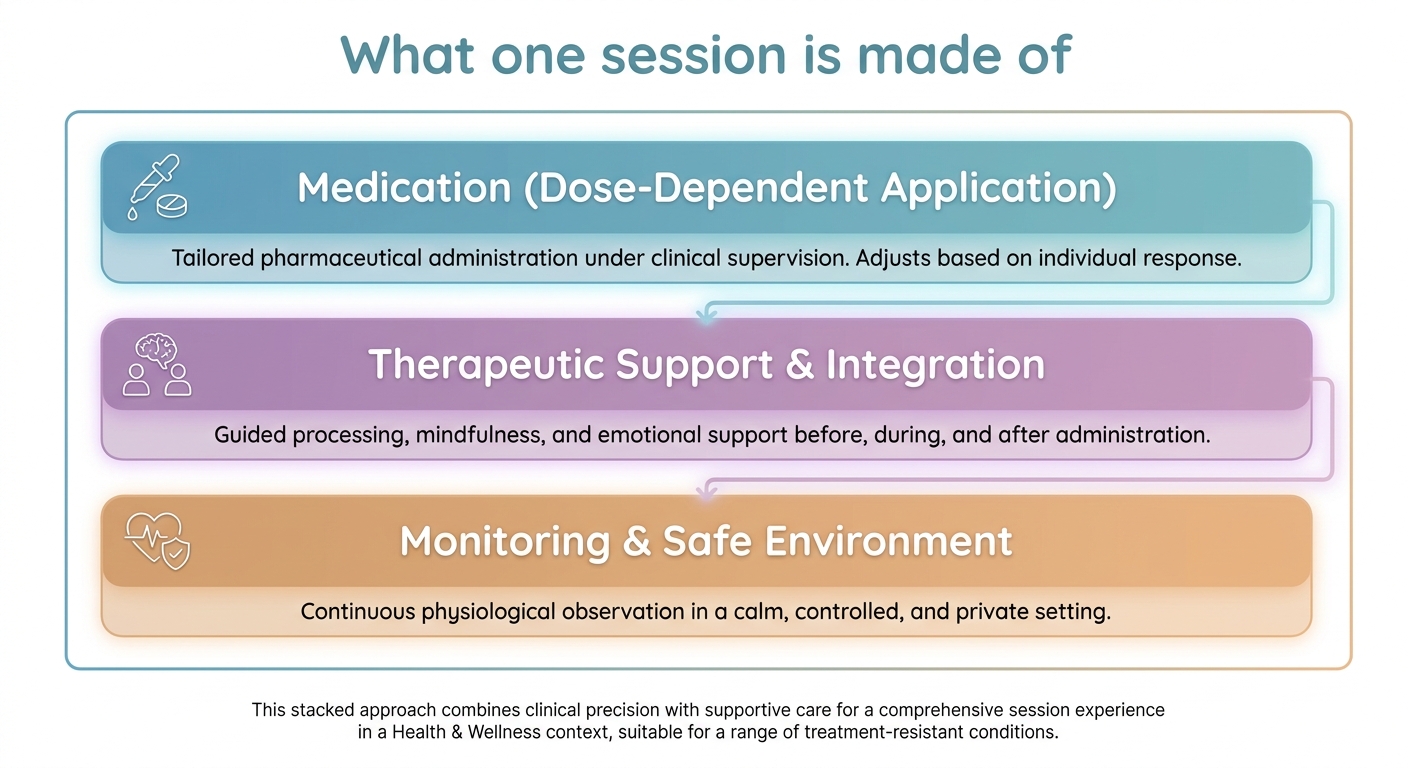
Paying out of pocket for mental health treatment means you need real numbers, not vague ranges — and esketamine cost without insurance is one of the hardest figures to pin down before you call a clinic. The price isn't one charge; it's a stack of separate line items repeated across a dosing schedule set by the FDA label. This guide breaks down what you're actually buying at each visit, how many visits the label calls for, and the exact questions that turn a fuzzy estimate into a written quote.
Quick Answer
There is no single published national price for cash-pay esketamine. Your esketamine cost without insurance is built from three separate charges per visit — the branded medication, the required in-clinic monitoring period, and the clinic's provider and visit fees — multiplied by a dosing schedule that is heaviest in the first month. Ask any clinic for a written quote that itemizes all three, and ask whether that quote changes at the higher dose.
Esketamine is a prescription nasal spray approved by the FDA for treatment-resistant depression in adults, used together with an oral antidepressant, and available only through a restricted distribution program with at least two hours of supervised monitoring after each dose (FDA prescribing information).
TL;DR
- Cash price is never one number — it's medication plus monitoring plus provider fees, and clinics quote each differently. See how the per-session charges stack up
- The FDA label front-loads dosing into the first four weeks, so your first month costs the most. Budget by treatment phase, not by visit
- Most plans that cover it require prior authorization, a documented inadequate response to at least two antidepressants, and a certified treatment site. Review the coverage criteria plans apply
- Manufacturer copay cards and patient assistance programs follow different eligibility rules, and many copay cards exclude uninsured patients entirely. Check which cost levers apply to self-pay
- Self-pay patients often compare the nasal spray against IV infusions, which use an older generic medication and a different billing path. Compare the two routes side by side
In This Article
- What Makes Up Esketamine Cost Without Insurance?
- What Does a Full Course Actually Cost Out of Pocket?
- Does Insurance Cover Esketamine, and What Do Plans Require?
- What Lowers the Price if You're Paying Cash?
- Is IV Ketamine Cheaper Than Esketamine Without Insurance?
- How Do You Get a Straight Price Before You Commit?
What Makes Up Esketamine Cost Without Insurance?
A single session carries at least three separate price tags, and clinics bundle them differently. That's why two quotes can look wildly different while describing the same visit. Before you compare clinics, learn the line items.
The medication is the largest and least flexible piece. The FDA label describes a 56 mg starting dose with later doses of 56 mg or 84 mg, so the quantity of drug used — and therefore what you're charged for it — can change between visits.
The second piece is time in the chair. The label requires that patients be monitored by a healthcare provider for at least two hours after each dose, with blood pressure checked before and after administration, because the drug is only available through a restricted program.
REMS observation fee refers to the clinic charge covering that mandatory supervised monitoring period — the staff time, vital-sign checks, treatment space, and documentation required after every dose under the restricted distribution program.
| Line item | What it covers | Who sets it | What to ask |
|---|---|---|---|
| Medication | The nasal spray device kits used at the 56 mg or 84 mg dose | Manufacturer list price, plus any clinic handling charge | "Does the price change at the higher dose?" |
| Monitoring / observation | The required supervised recovery period and vital-sign checks | The clinic | "Is this billed per visit or per hour?" |
| Provider & visit fees | Assessment, prescribing, documentation, follow-up | The clinic | "Are consults and follow-ups billed separately?" |
A fourth cost rarely appears on a quote: transportation. The label instructs patients not to drive or operate machinery until the next day after a restful sleep, so every session needs a ride home. Over an eight-session month, rides, time off work, and childcare are real budget lines.
For a deeper walkthrough of how the drug charge and the clinic charge are billed separately, see our breakdown of esketamine nasal spray cost and insurance coverage.
Key takeaway: A quote that gives you one flat number per session isn't wrong — but ask for it broken into medication, monitoring, and provider fees so you can compare clinics honestly.
What Does a Full Course Actually Cost Out of Pocket?
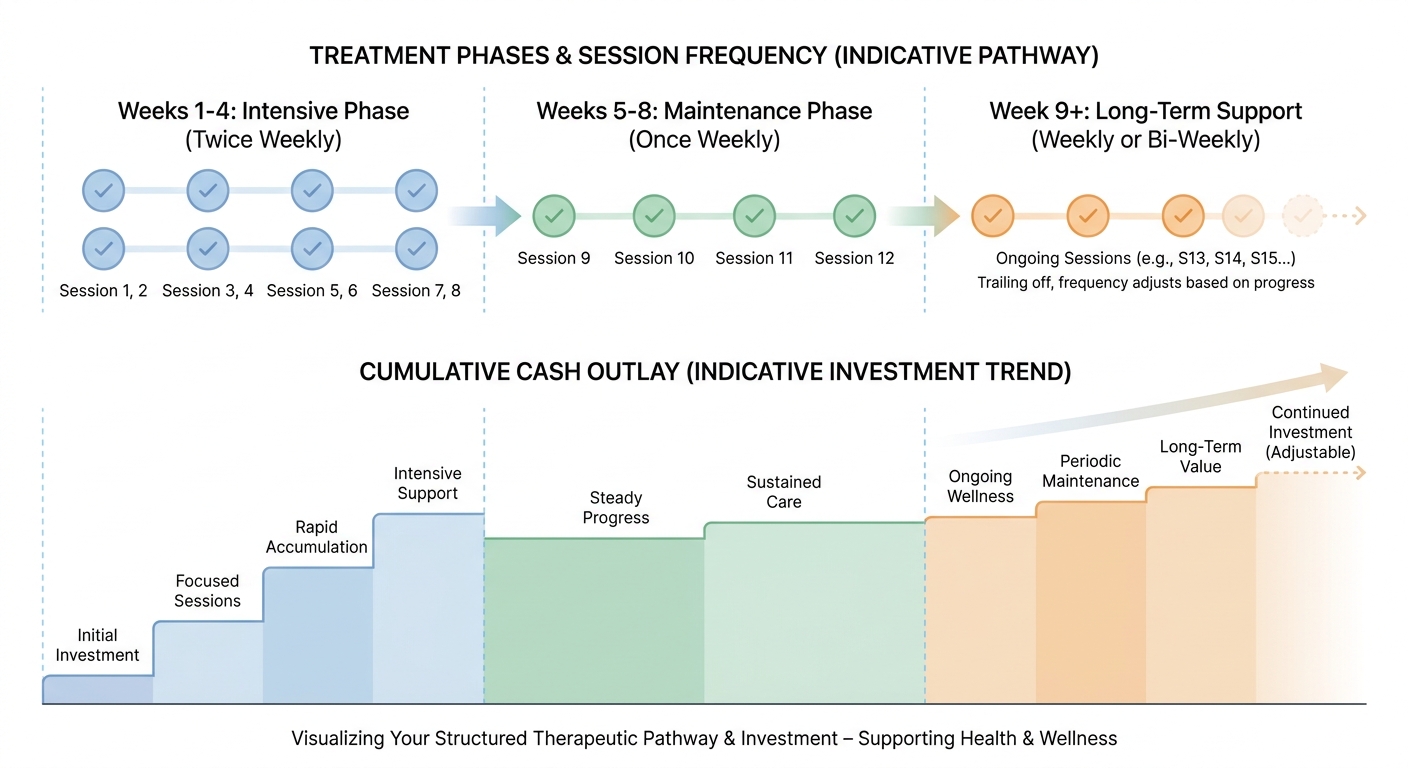
Budget by phase, not by visit. The FDA-labeled schedule is front-loaded, so your first month involves far more sessions than later months — and that's where most self-pay budgets get surprised.
According to the prescribing information, treatment-resistant depression dosing runs twice per week during weeks 1 through 4, once weekly during weeks 5 through 8, and then once weekly or once every two weeks from week 9 onward, with the maintenance interval individualized to the lowest frequency that maintains response.
| Phase | Labeled schedule | Sessions in the phase | Budget reality |
|---|---|---|---|
| Induction (weeks 1–4) | Twice per week | 8 | Heaviest spend; concentrated in one month |
| Weeks 5–8 | Once weekly | 4 | Spend roughly halves |
| Week 9 onward | Weekly or every 2 weeks | Varies by patient | Ongoing, open-ended cost |
Multiply your quoted per-session total by eight to get your induction figure. That number — not the per-visit price — is the one to compare against your savings, your HSA balance, or a payment plan. Then multiply by four for the second phase.
The maintenance phase is the part people under-plan. Because dosing continues at a weekly or biweekly interval determined by your prescriber, there is no fixed end date to budget toward. Treat it as a recurring monthly expense, the way you'd treat a prescription you expect to keep filling.
Local context matters too. Pricing structures differ between hospital-affiliated programs and independent outpatient clinics, and a hospital setting may add a facility charge that an outpatient clinic doesn't. For a regional view of how programs structure spravato cost in the Treasure Valley, see our guide to Spravato costs and clinics in Boise.
Key takeaway: Your realistic year-one planning number is eight induction sessions plus four weekly sessions plus ongoing maintenance — ask any clinic to quote all three phases in writing before you start.
Does Insurance Cover Esketamine, and What Do Plans Require?
Many commercial plans, Medicaid programs, and Medicare do cover esketamine for treatment-resistant depression — but nearly all of them require prior authorization first. If you're uninsured today, knowing the criteria still matters, because coverage is the single biggest lever on what you ultimately pay.
The requirements plans apply tend to track the FDA label closely. The label indicates esketamine for treatment-resistant depression in adults, used in combination with an oral antidepressant, and states that it is available only through a restricted program under a Risk Evaluation and Mitigation Strategy where the patient is monitored by a healthcare provider.
Prior authorization is a plan's advance review of whether a specific treatment meets its medical-necessity criteria for you — approval is required before the plan will pay, and denials can usually be appealed.
Documents to gather before you call your plan:
- Diagnosis records — a documented major depressive disorder diagnosis from your prescriber.
- Antidepressant history — names, doses, and dates for prior trials. The label frames treatment-resistant depression around inadequate response to prior antidepressants, and plans typically want at least two, each at an adequate dose and duration.
- Current oral antidepressant — proof you're on one, since the label specifies combination use.
- Site certification — confirmation the clinic is certified under the restricted program.
- Plan documents — your member ID, formulary or drug-list page, and the plan's specialty pharmacy contact.
- Denial letters — if you've been denied before, bring them; appeals often succeed on documentation, not on new arguments.
How the claim is billed also varies. Because the drug is administered in a clinical setting under supervision, it is commonly handled as a provider-administered medication rather than a pharmacy pickup — which changes which part of your benefits applies and which deductible you're drawing against. Ask your plan directly which benefit category applies to you.
For a fuller walkthrough of the eligibility questions plans ask, read our guide to who qualifies for esketamine and Spravato coverage.
⚠️ Coverage criteria, prior-authorization forms, and formulary placement change frequently. Verify current requirements with your specific plan rather than relying on any article, including this one.
What Lowers the Price if You're Paying Cash?
Four levers exist, and only some of them apply to uninsured patients. Knowing which is which saves you a frustrating phone call.

- Manufacturer copay savings programs — these exist for many branded medications, but eligibility is set by the manufacturer. Copay cards commonly require commercial insurance and exclude patients who are uninsured or covered by a government plan. Read the program's own terms before assuming it applies.
- Patient assistance foundations — separate from copay cards, manufacturer-sponsored assistance foundations may provide medication at reduced or no cost to income-qualifying uninsured patients. Applications typically require proof of income and residency, and eligibility rules change.
- HSA and FSA dollars — pre-tax health account funds can generally be applied to qualified medical expenses, which may stretch a self-pay budget further. Confirm eligibility with your account administrator.
- Clinic payment plans and prepaid packages — some clinics offer installment plans or package pricing across an induction course. Ask whether a package locks your per-session rate if your dose increases.
⚠️ "Savings card" advertising is easy to misread. Many copay programs are designed to reduce an insured patient's out-of-pocket share — not to discount the full cash price for someone with no coverage at all. If you're uninsured, ask specifically about patient assistance, not the copay card.
A fifth option is worth naming plainly: getting insured. If an open enrollment period or a plan change is available to you, coverage usually moves the esketamine conversation from "can I afford this" to "what is my prior authorization path." Our treatment cost and payment questions page covers how we handle payment logistics at our Eagle clinic.
Is IV Ketamine Cheaper Than Esketamine Without Insurance?
For self-pay patients, the two routes differ most in drug cost and billing path — and many people weighing esketamine cost without insurance end up comparing both before deciding. Neither is automatically the cheaper choice, so get a written quote for each.
The core difference is the medication itself. Esketamine is a branded, FDA-approved product delivered through a restricted program with mandatory post-dose monitoring. Generic ketamine, by contrast, is a long-established anesthetic agent that clinicians also use off-label for other indications (StatPearls) — an older generic, with a different cost structure behind it.
Induction phase refers to the initial, more frequent block of sessions at the start of treatment, before visits are spaced out — it's the period that dominates a self-pay budget.
| Factor | Esketamine nasal spray | IV ketamine infusion |
|---|---|---|
| Regulatory status | FDA-approved for treatment-resistant depression, used with an oral antidepressant | Approved anesthetic used off-label for other indications |
| Where it's given | Certified site under the restricted program | Outpatient clinic under medical supervision |
| Post-dose monitoring | At least two hours, required by the label | Set by clinic protocol |
| Insurance likelihood | Often covered with prior authorization | Commonly not covered; frequently self-pay |
| Drug cost driver | Branded, patent-protected product | Older generic medication |
| Schedule | Fixed phases defined in the FDA label | Protocol varies by clinic and condition |
The practical read: if you have coverage, the nasal spray often becomes the lower-cost route because the plan absorbs the drug cost. If you have no coverage at all, the branded medication is a fixed line item you pay in full every visit, which is why many uninsured patients ask about infusions first. Clinic pricing varies enough that this isn't a rule — it's a question to ask both providers.
You can review how we structure IV ketamine therapy in Boise and Eagle, and our 2026 guide to infusion costs and protocols explains how session counts differ between the two approaches.
How Do You Get a Straight Price Before You Commit?
Ask for a written, itemized per-session quote — one that separates medication, monitoring, and provider fees — and ask whether it changes at the higher dose. A clinic that can't produce that in writing isn't a clinic you can budget around.

Read these six questions over the phone:
- What is the all-in price for one session, itemized? Medication, observation, provider fee.
- Does the price change between the 56 mg and 84 mg dose? It often does.
- Are the initial consultation and follow-up visits billed separately?
- Is there a facility fee on top of the session price?
- Do you offer a prepaid induction package, and does it lock the rate if my dose increases?
- If I later get coverage, can you bill my plan — and are you certified under the restricted program?
Write the answers down and compare clinics on the same six lines. Price differences usually come from bundling, not from the medication itself. Our guide on how to choose a ketamine clinic in Boise covers the clinical questions that belong alongside these financial ones.
Key takeaway: A verbal "around this much" is not a quote. Get the itemized number in writing, including what happens at the higher dose, before your first appointment.
Summary
Esketamine cost without insurance isn't one price — it's medication, mandatory monitoring, and provider fees, repeated across a schedule the FDA label front-loads into your first month. Budget by phase: eight induction sessions, then four weekly sessions, then open-ended maintenance. If coverage is available to you, pursuing prior authorization is almost always the highest-value step. If it isn't, compare an itemized nasal spray quote against an itemized infusion quote, and ask about patient assistance rather than copay cards.
Frequently Asked Questions
How much is esketamine per dose without insurance?
There is no single published cash price, and it varies by dose and by clinic. Your per-dose cost combines the branded medication — which differs between the 56 mg and 84 mg doses described in the FDA label — with the clinic's charge for the required supervised monitoring period and its provider fees. Ask for those three figures separately in writing so you can compare clinics accurately.
Can you get esketamine if you have no insurance at all?
Yes. Clinics certified under the medication's restricted distribution program can treat self-pay patients, and coverage is not a clinical requirement for eligibility. If paying the full cash price isn't realistic, ask about manufacturer-sponsored patient assistance for income-qualifying uninsured patients, which is separate from copay savings cards. Eligibility rules and application requirements change, so verify current terms directly with the program.
Does insurance cover esketamine in Idaho?
Many commercial plans and government programs do cover it for treatment-resistant depression, but almost always with prior authorization. Plans generally want a documented major depressive disorder diagnosis, evidence of inadequate response to prior antidepressant trials, a current oral antidepressant, and treatment at a certified site. Criteria and forms change frequently — confirm your specific plan's current requirements before scheduling.
Why is esketamine more expensive than generic ketamine?
Esketamine is a branded, patent-protected product approved by the FDA for treatment-resistant depression, and it carries a mandatory monitoring structure that adds clinic time to every visit. Generic ketamine is a long-established anesthetic that clinicians use off-label, with a very different cost profile. The price gap reflects branding, regulatory structure, and the supervised observation period — not a judgment about which treatment is right for you.
Information about third-party platforms reflects publicly available details at the time of writing and may have changed. Please verify directly with the provider. See our Terms of Use for more.