Esketamine Nasal Spray Cost With and Without Insurance
Zora Neuro Spa Editorial · October 20, 2026

Few things stall treatment faster than not knowing the price. If you're researching esketamine nasal spray cost in the Boise area, you've probably found plenty of pages that mention insurance and almost none that explain how the bill is actually built. This guide breaks down the structure of the cost — what you're charged for, what insurers require before they pay, and how to get a real number for your plan.
Quick Answer
Esketamine nasal spray cost is not one price — it's two charges per visit: the medication itself and the clinic's supervised observation period. The medication comes in 56 mg and 84 mg doses, and the FDA-approved label requires it to be taken in a certified healthcare setting with at least two hours of monitoring afterward. Most commercial plans, Medicare, and many Medicaid programs cover it for treatment-resistant depression after prior authorization. Your real out-of-pocket number comes from a benefits check against your specific plan and deductible.
TL;DR
- The sticker price is per session, not per course. The FDA label sets a twice-weekly induction schedule for the first four weeks, so month one has the most visits. See the session-by-session schedule
- You will see two line items for one visit. The drug and the two-hour monitored observation are typically billed separately. Understand the two-bill structure
- Coverage hinges on documentation, not just diagnosis. Insurers want proof of prior antidepressant trials and a concurrent oral antidepressant. Review the medical-necessity criteria
- Denials are often linked to incomplete documentation rather than true ineligibility, based on common clinic experience. Missing records on a prior medication trial is a far more common blocker than true ineligibility. Walk through the prior authorization steps
- If you're denied, you have options. Written denial reasons, peer-to-peer review, and manufacturer or foundation assistance all exist. See the five-step appeal sequence
In This Article
- How Much Does Esketamine Nasal Spray Cost?
- Why Do You Get Two Bills for One Spravato Session?
- Does Insurance Cover Spravato?
- What Does Prior Authorization Actually Require?
- How Does Coverage Work in Idaho Specifically?
- Esketamine vs IV Ketamine: Which Costs Less Out of Pocket?
- What Can You Do If Your Claim Is Denied?
- Frequently Asked Questions
How Much Does Esketamine Nasal Spray Cost?
Your total depends on three variables: your dose, how many sessions your schedule calls for, and whether a payer is involved. Esketamine is the S-enantiomer of ketamine, approved by the FDA and sold under the brand name Spravato as a nasal spray that patients self-administer under direct clinical supervision.
Per the FDA prescribing information, esketamine is dosed at 56 mg or 84 mg for treatment-resistant depression, and it is used together with an oral antidepressant — not instead of one. The dose and the visit count are what drive the math, so start there.
| Phase | Schedule (per FDA label) | Sessions in phase | Typical dose |
|---|---|---|---|
| Induction, weeks 1–4 | Twice per week | 8 | 56 mg starting dose, then 56 or 84 mg |
| Weeks 5–8 | Once per week | 4 | 56 or 84 mg |
| Week 9 onward | Every 2 weeks, or weekly | Varies | 56 or 84 mg |
Two things fall out of that table. First, month one is your most expensive month because it holds eight of the first twelve sessions. Second, maintenance frequency is individualized — the label directs that dosing beyond week nine be set to the least frequent interval that maintains the treatment plan, which your prescriber determines.
We don't publish a flat per-session dollar figure here, because the medication price your clinic is quoted, your plan's contracted rate, and your deductible status all change the answer. A quoted "average cost" from a general website is close to meaningless for your bill. For a local breakdown of how these charges are structured in the Treasure Valley, see our guide to Spravato in Boise: costs, clinics and insurance.
Key takeaway: Price esketamine by the phase, not by the visit — ask any clinic for the projected cost of all eight induction sessions, not just the first one.
Why Do You Get Two Bills for One Spravato Session?
Because one visit involves two distinct billable things: the medication, and the supervised time in the clinic. The spray itself is a specialty drug supplied to a certified site. The observation period is clinical staff time, space, and monitoring — a separate service with its own charge.
REMS refers to the FDA's Risk Evaluation and Mitigation Strategy, a safety program that restricts how certain medications can be dispensed and administered. Under the esketamine REMS described in the FDA label, the spray must be administered in a certified healthcare setting, patients must be monitored by a healthcare provider for at least two hours afterward, and they must arrange transportation home — driving isn't permitted until the next day after restful sleep.
That two-hour requirement is the reason the second charge exists. It's not an upsell; it's a regulatory condition of treatment. If you want a clearer picture of how those two hours are spent, read what actually happens during a Spravato session.
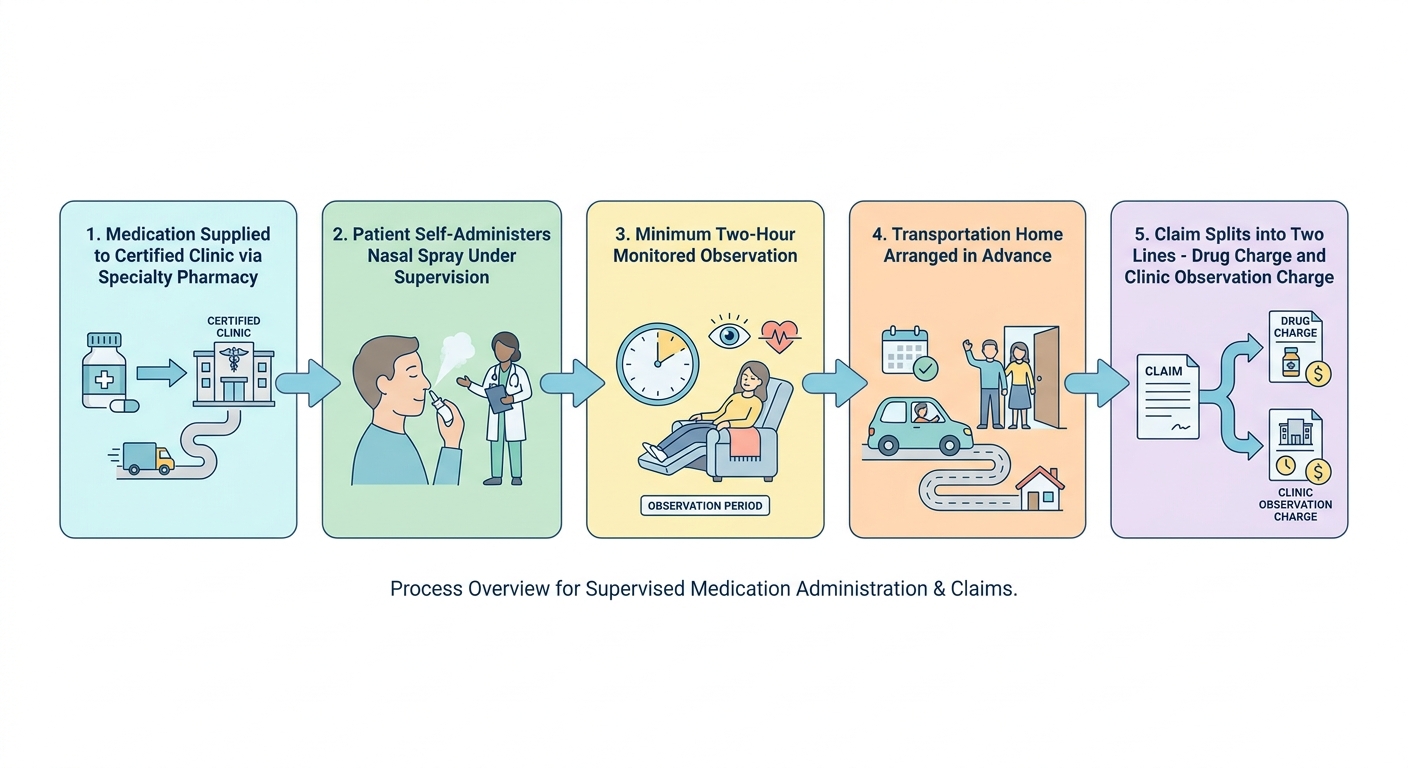
Here's how to avoid a surprise: before you book session one, ask the clinic for both numbers in writing.
- The medication charge — what the drug costs at your dose, and whether it's billed by the clinic or the specialty pharmacy
- The observation charge — the clinic's fee for the monitored two hours, per visit
- Which benefit each falls under — medical versus pharmacy, since deductibles may differ
- What changes at 84 mg — confirm whether a dose increase changes the medication line
⚠️ Ask for a written estimate covering the full induction phase. A quote for a single session can understate what the first month looks like, because induction is twice weekly.
Does Insurance Cover Spravato?
Yes — esketamine is FDA-approved for treatment-resistant depression, which makes it billable to insurance in a way that off-label treatments are not. Many commercial plans, Medicare, and some state Medicaid programs cover esketamine for treatment-resistant depression, though prior authorization is typically required; coverage varies by plan.
Treatment-resistant depression (TRD) refers to major depressive disorder that has not responded adequately to prior antidepressant treatment. The National Institute of Mental Health notes that depression is treated with medication, psychotherapy, or a combination, and that people respond differently to different approaches — which is precisely why payers want a documented history before approving a REMS-restricted drug.
Payer policies vary, but the criteria insurers commonly build their reviews around track the label's approved use:
- A confirmed diagnosis of major depressive disorder
- Documented inadequate response to prior antidepressants at an adequate dose and duration in the current episode
- A concurrent oral antidepressant, since the FDA label specifies esketamine is used in combination with one
- Treatment at a REMS-certified site, because administration outside one isn't permitted
- Prescriber attestation that monitoring and transportation requirements will be met
The label also covers use in depressive symptoms in adults with major depressive disorder who have acute suicidal ideation or behavior, alongside oral antidepressant therapy. Whether your plan treats that as a separate authorization pathway is plan-specific.
For a deeper walkthrough of eligibility and local cost structure, see our guide to esketamine and Spravato insurance, cost and who qualifies. Whether esketamine is appropriate for you is a clinical decision made in consultation, not something a coverage policy decides on its own.
Key takeaway: Insurers rarely deny esketamine because the drug isn't covered — they deny it because the file doesn't yet prove the criteria were met.
What Does Prior Authorization Actually Require?
A prior authorization is a request your prescriber submits asking the plan to approve coverage before treatment begins. Prior authorization is a payer review process that confirms a requested treatment meets the plan's medical-necessity criteria. For esketamine, the packet is mostly history: your diagnosis, your prior medication trials, and your current prescription.
The sequence usually looks like this:
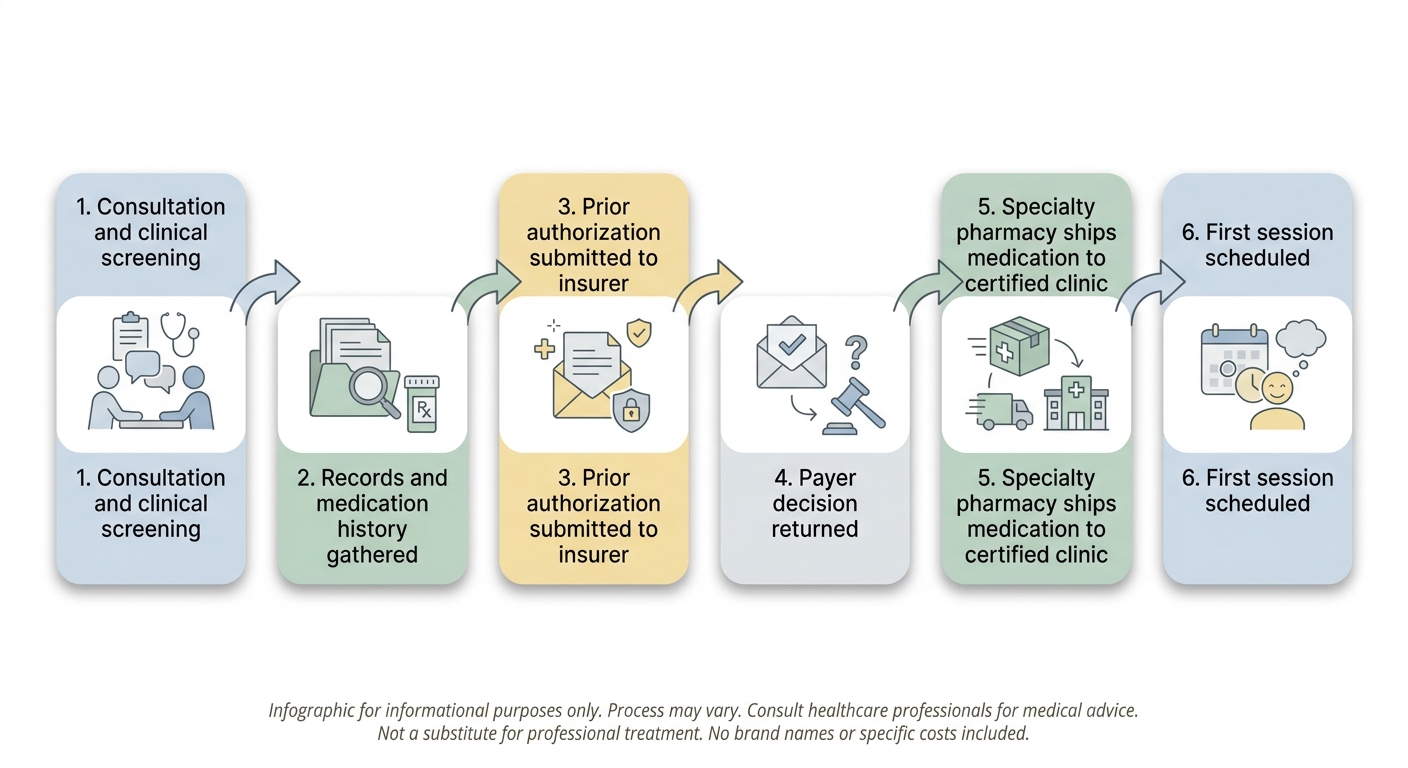
Decision turnaround is set by your plan and by state rules, so ask your clinic what window your insurer works to rather than assuming. Expedited review may be available when a prescriber documents urgency.
Documents to bring to your first consult:
- A written medication list — every antidepressant you've tried, the dose, and roughly how long you stayed on it
- Pharmacy fill history — easy to request from your pharmacy, and often the fastest way to prove duration
- Chart notes or records from previous prescribers, including any psychiatric hospitalizations
- Depression rating scores such as PHQ-9 results, if a prior provider recorded them
- Your current oral antidepressant prescription details
- Insurance card and plan documents, including your deductible status for the year
The weakest link is almost always the second medication trial. People remember trying something years ago but have no record of the dose or how long they took it. A pharmacy printout usually solves it. For eligibility details specific to this area, see who qualifies for Spravato in Boise and Eagle.
Key takeaway: The most common cause of an esketamine denial is incomplete documentation of a prior antidepressant trial — not actual ineligibility.
How Does Coverage Work in Idaho Specifically?
In Idaho, the practical questions are which benefit your plan processes esketamine under, whether your deductible has been met, and whether the clinic is REMS-certified. Because the spray is administered in a certified setting rather than picked up and used at home, plans frequently process it through the medical benefit rather than the pharmacy benefit — but confirm which applies to yours, since that determines which deductible and which copay structure you hit.
| Plan type | Common benefit pathway | What drives your cost | PA required? |
|---|---|---|---|
| Employer commercial plan | Often medical benefit | Copay or coinsurance after deductible | Nearly always |
| Individual marketplace plan | Often medical benefit | Deductible status early in the year | Nearly always |
| High-deductible health plan | Medical benefit | Full contracted rate until deductible is met | Nearly always |
| Medicare | Depends on how the plan processes clinic-administered drugs | Coinsurance; supplemental coverage may apply | Usually |
| Idaho Medicaid | State program rules | Program-set cost sharing | Usually |
| Uninsured / cash pay | N/A | Clinic's cash rate plus any assistance you qualify for | N/A |
The January problem is real for Treasure Valley patients on deductible-first plans. If induction starts in early January, those eight first-month sessions may land before your deductible is satisfied — meaning your highest-volume month is also your highest-cost month. Starting later in a plan year can look very different. Ask your clinic to model both.
Patients traveling in from Nampa, Caldwell, Meridian, and Boise should confirm certification before assuming coverage applies, since the label restricts administration to certified settings. You can review how Spravato treatment in Boise and Eagle is structured, or read more on esketamine in Boise for treatment-resistant depression.
⚠️ A plan can cover esketamine and still deny your claim if it was administered at a site that isn't REMS-certified. Verify certification first.
Esketamine vs IV Ketamine: Which Costs Less Out of Pocket?
For insured patients, esketamine is usually the lower out-of-pocket option — because it's FDA-approved and therefore billable. IV ketamine for depression is used off-label; StatPearls notes ketamine's approved indication is as an anesthetic agent, with a range of off-label uses including depression. Off-label generally means cash-pay, which puts the entire cost on you regardless of how good your insurance is.
| Factor | Esketamine nasal spray | IV ketamine infusion |
|---|---|---|
| FDA status for depression | Approved for treatment-resistant depression | Used off-label |
| Typical payment route | Billed to insurance after prior authorization | Usually cash-pay |
| Administration setting | Certified site, self-administered under supervision | Clinic, IV administered by staff |
| Monitoring required | At least two hours post-dose, per FDA label | Clinic protocol-dependent |
| Required co-treatment | Taken with an oral antidepressant | Not specified by an FDA label |
| Who it tends to suit | Insured patients who meet TRD criteria | Patients who are denied, uninsured, or not label-eligible |
The flip happens when coverage doesn't. If your prior authorization is denied and you're paying cash either way, the comparison becomes a straight price-per-course question between two cash rates — and the answer depends entirely on the clinic's pricing, not on which drug is "cheaper" in general. Get both quotes in writing and compare the full course, not the single session.
Dose control is the other practical difference. Infusions are titrated by the clinician in real time; nasal dosing uses fixed device strengths. For the clinical side of that comparison, see our guide to IV ketamine versus esketamine protocols and costs.
Key takeaway: Insurance status, not drug choice, is the biggest single factor in your esketamine nasal spray cost.
What Can You Do If Your Claim Is Denied?
Treat a denial as a first draft, not a verdict. Most are administrative, and plans build appeal rights into the process. The key is moving quickly, because appeal windows are finite and printed on the denial letter.

The five-step appeal sequence:
- Get the denial reason in writing. Verbal explanations aren't appealable. You want the specific criterion the plan says wasn't met.
- Fill the documentation gap. If the issue is a missing medication trial, pull the pharmacy fill history and prior chart notes.
- Request a peer-to-peer review. This puts your prescriber on the phone with the plan's reviewing clinician — often the fastest route to a reversal.
- File the formal appeal within the window stated on your denial letter, and keep copies of everything you send.
- Layer in financial assistance while the appeal runs, so treatment isn't gated on the outcome alone.
On assistance: the manufacturer publishes its own savings and support program terms, including options for patients without coverage, on its patient support site. Eligibility rules are set by the manufacturer and change over time — manufacturer copay programs also commonly exclude people with government insurance such as Medicare or Medicaid. Verify the current terms directly rather than relying on any third-party summary. Independent charitable foundations that assist with medication costs are another avenue worth asking your clinic about.
If you're still mapping out logistics and pricing generally, our ketamine cost, safety and process FAQ covers the common next questions.
Frequently Asked Questions
Which insurance plans cover Spravato treatment?
Many major commercial carriers, Medicare, military and veterans' benefit programs, and some state Medicaid programs, including Idaho Medicaid, may cover esketamine, though coverage varies by plan. The catch is that coverage at the plan level doesn't guarantee approval at the patient level — nearly every payer requires prior authorization with documented treatment history first. Ask your clinic to run a benefits verification using your member ID rather than relying on a general carrier list.
How much does esketamine nasal spray cost per month with insurance?
It varies more by month than most people expect. Month one includes eight sessions under the twice-weekly induction schedule in the FDA label, while later months taper to weekly or every two weeks. With coverage, your monthly figure comes down to your copay or coinsurance per visit multiplied by that visit count — plus anything still owed toward your deductible.
Can you get esketamine for free?
Not free, but assistance exists. The manufacturer operates patient support and savings programs with published eligibility rules, and independent charitable foundations sometimes help with medication costs. Federal rules generally keep people with government insurance, such as Medicare or Medicaid, out of manufacturer copay programs. Confirm current eligibility terms directly with the program before counting on them.
What disqualifies you from Spravato treatment?
The FDA label lists contraindications including aneurysmal vascular disease, arteriovenous malformation, a history of intracerebral hemorrhage, and hypersensitivity to esketamine or ketamine. There are practical barriers too: you must be able to stay for at least two hours of monitoring and arrange a ride home, since driving isn't permitted until the next day. Our guide to who qualifies for Spravato in Boise and Eagle covers screening in more detail.
Is esketamine cheaper than staying on antidepressants?
Per prescription, no — generic oral antidepressants are inexpensive by comparison. But that's not the decision most readers are actually facing. If two or more antidepressants have already been tried without adequate response, the honest comparison is between continuing an approach that hasn't worked and adding a treatment your plan may cover. Esketamine is also taken alongside an oral antidepressant, not as a replacement for one.
Your Next Step: Get a Real Number Before You Commit
The only reliable esketamine nasal spray cost is the one calculated against your plan, your deductible status, and your clinic's billing structure. Everything else is an estimate built from someone else's coverage.
What we covered: the price splits into a medication charge and a monitored observation charge, the FDA-set schedule front-loads sessions into month one, and insurance approval turns on documented prior antidepressant trials rather than diagnosis alone. Get both charges in writing, confirm whether your plan runs it through the medical or pharmacy benefit, and check where your deductible stands before you schedule.
Cost confusion keeps a lot of people out of care they already qualify for. If you'd rather start with a number than a guess, talk to the team in Eagle, Idaho and we'll verify your benefits first. Whether esketamine is right for you is a clinical decision made together in consultation, and individual circumstances vary.
Information about third-party platforms reflects publicly available details at the time of writing and may have changed. Please verify directly with the provider. See our Terms of Use for more.