IV Hydration Near Me in Meridian: How to Pick a Drip
Zora Neuro Spa Editorial · November 8, 2026

Searching for IV hydration therapy near me in Meridian returns a confusing mix of mobile vans, drip lounges, and medical clinics — all showing similar menus at wildly different prices. The difference that matters isn't the bag. It's who screens you, who places the line, and who is standing there if something goes sideways.
Quick Answer
IV hydration therapy near Meridian, Idaho comes from three provider models: medically supervised clinics in the Eagle and Boise corridor, mobile IV services that travel to your home or hotel, and walk-in drip lounges. All three can deliver fluid and electrolytes into a vein. The deciding factor is clinical oversight — who reviews your health history, who places the catheter, and what happens if you react. Ask that before you ask about price.
TL;DR
- Three provider types serve the Meridian area, and they differ more in supervision than in ingredients. Compare the three provider models
- Most drips start with the same base fluid. The add-ons are where menus — and marketing — diverge. See what's actually in the bag
- For mild dehydration, water and oral electrolytes are the first-line option. IV therapy's real advantage is bypassing a stomach that can't hold fluids down. Read the honest water comparison
- Price quotes vary by formula, setting, and travel fees — get the full total before anyone opens a kit. Understand what's bundled into the price
- Vet the provider in seven checks before you book anything. Use the safety checklist
In This Article
A quick map of what's ahead, so you can jump to the part you need.
- What Types of IV Hydration Providers Are Near Meridian?
- What's Actually in a Hydration Drip?
- Is IV Hydration Better Than Just Drinking Water?
- What Does IV Hydration Therapy Near Me Cost in the Meridian Area?
- How Do You Vet a Safe IV Provider? A 7-Point Checklist
- Who Is a Good Candidate — and Who Should Skip It?
- What Happens During a Session, Start to Finish?
- How Do You Book a Meridian IV Appointment This Week?
What Types of IV Hydration Providers Are Near Meridian?
Three models operate within a short drive of downtown Meridian: medically supervised clinic infusions, mobile IV services that come to you, and retail drip lounges with walk-in hours.
IV hydration therapy is the delivery of sterile fluid and electrolytes directly into a vein through a small catheter, bypassing the digestive tract. The base fluid is usually an isotonic solution — one balanced to match the salt concentration of your blood.
| Model | Setting | Supervision | Best for |
|---|---|---|---|
| Clinic infusion | Fixed treatment room | On-site licensed clinician under medical direction | First-time patients, anyone with a health history to review |
| Mobile IV service | Home, hotel, office | Travels with the clinician; backup is off-site | Convenience when you can't drive or leave the house |
| Drip lounge | Retail storefront | Varies by location | Repeat customers who already know their formula |
Clinic-based care is the most conservative choice because everything happens in one controlled room. Supplies are stocked, a medical director's standing orders govern what can be given, and emergency equipment is a few steps away rather than in a vehicle.
Mobile Meridian IV services solve a real problem: when you're too wiped out to drive, having a nurse come to you is the difference between getting fluids and not getting them. The trade-off is that backup support is wherever the clinician left it.
For readers who want the clinic route, our Eagle location sits a short drive up Eagle Road from Meridian and offers Quench hydration IV therapy in a quiet, supervised treatment room.
Key takeaway: The three Meridian-area models deliver similar fluids — what separates them is how much clinical structure surrounds the needle.
What's Actually in a Hydration Drip?
Nearly every hydration drip starts with the same thing: a sterile isotonic fluid such as normal saline or lactated Ringer's. Everything printed above that on the menu is an add-on.
| Component | What it is | How to think about it |
|---|---|---|
| Isotonic base fluid | Sterile salt-and-water solution matched to blood | The core of any hydration drip |
| Electrolytes | Sodium, potassium, chloride, sometimes calcium | Replaces what's lost through sweat, vomiting, or diarrhea |
| B-complex / B12 | Water-soluble vitamins | Commonly added; ask the clinic what it's intended to support |
| Magnesium | Mineral additive | Often requested for cramping; discuss with the clinician |
| Vitamin C and zinc | Antioxidant and trace mineral | Common in immunity formulas; benefits vary by person |
Be skeptical of any menu that promises a specific physiological outcome from an add-on. A reputable provider will describe what a formula contains and what it's intended to support, not guarantee how you'll feel afterward.
If you want the deeper mechanism — how fluid moves from the bag into your tissues, and which situations actually call for it — we cover how IV hydration therapy works and who it helps in a separate explainer. This article stays narrower: picking a provider.
Curious about the vitamin C and zinc formulas specifically? We break down what's in an immunity IV bag ingredient by ingredient, including what each one is and isn't for.
Is IV Hydration Better Than Just Drinking Water?
For mild dehydration in an otherwise healthy adult, drinking water with an oral electrolyte mix is the sensible first move. It costs almost nothing, requires no appointment, and carries no infection risk.
IV therapy earns its place in a narrower situation: when your gut isn't cooperating. If you're vomiting, nauseated, or simply can't keep fluids down, oral rehydration stops being an option. An IV bypasses the stomach entirely.
The second honest advantage is pace. Fluid delivered into a vein enters circulation directly rather than waiting on digestion and absorption. That's a mechanism difference, not a promise about how quickly you'll feel better.
⚠️ If you're dehydrated enough to be dizzy, confused, or unable to keep down water for more than a day, that's an urgent care or emergency room situation — not a wellness drip.
Key takeaway: Water wins on cost and convenience. An IV wins when the digestive route is closed.
What Does IV Hydration Therapy Near Me Cost in the Meridian Area?
Pricing in the Treasure Valley is quoted per bag, and it varies by formula, setting, and provider. Rather than trusting a range you read online, ask for the all-in total before anyone opens a sterile kit.
Here's what typically sits inside — and outside — a quoted price:
| Usually bundled | Usually extra |
|---|---|
| Clinician time and catheter placement | Additional vitamin or mineral add-ons |
| Base fluid and standard supplies | Mobile travel or after-hours fees |
| Brief intake and vitals check | Repeat-visit packages or memberships |
| Post-infusion observation | Anti-nausea or other prescription medications |
Two cost questions catch people off guard. First, add-on pushes at the chair: you booked a basic recovery drip, and the menu grows once you're seated. Second, travel fees for mobile visits, which are sometimes quoted separately from the bag itself.
Insurance and elective hydration: wellness IV therapy is generally treated as elective and is rarely covered. Medically necessary fluids ordered in a clinical or emergency setting are a different category. HSA and FSA eligibility usually depends on having a documented medical reason, so check with your plan administrator before assuming.
You can review formulas and what each includes on our IV nutrition therapy in Eagle, Idaho page, which lists the drips we offer and what goes into each one.
How Do You Vet a Safe IV Provider? A 7-Point Checklist
Verify licensure, oversight, screening, sterility, and emergency readiness — in that order — before you book. These seven checks take about five minutes on the phone.
- A licensed clinician places the line. Ask directly whether an Idaho-licensed RN, paramedic, or advanced practice provider is performing the stick.
- There's a named medical director. A medical director is the licensed physician or nurse practitioner who writes the standing orders that govern what the clinic may administer.
- You get a real intake screening. A short health history should cover kidney function, heart conditions, blood pressure, allergies, and pregnancy.
- Supplies are single-use and opened in front of you. Sealed catheter, fresh tubing, new bag. No exceptions.
- Additives come from a reputable, properly licensed source. Ask where compounded ingredients are sourced and how they're stored.
- There's an emergency protocol on site. Specifically: what the provider does if you have an allergic reaction, and whether epinephrine is available.
- Pricing is transparent before the line goes in. You should know the total — including add-ons and fees — before you sit down.
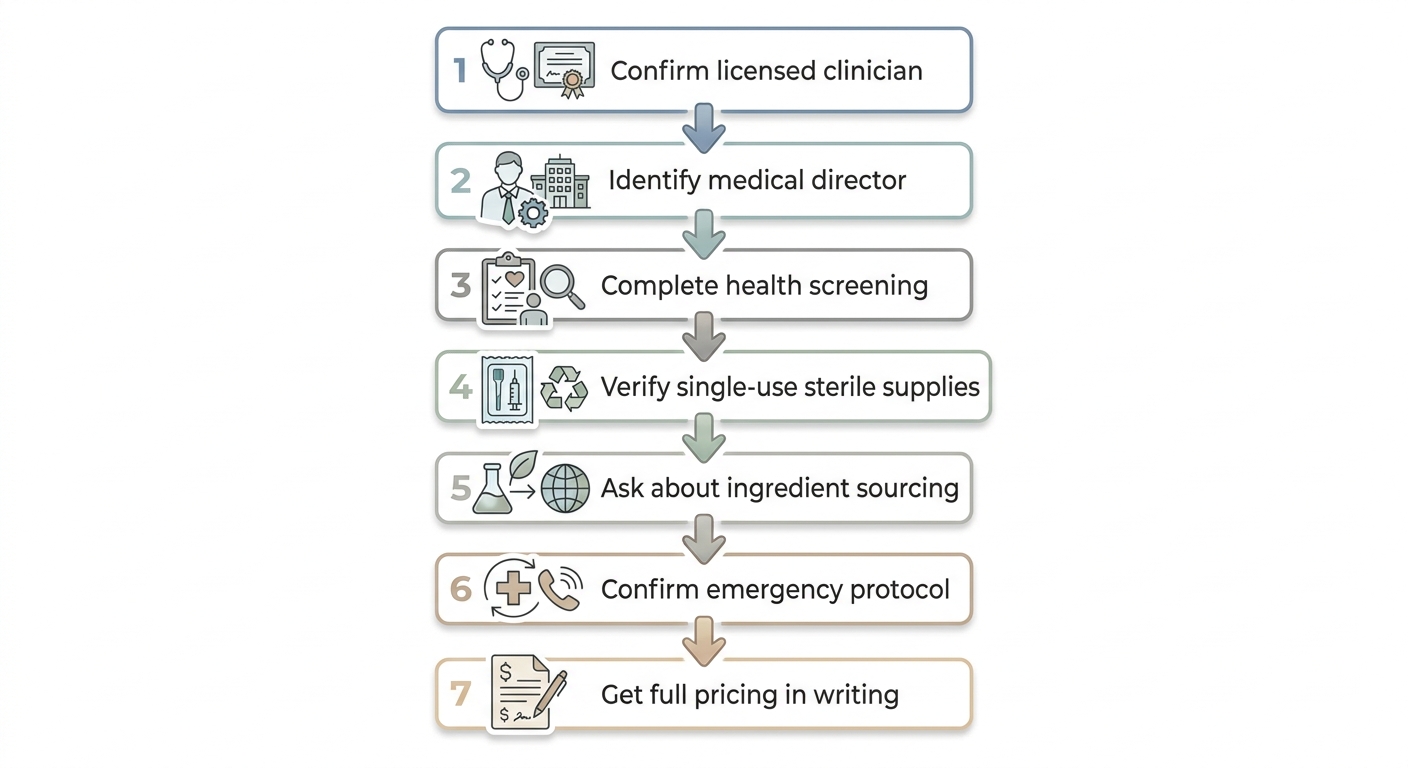
A provider who answers all seven without hesitation is a provider who has thought about safety. One who deflects on the medical director question is telling you something.
⚠️ Be cautious with any clinic that offers infusion formulas without reviewing your medical history first. Screening isn't paperwork — it's how contraindications get caught.
Who Is a Good Candidate — and Who Should Skip It?
Good candidates are generally healthy adults dealing with acute fluid loss: a stomach bug, heat exhaustion after a July ride on the Greenbelt, depletion following a hard effort, migraine with vomiting, or travel fatigue after a long flight into Boise.
A contraindication is a medical reason not to receive a treatment. For IV hydration, the common ones include:
- Congestive heart failure or other conditions involving fluid overload
- Chronic kidney disease or reduced kidney function
- Uncontrolled high blood pressure
- Any physician-ordered fluid restriction
- Pregnancy, without clearance from your OB
- Known allergy to a proposed additive
If any of those apply to you, talk to your primary care provider before booking — not after.

Dehydration tied to migraine or muscle cramping is a common reason people look for a Meridian IV appointment. If that's your situation, the Alleviate IV formula breakdown explains what that particular drip contains and who it's designed for.
What Happens During a Session, Start to Finish?
Plan for a single-sitting appointment: check in, get set up, sit through the drip, and go. Here's the sequence.
- Intake and vitals. Health history review, blood pressure, pulse.
- Vein assessment. The clinician checks both arms and picks the best access point.
- Catheter placement. One brief pinch, then the needle is withdrawn and a soft catheter stays behind.
- Drip rate set. The clinician adjusts flow based on the bag and how you're doing.
- Monitoring. You stay seated. Say something immediately if you feel burning at the site, chest tightness, or itching.
- Flush, removal, bandage. The line comes out, pressure is held, and you're done.
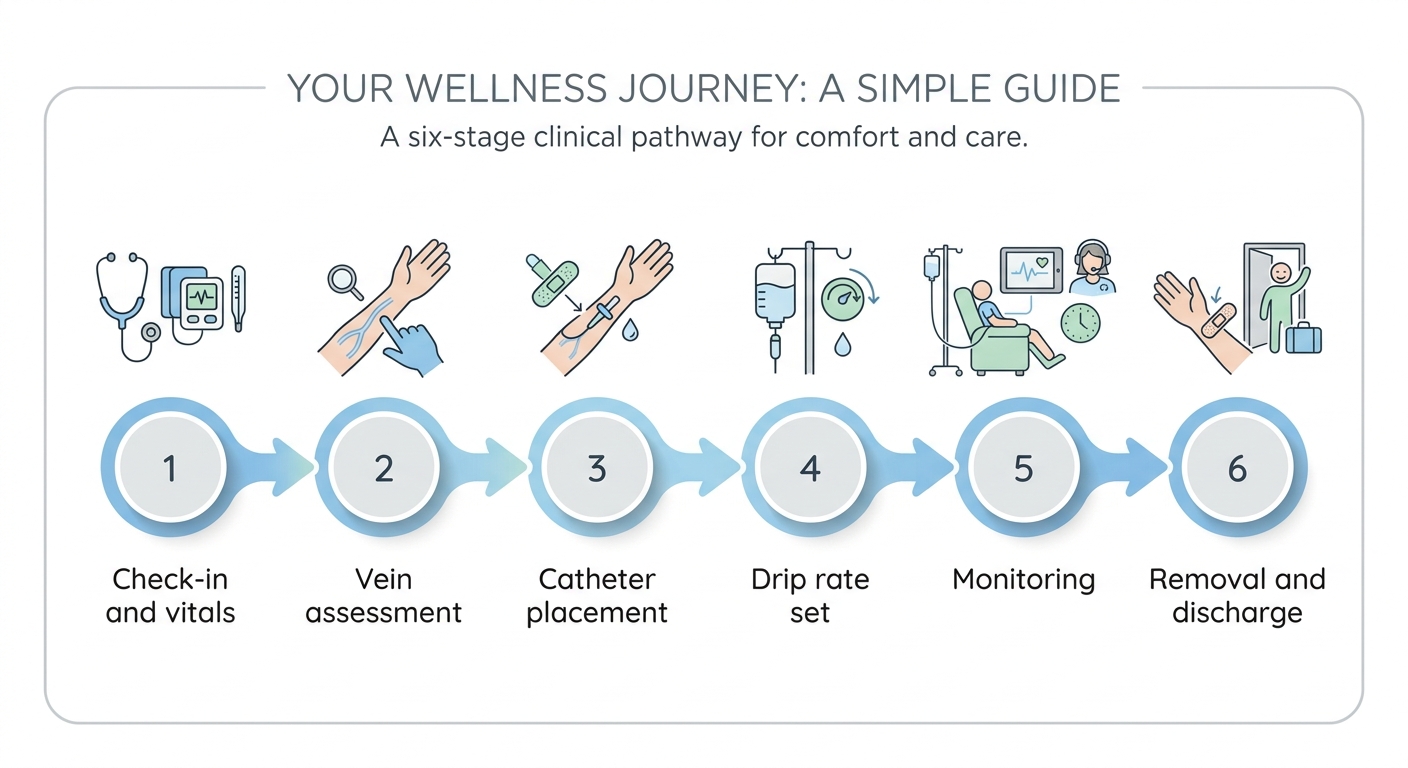
Two sensations surprise first-timers. Many people notice a cool feeling moving up the arm as room-temperature fluid enters the vein. Some also report a brief metallic or vitamin-like taste when B vitamins are included. Both are commonly described and typically pass.
For plain hydration with no sedating medication involved, driving yourself home afterward is generally fine. Confirm with your provider, since that answer changes if anything else is added.
How Do You Book a Meridian IV Appointment This Week?
Call or submit a request form, complete a short health history, and ask when the next opening is. Many Treasure Valley providers can accommodate requests within a few days, though availability varies.
Before your visit:
- Drink a glass of water. Well-hydrated veins are easier to access.
- Eat something light. An empty stomach makes some people lightheaded in the chair.
- Wear short sleeves. Or something you can push up past the elbow comfortably.
- Bring your medication list. Including supplements.
- Allow drive time. From Meridian, the Eagle corridor is a short hop up Eagle Road; downtown Boise is a bit farther east.
When you're ready, you can request an appointment and we'll walk you through the intake before you ever sit down.
Key takeaway: Booking is simple — the preparation that matters is hydrating beforehand and being honest on your health history.
Frequently Asked Questions
These are the questions we hear most often from people comparing IV hydration options around Meridian, Eagle, and Boise.
How long does IV hydration last in your body?
Fluid delivered intravenously distributes through your circulation and tissues over a period of hours, and your kidneys clear whatever your body doesn't need. How long you subjectively feel better depends heavily on how depleted you were and what caused the depletion. Results vary between individuals, and a drip doesn't address an ongoing cause of fluid loss.
Does insurance cover IV hydration therapy in Idaho?
Elective wellness hydration is generally not covered by insurance, because it isn't ordered for a diagnosed medical condition. Medically necessary IV fluids given in an emergency room or clinical setting fall under different rules and may be billable. HSA and FSA eligibility usually requires a documented medical reason, so confirm with your plan administrator before you assume the expense qualifies.
Are mobile IV services as safe as a clinic?
A mobile service staffed by licensed clinicians working under physician oversight, carrying emergency medications, can be a reasonable option. The structural difference is backup: a clinic has supplies, staff, and equipment on site, while a mobile visit has whatever came in the vehicle. Run the seven-point vetting checklist on either one before booking.
How often is it safe to get an IV drip?
For most healthy adults, occasional use is reasonable. A standing weekly drip is rarely necessary, and if you feel you need one, that's worth investigating with a physician rather than managing with fluids. Repeated high-dose vitamin additives can accumulate, particularly fat-soluble ones, so discuss frequency with the clinician who knows your history.
How long does an IV hydration appointment take?
Most hydration visits run as a single sitting: a short intake and vitals check, catheter placement, the infusion itself, then removal and a bandage. The drip portion is the longest stretch, and the exact time depends on the bag volume and the rate your clinician sets. Ask the provider for their typical appointment window when you book, so you can plan the rest of your day.
Does an IV drip help with exercise recovery?
An IV can replace fluid and electrolytes lost through heavy sweating, which is the same thing oral rehydration does — just through a different route. If you tolerate drinking, water with an electrolyte mix is the cheaper first step after a hard effort. A recovery drip makes more sense when you're nauseated, cramping, or genuinely unable to rehydrate by mouth. It isn't a substitute for sleep, food, or sensible training.
What should I look for in an IV therapy menu before I book?
Look for plain descriptions of what's in each bag, clear pricing that includes add-ons, and language that describes what a formula is intended to support rather than guaranteeing a result. A menu that names its base fluid and lists each additive is easier to evaluate than one selling outcomes. If you can't tell what's in a drip from the description, call and ask before you reserve the slot.
Summary
Picking the right provider when you search IV hydration therapy near me in Meridian comes down to four questions: who supervises the infusion, what's actually in the bag, what the full price includes, and whether you're a safe candidate. The ingredients are largely interchangeable across Meridian IV providers — the clinical structure around them is not.
Start with the vetting checklist. If a provider can't name a medical director or won't quote a total before the catheter goes in, keep looking. Whether you need a simple recovery drip after exercise recovery, illness, or travel, the right IV therapy visit should feel unhurried, screened, and clearly explained.