Ketamine Treatment Cost and Prep: The Day-Before Budget
Zora Neuro Spa Editorial · November 19, 2026
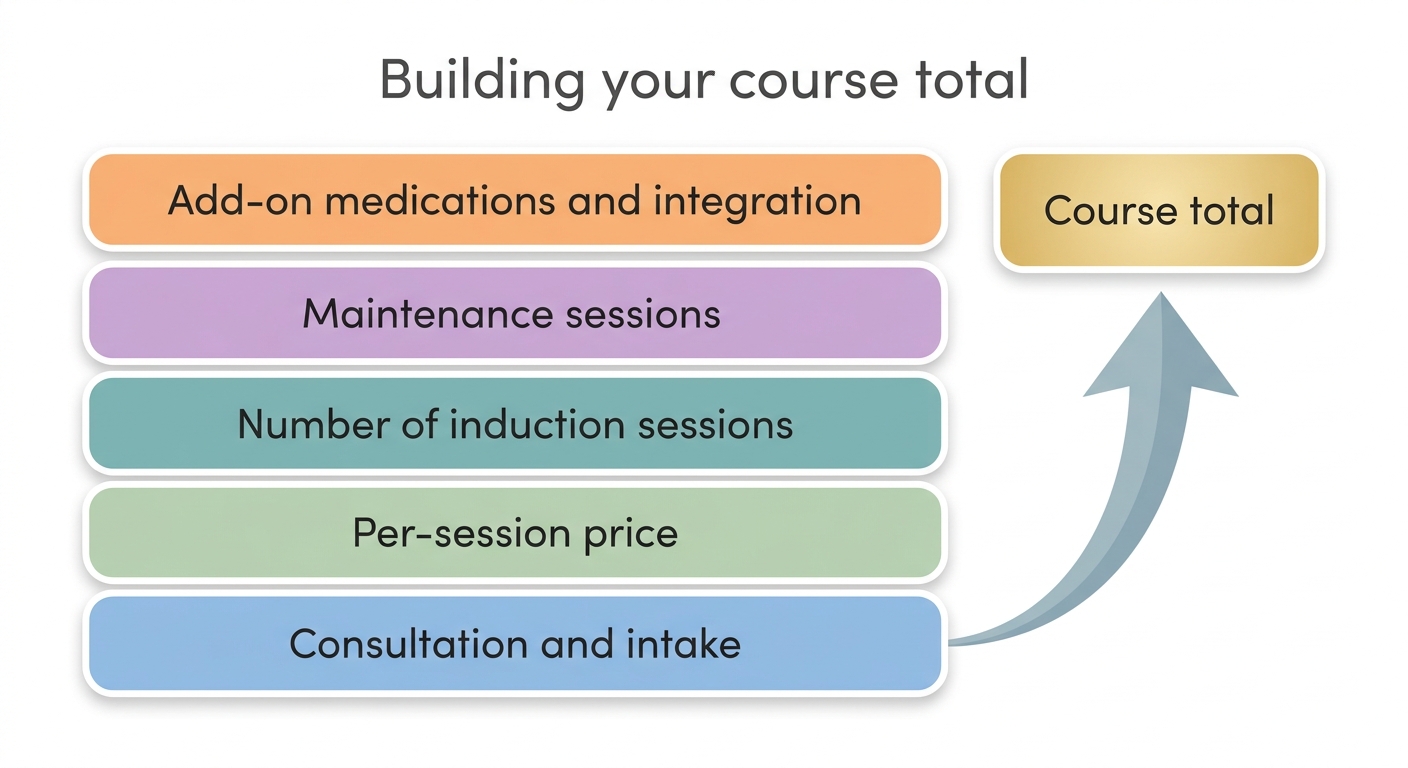
You have already decided on ketamine. What you need now are two things on the same page: a realistic picture of the full ketamine treatment cost before you hand over a card, and a precise plan for the 48 hours before your first infusion. This is the booking-day version — a budget worksheet and a night-before protocol, written for people in Boise and Eagle who are scheduling, not browsing.
Quick Answer
Ketamine treatment cost is built from two numbers, not one: the per-session price your clinic quotes, and the number of sessions in your course. Ask for both in writing, then add the four items most price lists omit — consultation, maintenance sessions, integration time, and anti-nausea medication. On the prep side, the rules that matter most are simple: follow the exact fasting window your clinic gives you, arrange a confirmed adult driver, and tell your prescriber about every medication and supplement you take. Costs, protocols, and candidacy are all decided in a clinical consultation, and they vary between individuals.
TL;DR
- Course cost, not session cost, is the real number. Multiply the quoted per-session price by the planned number of infusions before you compare clinics. See how the pricing structures compare
- Four line items are routinely left off the price list. Intake fees, maintenance sessions, integration support, and add-on medications. Review the questions to ask when you call
- IV ketamine for depression is off-label; Spravato is FDA-approved. That single difference drives most of what insurance will and won't touch. Understand the coverage split
- The week before is about logistics, not heroics. Confirm the ride, review medications, protect sleep. Walk the seven-day countdown
- Two things cancel a session on arrival: eating inside the fasting window and showing up without a driver. Check the reschedule triggers
In This Article
- What Does Ketamine Treatment Cost in 2026?
- Which Costs Do Clinics Leave Off the Price List?
- Does Insurance, HSA or FSA Cover Any of It?
- How Should You Prepare in the 7 Days Before an Infusion?
- What Are the Fasting Rules Before a Ketamine Infusion?
- Which Medications and Supplements Should You Flag First?
- How Do You Prepare Mentally for a Ketamine Session?
- What Are the Logistics on the Day?
- What Should Make You Reschedule?
- Summary
- Frequently Asked Questions
What Does Ketamine Treatment Cost in 2026?
Ketamine treatment cost depends far more on the delivery format than on the city you live in. Four formats dominate, and each is priced on a different logic — per infusion, per administration plus drug, per bundled therapy hour, or per month. Comparing a single session price across those formats tells you almost nothing.
Induction course refers to the initial cluster of sessions scheduled close together to establish whether you respond. Maintenance refers to the spaced-out sessions that may follow. Your total is induction plus maintenance, not a single appointment.
| Treatment type | How it's usually priced | Course shape | Billed to insurance? | On-site monitoring |
|---|---|---|---|---|
| IV ketamine infusion | Flat cash price per infusion | Induction series, then spaced maintenance | Rarely — off-label for depression | Yes, in-clinic |
| Spravato (esketamine) nasal spray | Drug cost plus a separate administration and observation charge | Induction phase, then a maintenance phase set by the prescriber | Often submitted to commercial plans and Medicare | Required — at least 2 hours of monitoring per the FDA prescribing information |
| Ketamine-assisted psychotherapy | Per session, with a therapist's time bundled in | Fewer, longer sessions | Therapy portion sometimes billable | Yes, in-clinic |
| At-home oral or telehealth programs | Monthly subscription | Recurring monthly cycles | Rarely | No in-person monitoring |
A standard session of IV ketamine therapy in Boise and Eagle covers the medication, the IV placement, the chair, and continuous monitoring by clinical staff. That monitoring matters clinically as well as financially: ketamine can transiently raise blood pressure and heart rate and can cause nausea or dissociation, which is why supervised administration is the standard described in the clinical literature on ketamine.
Build your estimate like this:
- Ask for the per-session price in writing.
- Ask how many sessions the initial course is expected to include.
- Multiply.
- Ask what the maintenance interval typically looks like for your condition.
- Add the four hidden items in the next section.
For protocol-level detail on how infusion schedules are structured by condition, the full 2026 cost and protocol guide goes deeper than this planner does.
Key takeaway: A low per-session price attached to a long course can cost more than a higher price attached to a short one. Always compare course totals.
Which Costs Do Clinics Leave Off the Price List?
The sticker price typically covers the chair and the medication — not the five things arranged around them. These are the items that turn a tidy estimate into a surprise.
- Consultation or intake fee — Some clinics fold this into the first session; others bill it separately. Ask which.
- Psychiatric evaluation or records review — Reviewing prior medication trials takes clinician time, and that time is sometimes a separate charge.
- Maintenance sessions — Budget for them from day one. They are part of the plan, not an exception to it.
- Integration support — A structured conversation after dosing. Sometimes included, sometimes billed per hour.
- Anti-nausea medication — Nausea is a recognized adverse effect of ketamine, so clinics often offer a pre-medication. Ask whether it's bundled.
- No-show and reschedule fees — These can be the most expensive line item of all if you cancel on arrival.

What exactly should you ask when you call?
Read these six questions straight off the page:
- What is the per-session price, and what is included in it?
- How many sessions are in the initial course for my condition?
- Is the consultation billed separately?
- What does maintenance usually look like after the initial course?
- Are anti-nausea medication and IV supplies extra?
- What is the cancellation window and fee?
⚠️ Be careful with prepaid "packages." If the package expires before you reach the maintenance phase, you may pay twice for the same stretch of treatment. Ask for the expiry date in writing before you buy.
At our clinic, the consultation is where this entire worksheet gets filled in for your situation — the quoted course, the add-ons, and the schedule — so you leave with numbers rather than ranges.
Key takeaway: Course cost, not session cost, is the real number. Everything above either adds to it or hides inside it.
Does Insurance, HSA or FSA Cover Any of It?
IV ketamine for depression is used off-label, which is the main reason most plans decline to cover the drug or the infusion itself. Some adjacent services may still be billable — the office visit, a psychiatric evaluation, and in some cases the clinical assessment time. That varies by plan and by clinic.
Spravato sits in a different category. It is FDA-approved for treatment-resistant depression in adults when used with an oral antidepressant, and it is available only through a restricted distribution program with required in-clinic observation, per the FDA prescribing information. Because it is approved and administered under that program, it is routinely submitted to commercial plans and Medicare. The specifics of eligibility, prior authorization and documentation are covered in our guide to Spravato insurance coverage and qualification rules.
Three practical routes are worth asking about:
- HSA and FSA funds — Generally usable for qualified medical expenses. Ask your administrator what documentation they require, and whether a letter of medical necessity from your prescriber helps.
- Superbills — An itemized receipt you submit yourself for possible out-of-network reimbursement. Reimbursement is never guaranteed.
- Payment plans — Ask whether the clinic offers one, and whether it carries interest.
⚠️ Never rely on a verbal coverage quote from a phone representative. Get the benefit confirmation, the authorization number and the patient-responsibility estimate in writing before your first appointment.
How Should You Prepare in the 7 Days Before an Infusion?
The week before is about stabilizing sleep, clearing your calendar and confirming logistics. Nothing dramatic is required — A missing ride is a common and avoidable reason a first session gets rescheduled..
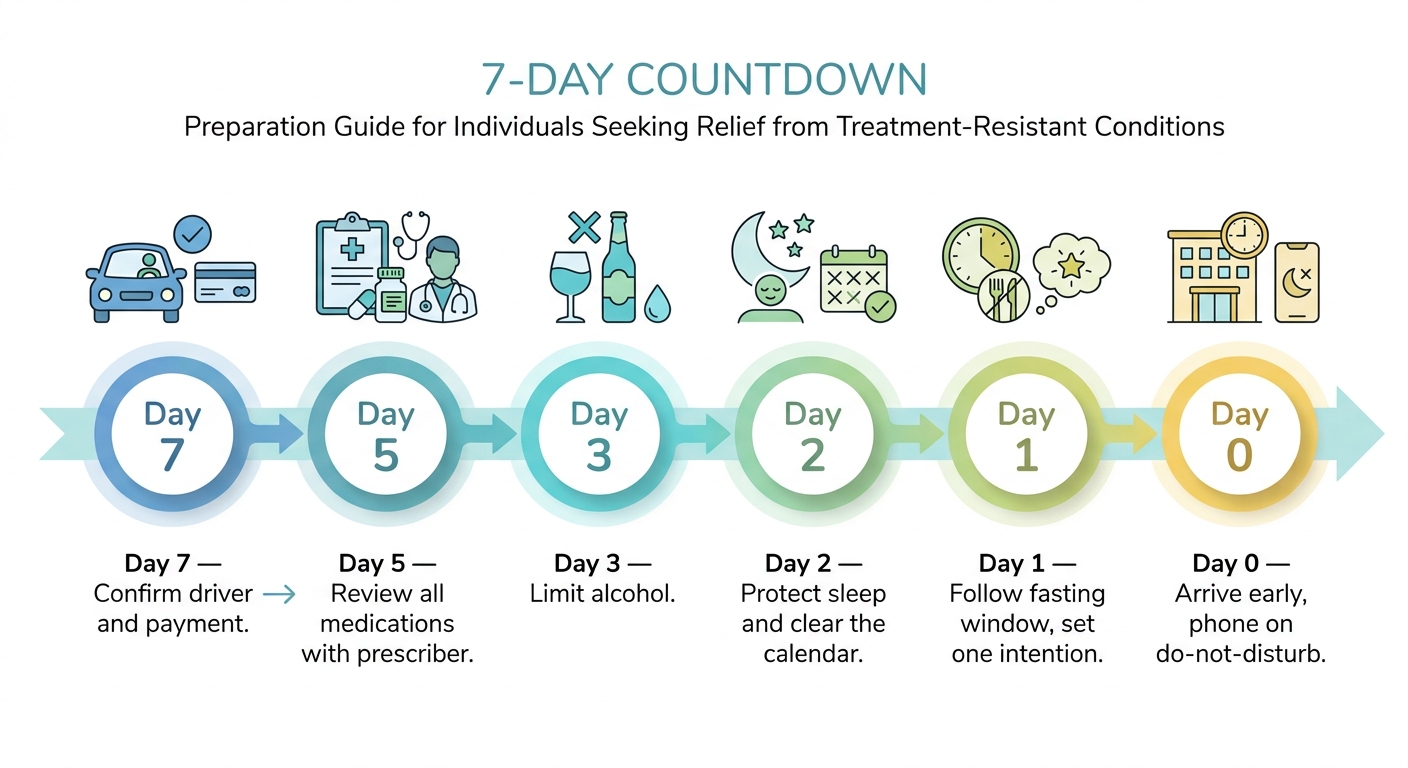
Days 7 to 5: lock the logistics
Confirm your driver by name, not by intention. Confirm your payment method and the exact amount due. Send your prescriber a complete list of every prescription, over-the-counter product and supplement you take — including doses and the time of day you take them.
Days 3 to 2: steady the inputs
Reduce alcohol. Alcohol disrupts sleep and complicates how you feel going in, and most clinics ask you to avoid it in the days immediately before a session. Protect your sleep window, and block the rest of treatment day on your calendar so you are not rushing back to anything.
Day 1: fasting, intention, and a packed bag
Confirm your fasting start time against your appointment time. Set out short sleeves and layered clothing. Decide on your one intention — more on that below — and put your phone's do-not-disturb schedule in place.
For a version you can print and stick on the fridge, use the printable 7-day preparation checklist. This section focuses on sequencing and logistics; that one is the task-by-task companion.
What Are the Fasting Rules Before a Ketamine Infusion?
Clinics follow standard pre-sedation fasting practice, and your clinic will give you an exact window measured from your appointment start time — not from when you walk in the door. Follow their numbers, not a number you read online.
NPO is the clinical shorthand for "nothing by mouth." The reason for it is straightforward: nausea and vomiting are recognized adverse effects of ketamine, as described in the clinical monograph on ketamine, and an empty stomach reduces risk if that happens while you are dissociated.
| Item | Usually treated as | Practical note |
|---|---|---|
| Solid food | Food — longest fasting window | Includes snacks and anything chewed |
| Milk, cream, protein shakes | Food, not a clear liquid | Catches people out with morning coffee |
| Black coffee, water, clear juice | Clear liquid — shorter window | Confirm the cut-off with your clinic |
| Chewing gum and hard candy | Varies by clinic | Ask rather than assume |
| Alcohol | Avoid in the days before | Ask your clinic for their specific guidance |
| Cannabis | Must be disclosed | Tell your prescriber about frequency and timing |
⚠️ If you ate inside the fasting window, call the clinic before you drive over. Rescheduling is cheaper and safer than being turned away at the door.
Which Medications and Supplements Should You Flag First?
Do not stop anything on your own. Bring the complete list and let the prescriber decide what, if anything, changes. Self-adjusting a psychiatric or cardiac medication before a session creates more risk than it removes.
Flag these first:
- Benzodiazepines — Timing of your most recent dose is a routine part of the pre-session conversation. Your prescriber will advise.
- Lamotrigine and other mood stabilizers — Commonly discussed when planning ketamine sessions. Report the dose and schedule.
- Blood pressure medication — Ketamine can transiently raise blood pressure and heart rate, so your baseline readings and your current regimen matter to the clinical team.
- Stimulants — Note the dose and whether you took it that morning.
- MAOIs and any recent medication changes — Including anything started or stopped in the past month.
- Supplements — High-dose magnesium, kava, St. John's wort and sleep aids all belong on the list.
The simplest method: photograph every bottle in your cabinet and bring the photos. It is faster than writing them out and it captures the exact dose on the label.
Your blood pressure, heart rate and oxygen levels are tracked throughout the session, which is part of how clinics screen and monitor during a session. Telling the team about a medication they didn't know about is never a problem; not telling them is.
Key takeaway: Bring the whole list, including supplements, and let the prescriber make the call. Nothing on this list is automatically disqualifying.
How Do You Prepare Mentally for a Ketamine Session?
Set one simple, non-demanding intention and stop there. Rigid expectations tend to create resistance during the session, and the goal of the hour is to allow the experience rather than steer it.
Workable intentions sound open:
- "I want to notice what's underneath the numbness."
- "I'd like to be curious instead of braced."
- "I'm willing to let this be whatever it is."
Less workable intentions sound like demands: "I need to be fixed today," or "I have to figure out my marriage during this infusion." Those set a pass-fail test on an experience that doesn't work that way.

Three small comfort decisions to make in advance:
- Music — Many clinics provide curated instrumental playlists. If sound matters to you, bring your own headphones and a playlist you already know.
- Eye mask — Reduces visual input and helps most people settle. Ask if one is provided.
- Breathing — Practice ten slow breaths a few times in the days before. It gives you something familiar to return to if you feel anxious at the start.
If the unknown is the part that worries you, read what the infusion itself actually feels like before your appointment. Experiences differ between individuals.
Key takeaway: One gentle intention beats a detailed agenda. You are preparing to allow an experience, not to perform one.
What Are the Logistics on the Day?
Block substantially more time than the infusion itself. Between check-in, vitals, the session and the post-session monitoring period, treatment day is a half-day commitment — plan your ride, your work schedule and your evening accordingly.
A confirmed adult driver is non-negotiable. For Spravato specifically, the FDA prescribing information directs that patients not drive or operate machinery until the next day after a restful sleep. IV clinics apply comparable precautions. Most do not accept rideshare alone, because there is no accountable adult at either end of the trip.
| Bring | Leave at home |
|---|---|
| Photo ID and payment method | Jewelry and anything valuable |
| Your medication and supplement list | Heavy makeup or scented products |
| Short sleeves plus a warm layer | Tight sleeves that block IV access |
| Headphones and eye mask, if you prefer your own | Your work laptop |
| A light snack for afterward | Any plan to drive yourself |
| Your driver's phone number | Big decisions scheduled for that day |
Rules for the rest of the day: no driving, no signing legal or financial documents, no important conversations you can postpone. Integration is the structured conversation after your session where you make sense of what came up — if it's offered, take it, and keep the evening quiet afterward.
You'll be greeted, screened and monitored by our Eagle, Idaho clinic team, who will also confirm your fasting window and driver before anything begins.
What Should Make You Reschedule?
Call the clinic instead of showing up if any of these are true:
- You ate or drank inside the fasting window.
- You have a fever, active respiratory infection, or new chest symptoms.
- Your blood pressure is unusually high that morning, if you monitor it at home.
- Your driver fell through and you have no confirmed replacement.
- You took a medication you haven't cleared with the prescriber, including a benzodiazepine or a new over-the-counter product.
⚠️ Rescheduling by phone usually costs less than a cancelled-on-arrival fee, and far less than an unsafe session. Clinics expect these calls.
If you're uncertain whether something counts, describe it and let the clinical team decide. For a plain-language walk-through of how a session typically unfolds afterward, see ketamine side effects hour by hour.
Summary
Your real ketamine treatment cost is the course total — per-session price multiplied by planned sessions, plus consultation, maintenance, integration and medication add-ons. Get every one of those in writing before you book, and confirm separately whether your plan, HSA or FSA can absorb any part of it. On the prep side, three things carry most of the weight: follow your clinic's exact fasting window, disclose every medication and supplement, and show up with a confirmed driver.
Do those six things and treatment day becomes logistics rather than uncertainty. Everything else — the music, the intention, the blanket — is comfort layered on top of the plan you and your clinical team have put together.
Frequently Asked Questions
Can I drink coffee before a ketamine infusion?
Black coffee is generally treated as a clear liquid and permitted up to your clinic's clear-liquid cut-off. Coffee with milk, cream or a protein additive counts as food and falls under the longer fasting window. Confirm the exact cut-off with your clinic. Caffeine can also amplify pre-session jitters, so consider going lighter than usual.
How many infusions will I need, and how does that change the total cost?
Most protocols begin with an initial series of infusions scheduled close together, followed by maintenance sessions at intervals your clinician sets based on how you respond. Your total is the per-session price times the induction series, plus maintenance over the following year. Because response varies between individuals, ask your clinic for both a baseline estimate and a maintenance scenario so you can budget for the higher figure.
Is ketamine therapy cheaper than Spravato?
Cash-pay IV ketamine is often the lower per-session price. But Spravato can cost less out of pocket if your plan covers it, since you may owe only a copay rather than the full price. The deciding factor is your specific coverage, not the list price — so verify benefits in writing before comparing.
Can I take my regular antidepressant on infusion day?
Most SSRIs and SNRIs are continued without interruption, and Spravato is specifically indicated for use alongside an oral antidepressant per its FDA label. The medications more likely to prompt a timing discussion are benzodiazepines and certain mood stabilizers. Never adjust a dose yourself — ask the prescriber who manages it.
Do I really need someone to drive me home?
Yes. Ketamine affects coordination, judgment and memory for a period after dosing, and clinics commonly cancel sessions when no driver is present. A friend, family member or arranged medical transport all work. Plan it the week before, not the morning of.
Information about third-party platforms reflects publicly available details at the time of writing and may have changed. Please verify directly with the provider. See our Terms of Use for more.