Ketamine Side Effects: What the Fact Sheets Leave Out
Zora Neuro Spa Editorial · October 23, 2026

Most descriptions of ketamine side effects blur two completely different situations: a monitored medical infusion and repeated non-medical use. That blur is why one source calls the side effects mild and short-lived while another lists amnesia and bladder damage. This guide separates them clearly — what actually happens during a supervised session, how long each effect tends to last, how the route of delivery changes the picture, and which risks are genuinely tied to frequency rather than to the molecule itself.
Quick Answer: What Are Ketamine's Side Effects?
At the low, supervised doses used in mental health and pain care, the most common ketamine side effects are short-lived: dissociation (a floaty, detached feeling), dizziness, nausea, sedation, and a temporary rise in blood pressure. These build during the dose, peak partway through, and generally settle during a planned recovery period before you go home. The serious long-term concerns you've read about — bladder irritation and dependence — cluster in frequent, high-dose, unsupervised use rather than in scheduled clinical dosing. Dose, frequency, and setting shape the risk far more than the drug alone.
TL;DR
- Acute effects are tied to the dose window. They rise, peak, and taper around the session itself. See the minute-by-minute breakdown
- Duration matters more than the list of names. Most perceptual effects fade the same day; nothing from one supervised session should feel unresolved the next morning. Check the duration table
- The route changes everything. IV offers real-time dose control; esketamine nasal spray carries FDA-mandated in-office observation. Compare IV, nasal spray, and oral
- Bladder and dependence risks track frequency of use. They are documented largely in repeated unsupervised use, not single monitored sessions. Read what the evidence shows
- Screening is the real safety lever. Blood pressure, psychiatric history, and medication review decide suitability. See who is screened out and why
In This Article
- Why Do Ketamine Side Effect Lists Vary So Much?
- What Happens During a Ketamine Infusion, Minute by Minute?
- How Long Do Ketamine Side Effects Last?
- IV, Nasal Spray, or Oral: How Does the Route Change Side Effects?
- What About Bladder Problems, Memory, and Dependence?
- Who Is Most Likely to Have Side Effects?
- How Do Clinics Actually Reduce These Side Effects?
Why Do Ketamine Side Effect Lists Vary So Much?
Because most published lists combine two very different exposures under one heading. A government drug fact sheet is written primarily about misuse. A clinical monograph is written about measured dosing with a clinician in the room. Same molecule, different dose, different frequency, different setting — and therefore different risk.
Sub-anesthetic dosing is the low-dose range used for depression and certain pain conditions, well below the levels used for surgical anesthesia. A commonly described protocol for depression is roughly 0.5 mg/kg infused over about 40 minutes, as summarized in the StatPearls clinical monograph on ketamine. Non-medical use involves no weight-based calculation, no infusion rate, and no monitor.
Setting does real work here too. In a clinic, the dose is calculated, delivered slowly, and stopped at any moment. Vital signs are watched continuously. Someone is present to respond if the experience turns uncomfortable.
⚠️ A caution worth stating plainly: street-sourced ketamine has no verified dose, no purity control, and no one monitoring blood pressure or airway. None of the reassurance in this article applies to it. The safety profile described here depends entirely on medical supervision.
Key takeaway: The gap between fact-sheet warnings and clinic experience is mostly a gap in dose, frequency, and supervision — not a disagreement about the drug.
What Happens During a Ketamine Infusion, Minute by Minute?
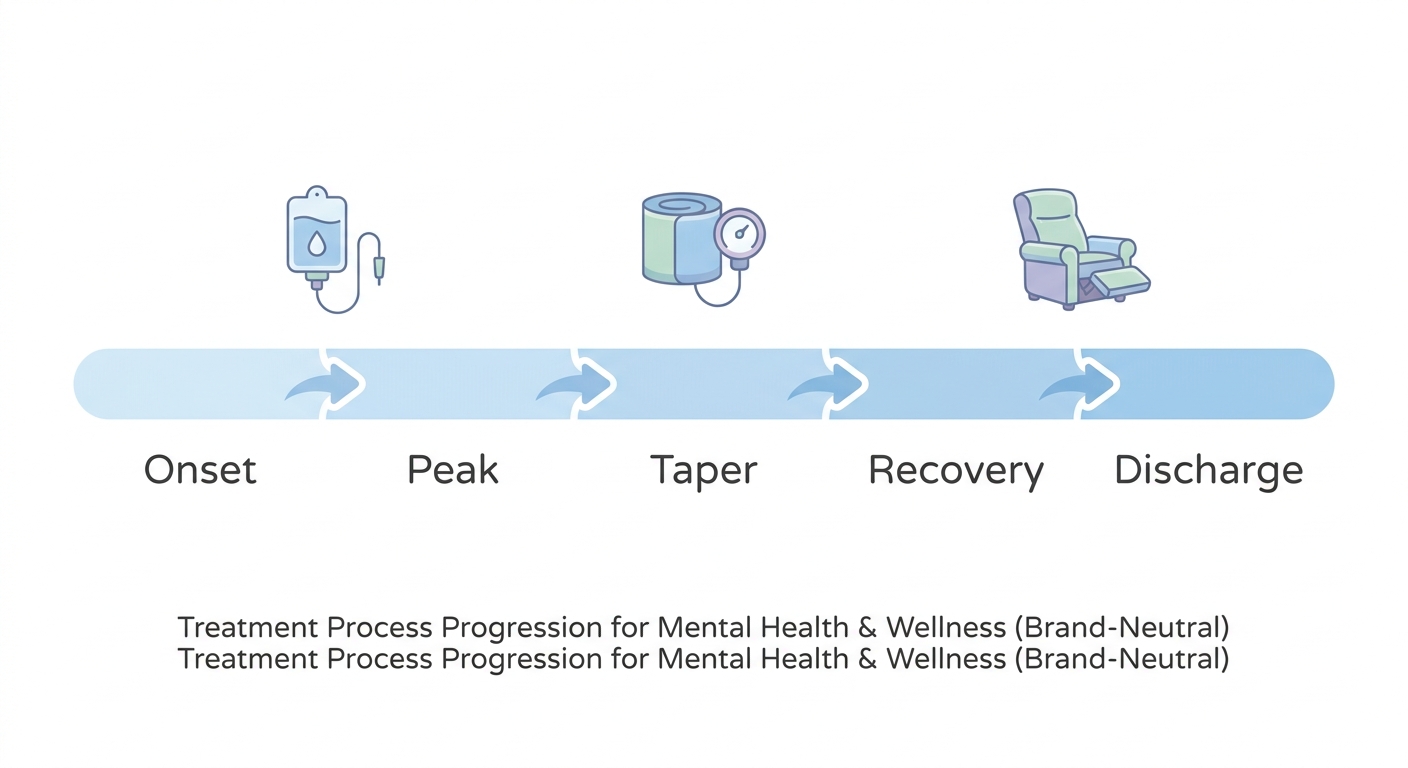
Effects typically begin within the first several minutes of the drip starting, build toward a peak partway through, and ease as the infusion finishes. Most clinics then hold a recovery period before discharge.
Here's the usual arc patients describe:
- Early minutes — a light, slightly heavy-limbed feeling. Colors or sounds may seem softer or stretched.
- Peak — dissociation is most noticeable: a sense of floating, of distance from the body, or of time moving oddly. This is the expected effect, not a complication.
- Possible nausea or dizziness — common enough that many clinics address it preventively.
- Transient cardiovascular changes — a temporary rise in blood pressure and heart rate is a recognized effect of ketamine and a key reason monitoring is standard, per the StatPearls monograph.
- Taper and recovery — the floaty quality recedes, orientation returns, and staff recheck vitals before you leave.
What monitoring looks like in practice: continuous pulse oximetry, an automated blood pressure cuff cycling at set intervals, and a clinician who can slow or pause the infusion. Anti-nausea medication such as ondansetron is often given ahead of time. A short-acting anxiolytic may be used selectively if anxiety becomes difficult, at the clinician's discretion.
If you want a fuller walkthrough of what a ketamine infusion actually feels like as the hours pass, that experience is mapped in more detail in our hour-by-hour guide to ketamine side effects.
How Long Do Ketamine Side Effects Last?
Most perceptual ketamine side effects resolve within the recovery window after dosing ends. Milder residual effects — grogginess, a dull headache, changes in appetite — can linger into the evening for some people. After a single supervised session, effects are not expected to carry into the following day.
| Effect | Typical onset | Typical course | When to call the clinic |
|---|---|---|---|
| Dissociation / perceptual shift | Early in the dose | Peaks mid-session, eases during recovery | If disorientation persists past the next morning |
| Nausea | During dosing | Usually brief; often pre-medicated | If vomiting prevents keeping fluids down |
| Elevated blood pressure | During dosing | Transient; rechecked before discharge | If you feel chest pressure or severe headache |
| Dizziness / unsteadiness | During dosing | Eases over the recovery period | If you can't walk steadily at discharge |
| Headache | During or after | Often same-day | If severe or unusual for you |
| Fatigue / grogginess | After the session | Rest of the day is common | If it continues for several days |
| Vivid dreams or odd sleep | Night after | Usually one night | If distressing or recurring |
Durations vary between individuals, and the table describes commonly reported patterns rather than a guarantee. If you want the longer view — which effects are measured in minutes and which are discussed in months — see our breakdown of which ketamine effects last minutes versus months.
Key takeaway: Use the next-morning rule. After a supervised session, anything still clearly present the following morning is worth a phone call to your clinic — not because it's necessarily serious, but because it's outside the usual pattern.
IV, Nasal Spray, or Oral: How Does the Route Change Side Effects?
The route determines how fast the drug arrives, how precisely the dose can be adjusted, and what monitoring is legally required. Esketamine is the S-enantiomer of ketamine, approved by the FDA as a nasal spray and dispensed only through a restricted program.
| Route | Dose control | Monitoring required | Commonly reported effects |
|---|---|---|---|
| IV infusion | Highest — rate adjustable in real time | Clinician-supervised with vital-sign monitoring | Dissociation, nausea, dizziness, transient blood pressure rise |
| Esketamine nasal spray | Fixed device doses | In-office; the FDA label requires observation for at least 2 hours after dosing under a REMS program | Label lists dissociation, dizziness, nausea, sedation, vertigo, anxiety, increased blood pressure, vomiting |
| Oral / sublingual | Lowest predictability | Varies by prescriber and program | Similar effect categories, with less consistent intensity |
The FDA prescribing information for the nasal spray also instructs patients not to drive or operate machinery until the next day following restful sleep, and lists contraindications including aneurysmal vascular disease and intracerebral hemorrhage.
For a side-by-side look at ketamine side effects by administration route, including what each format asks of your schedule, see our dedicated comparison.
A practical way to think about it: IV trades convenience for control. Nasal spray trades some control for a regulated, FDA-approved pathway with mandated observation. Neither is automatically "gentler" — they're different trade-offs, and the right one is a clinical conversation, not a preference.
What About Bladder Problems, Memory, and Dependence?
These are the headline risks in most warning materials, and they deserve an honest answer rather than reassurance. The documented cases of ketamine-induced bladder inflammation (cystitis), cognitive dulling, and dependence are concentrated in frequent, high-dose, unsupervised use over extended periods. The StatPearls clinical monograph discusses urinary and cognitive effects alongside ketamine's abuse potential in its adverse-effects review.
What that means for a patient on a spaced clinical schedule is different from what it means for someone using repeatedly on their own. But "different" is not "zero," and a good clinic will say so.
Bladder symptoms to report immediately:
- Pain in the lower abdomen
- Pain or burning when urinating
- Needing to urinate noticeably more often
- Blood in the urine
On memory and thinking: short-term confusion or fuzziness during and shortly after dosing is an expected acute effect. Concerns about longer-lasting cognitive change are raised in the context of chronic heavy use, not single supervised sessions.
On dependence: ketamine is a controlled substance with recognized misuse potential. In a clinical model, the patient does not hold the medication, does not control the dose, and does not decide the frequency — which removes the main mechanism by which misuse patterns develop.
⚠️ The honest gap: long-term data on repeated maintenance infusions continues to mature. Anyone who tells you the multi-year safety picture is fully settled is overstating it. That uncertainty is a reason for ongoing monitoring and periodic reassessment, not a reason to panic — and it's worth discussing openly with your prescriber.
If you're weighing extended treatment, our review of long-term ketamine side effects after six months looks at what's known and what isn't.
Who Is Most Likely to Have Side Effects?
Risk clusters in a fairly predictable set of medical and psychiatric histories — which is exactly what pre-treatment screening exists to catch. The FDA prescribing information for esketamine, for example, lists aneurysmal vascular disease, arteriovenous malformation, and a history of intracerebral hemorrhage among its contraindications, and flags blood pressure increases as a warning requiring monitoring.
A thorough intake should review:
- Blood pressure history — including whether hypertension is currently controlled
- Cardiac and vascular history — significant heart disease changes the calculus
- Psychiatric diagnosis — a history of psychosis warrants careful evaluation
- Substance use history — active substance use disorder is a central screening question
- Current medications — including benzodiazepines and other agents that interact with sedation
- Liver function — ketamine is metabolized hepatically
- Prior bladder or urinary conditions
- Pregnancy or breastfeeding status

Screening is also where expectations get set. People with high anxiety about losing control often find the dissociation phase harder, and knowing that in advance lets the care team plan for it. For a broader look at the risk-benefit framing, see our discussion of whether ketamine therapy is safe.
Suitability is always decided in a clinical consultation, not from an article. Results and tolerability vary between individuals.
How Do Clinics Actually Reduce These Side Effects?
Most acute effects are preventable or manageable with four levers: dose, pre-medication, environment, and monitoring. This is the part general fact sheets rarely cover, because they aren't describing a clinic.
- Dose and rate — if dissociation feels overwhelming, the infusion rate can be slowed or paused mid-session.
- Pre-medication — anti-nausea medication is commonly given before dosing rather than after symptoms start.
- Environment — eye masks, calm audio, dim lighting, and a reclining chair reduce sensory input and disorientation.
- Recovery time — discharge happens after vital signs are rechecked and you can walk steadily.
- Transport rules — a ride home is required, and no driving for the remainder of the day.
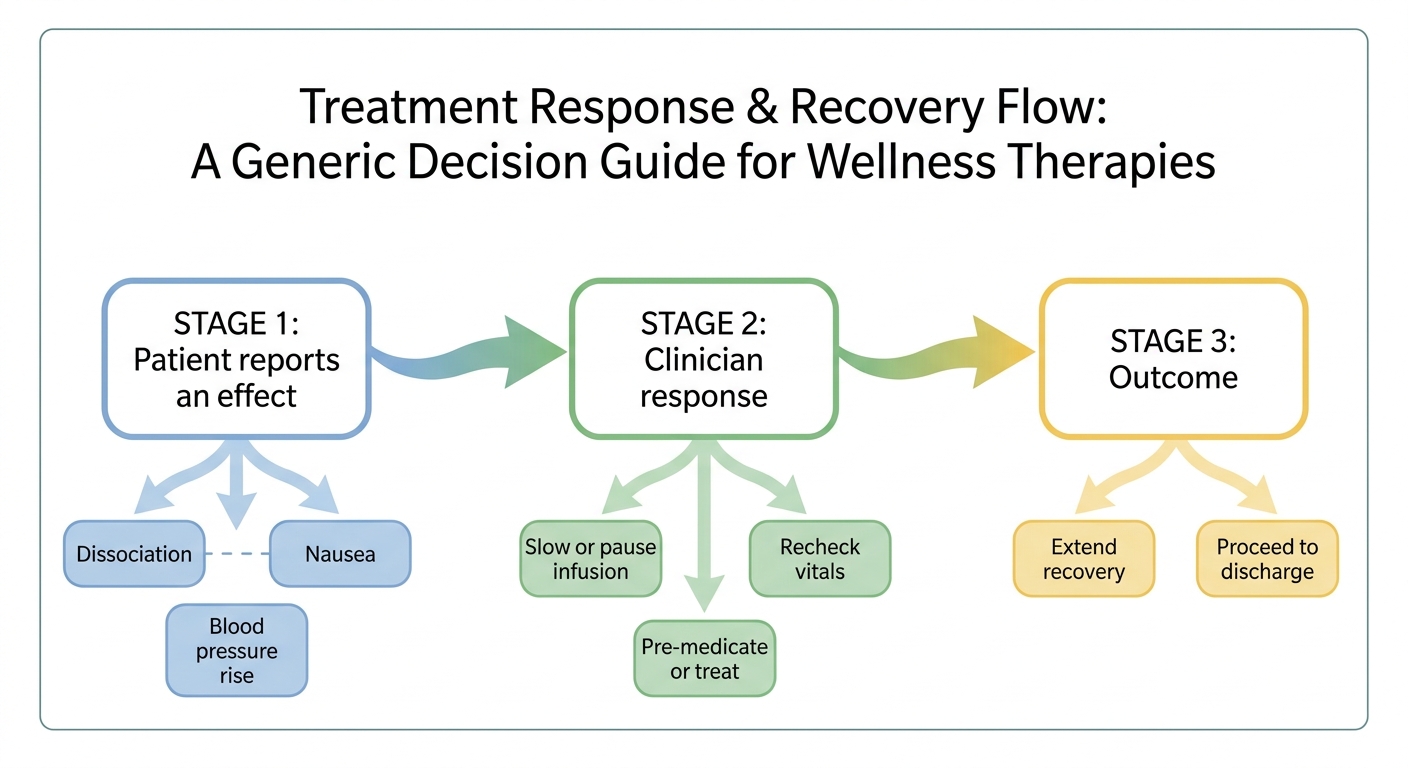
That responsiveness is the practical argument for clinician-supervised care. At Zora Neuro Spa, IV ketamine therapy in Boise and Eagle is delivered in a monitored setting with a clinician present throughout the session. For a deeper look at the protocols involved, see our guide to how clinics prevent ketamine side effects.
Key takeaway: The difference between an uncomfortable session and a manageable one is usually a clinician adjusting something in real time — which is only possible when someone is watching.
Frequently Asked Questions
Can you drive after a ketamine infusion?
No. Plan on a ride home and no driving or operating machinery for the rest of the day. The FDA prescribing information for esketamine nasal spray instructs patients not to drive or operate machinery until the next day following a restful night's sleep, and clinics applying similar caution to IV sessions is standard practice. Arrange transport before your appointment, not after.
Does ketamine therapy cause withdrawal?
Clinical protocols spaced out over weeks, where the clinic controls the dose and schedule, are a different exposure pattern from frequent self-administration. Ketamine is a controlled substance with recognized misuse potential, which is why access, dosing, and frequency stay with the prescriber. If you notice cravings or an urge to seek doses between appointments, tell your clinician — that's a conversation, not a judgment.
Are ketamine side effects worse with each infusion?
Many patients describe the opposite: dissociation often feels less startling by the third or fourth session simply because it's familiar. That's a patient-reported pattern, not a guarantee, and individual experiences vary. Some people find certain sessions more intense than others depending on dose adjustments, sleep, hydration, or mood going in. Tell your care team how the last session felt — it informs the next one.
What side effects mean I should call the clinic?
Call, don't wait, for: pain or burning when urinating, new urinary frequency, blood in the urine, chest pain or pressure, confusion that persists past the next morning, or a clear worsening of mood. None of these are expected after a supervised session. For anything that feels like a medical emergency, seek emergency care first and notify the clinic afterward.
Is ketamine nasal spray safer than IV ketamine?
Not inherently — they carry different trade-offs. Esketamine nasal spray is FDA-approved with a required observation period of at least two hours after dosing under a REMS program. IV allows the clinician to adjust or stop the dose in real time. Which fits you depends on your history, insurance, and schedule, as covered in the route comparison above.
Summary
The honest version of ketamine side effects is less dramatic than a warning label and more nuanced than a reassurance. At supervised doses, the common effects — dissociation, nausea, dizziness, a temporary blood pressure rise — are short-lived and actively managed by the people in the room. The serious long-term concerns are real but concentrated in frequent, unsupervised, high-dose use, and long-term data on maintenance treatment is still developing.
What should guide your decision: thorough screening, a route chosen for your specific history, continuous monitoring during dosing, and a clinic that tells you what to report afterward. If depression or chronic pain has stopped responding to standard treatment, background on the condition and its treatment landscape is available from the National Institute of Mental Health. The next step is a conversation with a clinician who can review your history in full.
Information about third-party platforms reflects publicly available details at the time of writing and may have changed. Please verify directly with the provider. See our Terms of Use for more.