What Happens Inside the Brain During KAP
Zora Neuro Spa Editorial · November 24, 2026

If you've been researching ketamine therapy anywhere around Boise, Eagle, or Middleton, you've probably seen the term "KAP" without a clear explanation of what the therapy part actually does. The question most people ask first is simple: how does ketamine assisted psychotherapy work, and why does pairing a medicine with talk therapy matter? Here's the honest, plain-English version — the brain science, the three phases, and the questions worth asking before you book.
Quick Answer
Ketamine-assisted psychotherapy (KAP) pairs a carefully measured, sub-anesthetic dose of ketamine — a medication that blocks NMDA receptors in the brain — with structured therapy before, during, and after dosing. Researchers believe that receptor blockade sets off a short-lived cascade of signaling linked to the growth of new connections between brain cells. KAP is built around three phases: preparation, dosing, and integration. The integration work is what separates KAP from receiving medication alone.
TL;DR
- Ketamine blocks NMDA receptors, and researchers link that action to a downstream signaling cascade associated with new synaptic growth. See how the cascade is described step by step
- KAP runs on three phases — preparation, dosing, integration — repeated across a planned series rather than delivered as a single appointment. Walk through the three-phase breakdown
- Therapy is the variable that distinguishes KAP from a standalone infusion; the medication is thought to open a window, and therapy shapes what happens inside it. Read why therapy is paired with dosing
- KAP, standalone IV ketamine, and Spravato are three different things with different monitoring rules and regulatory status. Compare the three routes side by side
- Many clinics market "KAP" while providing medication only — seven specific questions will tell you which you're looking at. Use the provider vetting checklist
In This Article
- What Is Ketamine-Assisted Psychotherapy, Exactly?
- How Does Ketamine Assisted Psychotherapy Work Inside the Brain?
- Why Does Adding Therapy Change the Outcome?
- What Are the Three Phases of a KAP Course?
- KAP vs IV Infusion vs Spravato: Which Does What?
- Who Is KAP Typically Considered For — and Who Should Pause?
- How Do You Tell a Real KAP Program From a Ketamine-Only Clinic?
- How Long Do the Effects Last, and What Happens After the Series?
What Is Ketamine-Assisted Psychotherapy, Exactly?
Ketamine-assisted psychotherapy (KAP) is a treatment model in which a sub-anesthetic dose of ketamine is given under medical supervision while a trained therapist supports the session and guides structured follow-up processing. The medicine and the therapy are treated as one combined course, not two separate services.
That distinction matters, because three different things get sold under similar names:
- Standalone IV ketamine — medication administered and monitored by clinical staff, without a paired therapy hour.
- KAP — the same class of medication, delivered alongside preparation and integration sessions with a licensed therapist.
- Spravato (esketamine) — a nasal spray version approved by the FDA in 2019 for specific depression indications, which must be administered at a certified site with direct observation under a restricted distribution program.
Ketamine itself is an NMDA receptor antagonist first established in medicine as an anesthetic, as described in the StatPearls clinical monograph. Psychiatric use at lower doses is off-label, which is why the surrounding structure — screening, monitoring, therapy — varies so much between providers.
⚠️ "Ketamine clinic" and "KAP provider" are not interchangeable terms. A clinic can legitimately offer excellent infusion care with no therapist involved at all. If the therapy component is what you're after, confirm it specifically rather than assuming it's included.
If you want the appointment-level view, our guide to what a KAP session actually involves walks through the room, the timing, and the handoffs.
How Does Ketamine Assisted Psychotherapy Work Inside the Brain?
Ketamine works differently from standard antidepressants. Rather than acting primarily on serotonin, ketamine acts as an antagonist at NMDA receptors — meaning it blocks a specific receptor for glutamate, the brain's main excitatory messenger. Researchers studying its antidepressant effects describe a chain reaction that follows.
Here is the sequence as it's commonly described in the research literature, translated into plain English:
- Receptor blockade. Ketamine binds NMDA receptors, including those on inhibitory cells that normally keep glutamate signaling restrained.
- Glutamate surge. With that brake temporarily lifted, glutamate release increases for a short period.
- AMPA activation. Glutamate then stimulates a different receptor type, AMPA, which researchers consider central to the downstream effect.
- Growth-factor signaling. AMPA activation is associated with signaling involving brain-derived neurotrophic factor (BDNF) and the mTOR pathway.
- Synaptic remodeling. That signaling is hypothesized to support the formation of new dendritic spines — the small contact points where brain cells connect.
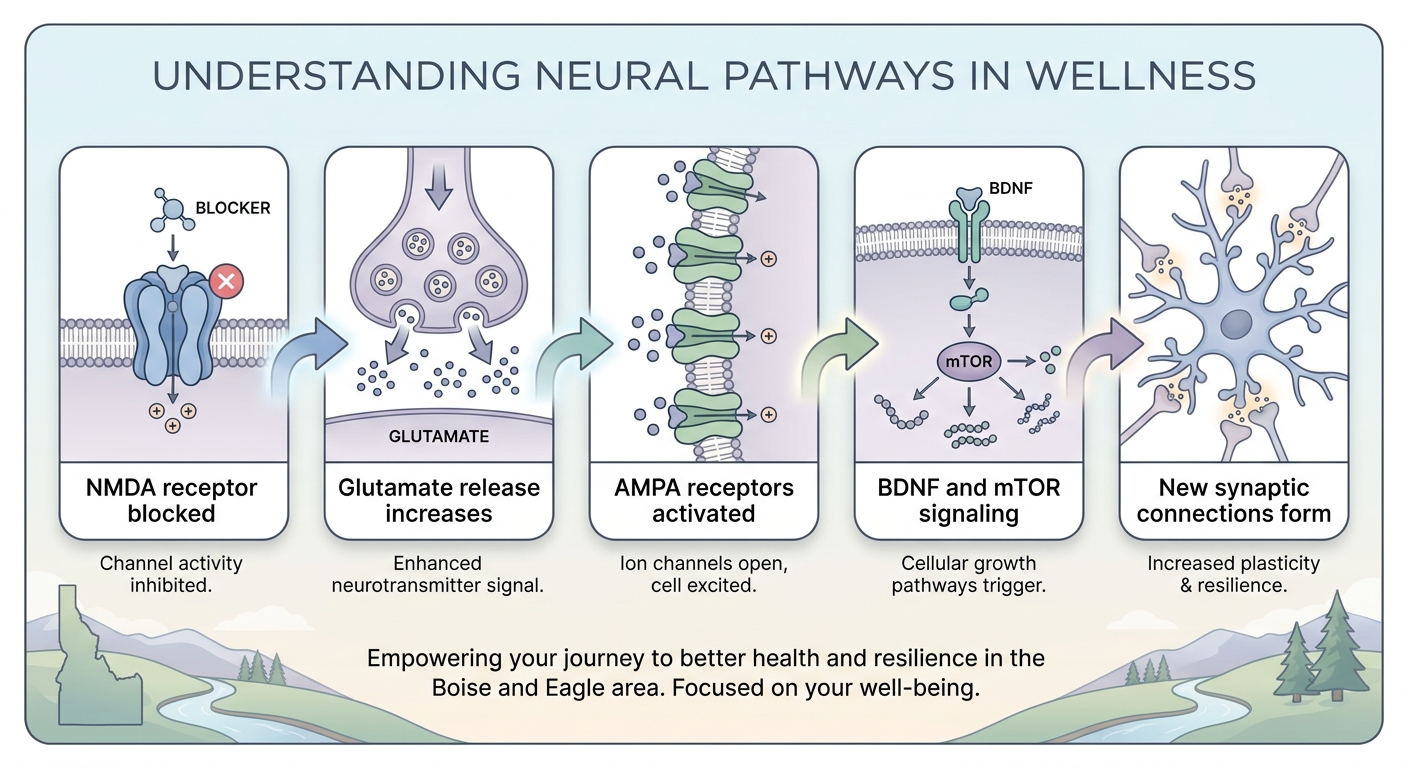
Neuroplasticity refers to the brain's ability to reorganize itself by forming, strengthening, or weakening connections between cells in response to experience. Much of the laboratory evidence for ketamine-related synaptic growth comes from animal studies; human imaging work is still developing, and clinicians should not present the mechanism as settled fact.
Why do people describe feeling like an observer?
Many people report a temporary sense of distance from their usual stream of thought during dosing. One widely discussed explanation involves reduced activity in the default mode network — the set of brain regions associated with self-referential thinking and rumination. When that chatter quiets, difficult material can feel approachable rather than threatening.
That subjective shift is the reason therapists find the state useful. Rigid self-narratives — I always fail, I'm not safe anywhere — can briefly feel less fixed and more examinable.
Dissociation, altered perception of time, and temporary increases in blood pressure are recognized effects of ketamine documented in the clinical literature, which is why vital-sign monitoring is standard. For a deeper look at the cellular story, see our explainer on the science of ketamine and neuroplasticity.
Key takeaway: The mechanism researchers describe is a short-lived shift in how readily brain circuits can change — not a direct chemical correction of mood.
Why Does Adding Therapy Change the Outcome?
The medication opens a window; therapy decides what gets built in it. That's the core logic behind KAP. If the plasticity ketamine is thought to produce is non-specific — meaning the brain becomes more changeable in general, not more positive in particular — then what you do with that period matters.
Think of orthopedic surgery. The procedure creates the conditions for a joint to work again, but physical therapy in the weeks afterward determines how the tissue actually rebuilds. Clinicians working in this field make the same argument about dosing and integration.
This is why KAP protocols deliberately schedule therapy inside and around the plasticity window rather than leaving it to chance. Preparation shapes what you bring in. Integration shapes what you carry out.
Published studies pairing psychotherapy with ketamine have explored whether structured therapy can extend benefit beyond what a single dose produces on its own. Sample sizes in this literature remain small, protocols differ widely, and it's fair to say the question is still open rather than answered.
What researchers and clinicians generally agree on:
- Depression involves patterns, not just chemistry — rumination, avoidance, and withdrawal are learned loops, and NIMH's overview of depression describes psychotherapy as a core part of the treatment landscape.
- A changeable brain is not automatically a healed one — plasticity is an opportunity, not a result.
- Unstructured time after dosing is still time — old habits can reconsolidate as easily as new ones.
For the deeper mechanistic argument, read our companion piece on why ketamine-assisted psychotherapy works.
Key takeaway: Medication-only infusions can be a legitimate and appropriate choice. KAP simply aims at a different target — durability of change rather than the dosing experience alone.
What Are the Three Phases of a KAP Course?
Every credible KAP program runs the same arc: preparation → dosing → integration, repeated across a planned series. One cycle is not a course. The phases below describe a single cycle, which typically repeats several times over a few weeks before the team reassesses.
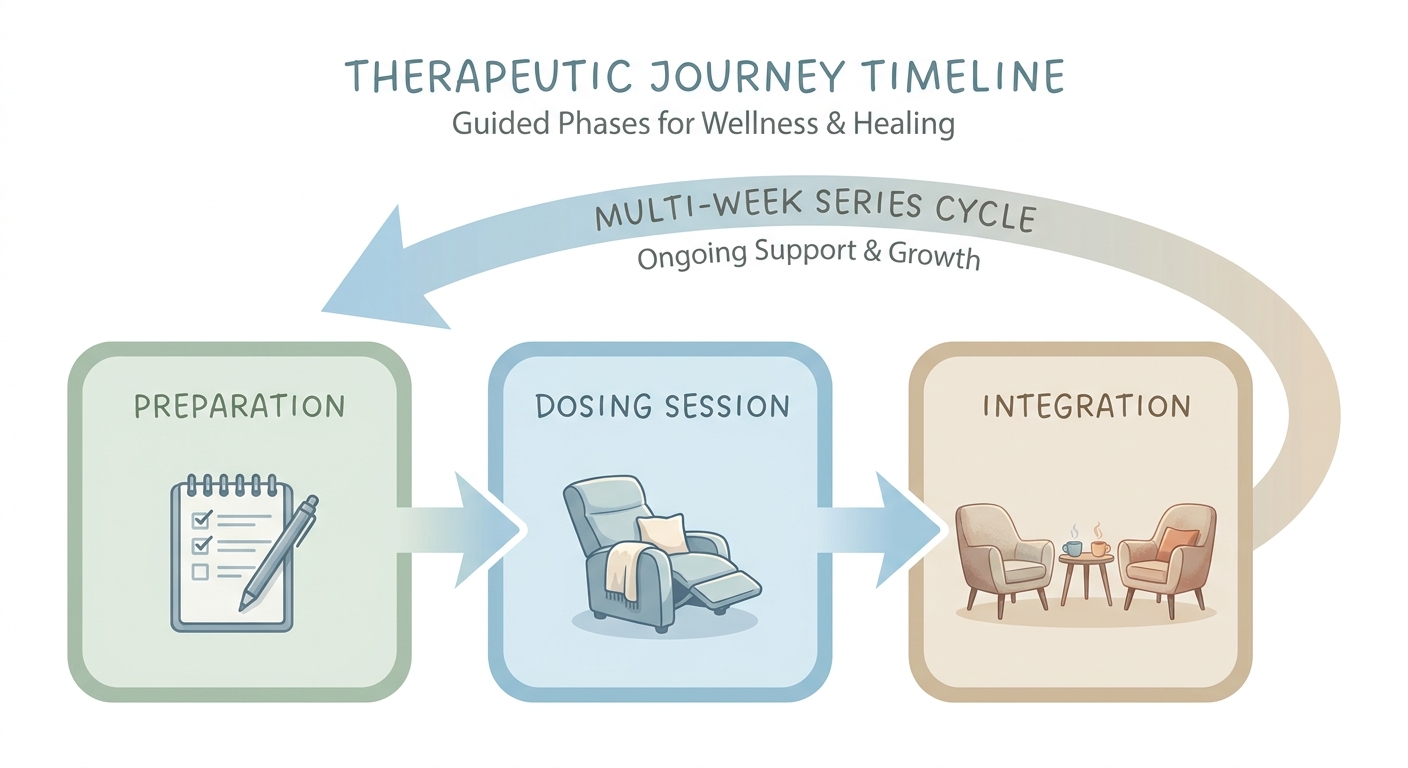
Phase 1: Preparation
Preparation is the screening and orientation work that happens before any medication is given, usually across one or two appointments. It covers three jobs: confirming you're a medically appropriate candidate, setting an intention for the work, and removing surprises from the dosing experience.
Medical screening commonly includes blood pressure measurement, cardiac and neurological history, psychiatric history with attention to psychosis and mania, current medications, and substance use history. Because ketamine can raise blood pressure and heart rate, cardiovascular review is not a formality.
The therapy side of preparation does something equally practical — it tells you what dissociation will feel like, so a strange sensation doesn't become a frightening one.
Preparation checklist (worth screenshotting):
- Medical clearance — blood pressure reading, cardiac history, medication review
- Psychiatric screening — history of psychosis, mania, or active substance use disorder
- Intention-setting session — what you want to work on, in your own words
- Food and drink instructions — many programs ask for a fasting window before dosing; follow your clinic's exact direction; follow your clinic's exact direction
- Transportation — arrange a driver; the Spravato prescribing information advises patients not to drive until the next day after restful sleep, and clinics commonly apply similar caution
- Clear the calendar — treat dosing day as a day off, not a lunch break
Phase 2: The Dosing Session
The dosing session is the appointment where medication is administered with a therapist present. Many programs schedule a visit lasting a few hours, with the period of active medication effect occupying a portion of it before recovery and monitoring, followed by recovery and monitoring before discharge.
The room is usually quiet. Most people recline, use an eye mask, and listen to a curated music playlist. Vital signs are checked on a schedule using a blood pressure cuff and pulse oximeter.
One thing surprises nearly everyone: the therapist is mostly silent. The job during dosing is attuned presence — being available if you speak, not directing the experience. The talking comes later.
On dose: psychotherapeutic dosing is sub-anesthetic, meaning it sits well below the levels used to induce anesthesia. You remain arousable and able to communicate. That is a different clinical register from the anesthetic use described in the StatPearls monograph.
Route affects timing. IV delivery produces effects within minutes of the infusion starting; intramuscular and oral routes come on more gradually. If you want the subjective detail — sounds, visuals, body sensations — our guide to what a ketamine infusion actually feels like covers it honestly.

Phase 3: Integration
Integration is the therapy session held after dosing — commonly within the first few days after dosing — where the material that surfaced during the experience is translated into specific, concrete changes in daily life. It is the phase most often skipped, and the one most clinicians consider essential.
A useful integration session doesn't just recount the experience. It asks what the experience suggested about a pattern, and what one different action this week would look like.
Common integration practices include:
- Journaling within 24 hours — before the memory smooths into a story
- Somatic tracking — noticing where tension actually lives in the body
- Pattern naming — identifying the specific loop you want to interrupt
- One behavioral commitment per cycle — a single, small, testable action rather than a life overhaul
⚠️ The most common way a KAP course underdelivers is a skipped integration session. If a program quotes you a price for dosing appointments without naming when integration happens and who provides it, you are being quoted for medication, not for KAP.
KAP vs IV Infusion vs Spravato: Which Does What?
These three routes differ in who's in the room, how they're regulated, and what the appointment costs you in time. None is universally better — they answer different questions.
| KAP | Standalone IV ketamine | Spravato (esketamine) | At-home oral ketamine (telehealth) | |
|---|---|---|---|---|
| Route | IM, oral, or IV | IV infusion | Nasal spray | Oral lozenge/tablet |
| Therapist during dosing | Yes, by design | Not typically | Not required by the program | No |
| Typical appointment | 2–3 hours plus integration visits | Varies by clinic protocol | Includes required post-dose observation | At home, remote check-ins |
| FDA status for depression | Off-label | Off-label | Approved in 2019 for specific indications | Off-label |
| Monitoring | On-site clinical monitoring | On-site clinical monitoring | Certified site, direct observation, restricted program | Remote, no on-site vitals |
| Often considered by | People who want structured therapy built in | People already in outside therapy or seeking medication alone | People whose coverage or diagnosis fits the approved indication | People prioritizing convenience and cost |
Honest trade-offs: KAP costs more time, because you're paying for clinician hours, not only medication. Standalone infusions are leaner and may suit someone who already has a therapist they trust — our overview of IV ketamine therapy in Boise and Eagle explains that model.
Spravato sits in its own category because it carries formal FDA approval and mandatory in-clinic observation, which also shapes how it's billed. Our breakdown of how Spravato works in the brain and who qualifies covers the eligibility criteria.
At-home oral protocols trade on-site monitoring for convenience. That trade is the whole conversation — discuss it with a prescriber who knows your cardiac and psychiatric history.
Who Is KAP Typically Considered For — and Who Should Pause?
KAP is most often discussed with adults whose depression has persisted after trials of antidepressants, and it is also an area of ongoing research interest for PTSD, anxiety, and OCD; these uses are off-label and suitability is determined individually by a prescriber. Suitability is always determined in a clinical consultation, never from an article.
| Commonly considered for | Commonly a reason to pause or rule out |
|---|---|
| Depression that hasn't responded to multiple medication trials | Uncontrolled high blood pressure |
| PTSD and trauma-related symptoms | Active psychosis or current manic episode |
| Anxiety disorders alongside ongoing therapy | Untreated substance use disorder |
| OCD, as an area of active research | Pregnancy or breastfeeding |
| Certain chronic pain conditions, as an area of ongoing research | Specific cardiovascular and vascular conditions |
The Spravato prescribing information lists contraindications including aneurysmal vascular disease, arteriovenous malformation, and a history of intracerebral hemorrhage — documented in the FDA label. Clinics typically apply comparable caution when screening for ketamine more broadly.
⚠️ KAP is not a replacement for ongoing psychiatric care, and it is not an emergency service. If you're in crisis, contact 988 or go to your nearest emergency department.
Because depression presents differently from person to person — NIMH's clinical overview describes a wide range of symptom patterns — two people with the same diagnosis can get very different recommendations. For trauma-specific considerations, see our guide to ketamine therapy for PTSD in Boise.
How Do You Tell a Real KAP Program From a Ketamine-Only Clinic?
Ask two questions: Is a licensed therapist in the room during dosing? and Are integration sessions scheduled and included in the price you just quoted me? If either answer is vague, you're looking at a medication service that uses KAP as a marketing term.
Directory listings — the kind that dominate search results for ketamine providers — typically publish pricing and insurance panels. They rarely tell you how to evaluate what you're buying. These seven questions close that gap on a consultation call:
- Who holds prescribing authority, and will they be on site during my session?
- Is the therapist licensed in Idaho, and what KAP-specific training have they completed?
- How many integration sessions are included, and when are they scheduled?
- What monitoring equipment is used, and how often are vitals checked?
- What is your protocol if my blood pressure rises mid-session?
- Can you coordinate with my existing outside therapist?
- What does the quoted price include — medication only, or the full three-phase cycle?

Credentials deserve a second look too. "Ketamine-trained" has no single national standard, which is why our explainer on what KAP credentials actually mean is worth ten minutes before you commit. If you're comparing several Treasure Valley options — Boise, Eagle, Middleton, Meridian — our guide to how to choose a ketamine clinic in Boise lays out the evaluation criteria side by side.
Key takeaway: The deciding question isn't what medication a clinic offers. It's whether anyone is scheduled to help you make sense of it afterward.
How Long Do the Effects Last, and What Happens After the Series?
Duration varies substantially between individuals, and anyone promising you a specific number of weeks is overstating what the evidence supports. What can be described accurately is the schedule clinics generally use.
A common structure looks like this:
- Initial series — a number of dosing sessions determined by your provider based on clinical assessment
- Paired integration — a therapy session following each dosing appointment
- Formal reassessment — a clinical review at the end of the series using standardized symptom measures
- Maintenance — additional sessions scheduled based on that reassessment and ongoing symptom tracking, not a fixed calendar
Maintenance planning is a clinical judgment call made with your provider. Some people are reassessed at longer intervals over time; others aren't. Results vary, and your prescriber is the only person who can map this for your situation.
The reason integration keeps coming up in this conversation is straightforward: the behavioral changes you build during a course are yours to keep, independent of medication timing. Clinicians working in KAP argue that this is where durability comes from, though the research comparing paired versus unpaired protocols remains limited.
For related reading on duration questions specific to anxiety, see how long ketamine infusion relief lasts.
Summary
So — how does ketamine assisted psychotherapy work? A sub-anesthetic dose of an NMDA receptor antagonist is given under medical supervision, researchers believe a signaling cascade follows that temporarily increases the brain's capacity for change, and structured therapy before and after dosing works to turn that window into specific, lasting adjustments in how you think and act. The three phases — preparation, dosing, integration — repeat across a planned series.
The practical takeaway for anyone in Boise, Eagle, or Middleton comparing providers: verify the therapy component explicitly. It is the part most often advertised and least often delivered, and it is the part that defines the model.
You can also browse common ketamine cost, safety and process questions before you call.
Frequently Asked Questions
Is ketamine-assisted psychotherapy the same as a ketamine infusion?
No. An infusion delivers medication under clinical monitoring, with no therapist in the room and no therapy hour attached. KAP adds a trained therapist during dosing plus scheduled integration sessions afterward. Both are legitimate models — they simply target different things, and the price you're quoted should make clear which one you're buying.
How many KAP sessions do most people need?
Most programs begin with a defined series of dosing sessions over a period determined by clinical assessment, each paired with an integration session, followed by a formal clinical reassessment. The number that follows depends entirely on that reassessment, your symptom tracking, and your prescriber's judgment. There is no universal course length, and individual plans vary.
Will I be unconscious or lose control during a KAP session?
No. Psychotherapeutic dosing is sub-anesthetic, which means it sits well below anesthesia levels. You stay arousable, you can speak, and you can ask the team to stop at any point. Perception of time, body, and sound commonly shifts during the session, which is why preparation covers these sensations in advance.
Does insurance cover ketamine-assisted psychotherapy?
Coverage is fragmented. The psychotherapy hour is sometimes billable through standard mental health benefits, while generic ketamine used off-label frequently is not. Spravato is the route most often covered because it carries FDA approval. Our guide to Spravato insurance and cost in Idaho and our cost, safety and process FAQ cover specifics — but always verify directly with your plan.
Can I do the therapy part with my existing therapist?
Often, yes. Many clinics coordinate with an outside therapist for integration work, provided you sign a release of information and both providers agree on a shared care plan. Ask about this on your consultation call. If you already have a therapist you trust, keeping that relationship intact is usually worth the coordination effort.
Information about third-party platforms reflects publicly available details at the time of writing and may have changed. Please verify directly with the provider. See our Terms of Use for more.