IV Hydration in Boise: Who Needs It, Who Doesn't
Zora Neuro Spa Editorial · November 6, 2026

IV Hydration in Boise: Who Needs It, Who Doesn't
Typing "iv hydration near me" into your phone usually means one of two things: you feel genuinely terrible, or you're curious whether a drip would make you feel better than you already do. Those two situations deserve very different answers. This guide separates what IV hydration reliably does from what it's marketed to do, so you can decide whether a Boise drip is worth your time and money — or whether a water bottle and a nap would do the same job.
Quick Answer
IV hydration therapy is the delivery of sterile fluid — usually a saline or balanced electrolyte solution — directly into a vein through a small catheter, often with vitamins added. Searching for IV hydration near me makes sense if you're dehydrated from vomiting, diarrhea, heat exposure, or heavy sweat loss and can't comfortably drink enough. For everyday thirst, mild fatigue, or general "wellness," oral fluids do the same job for far less money.
TL;DR
- A hydration bag is mostly salt water, not magic — the base fluid is a sterile sodium chloride or balanced electrolyte solution, and vitamin add-ins are optional extras. See what's actually in the bag
- The strongest case for IV therapy is correcting real, measurable dehydration or a documented deficiency — not boosting energy in a healthy, well-hydrated adult. Compare the evidence tiers
- Most IV hydration side effects are minor: a brief sting, a cool feeling up the arm, a small bruise. Serious problems are uncommon but real. Review the side effect table
- Heart failure, kidney disease, and pregnancy are genuine reasons to skip a drip or get clearance first. Check the screening questions
- The biggest difference between providers isn't the menu — it's who screens you and who's in the building if something goes wrong. Compare the three delivery models
In This Article
- What Is IV Hydration Therapy, Exactly?
- What Are the Real Benefits of IV Hydration?
- Do Athletes Actually Benefit From IV Hydration?
- What Side Effects Should You Expect?
- Is IV Hydration Therapy Safe — and Who Should Skip It?
- Searching IV Hydration Near Me in Boise: How the Options Compare
- What Does IV Hydration Cost Near You?
- Frequently Asked Questions
What Is IV Hydration Therapy, Exactly?
IV hydration therapy delivers sterile fluid through a thin catheter placed in a forearm or hand vein, so the fluid enters your bloodstream without passing through your digestive tract. A clinician checks your history, places the line, and the bag runs by gravity while you sit in a chair.
Two base fluids show up on nearly every menu:
- Normal saline is a sterile solution of sodium chloride in water, mixed at a concentration close to that of blood. It's the plainest option and the one most often used for simple fluid replacement.
- Lactated Ringer's provides sodium and chloride plus potassium, calcium, and lactate, which makes its electrolyte profile closer to plasma than plain saline.
From there, clinics add ingredients. Common additions include B-complex vitamins, vitamin C, magnesium, zinc, and anti-nausea medication. The most recognizable combination is the Myers' formulation — if you want the ingredient-by-ingredient breakdown, read what's actually in a Myers' cocktail before you pick an add-on.
Menu names vary a lot between clinics. A basic bag might be listed as a quench IV, a hydration drip, or simply "fluids." Different names, broadly similar contents.
Why does IV delivery differ from taking a supplement?
The difference is mechanism, not magic. When you swallow fluids or vitamins, everything passes through your stomach and intestines first, and how much reaches your bloodstream depends on the nutrient, your gut, and what else you've eaten. An infusion bypasses that step entirely, so the full dose enters circulation directly.
That matters most when the gut isn't cooperating — active vomiting, severe diarrhea, or a stomach that rejects anything you swallow. It matters much less if you're perfectly capable of drinking a liter of water.
If you want a deeper look at the formulations and what each ingredient is intended to support, the IV nutrition menu and pricing page lays out the drip options available in Eagle.
Key takeaway: IV hydration is a delivery route, not a treatment category. What matters is whether your body actually needs what's in the bag.
What Are the Real Benefits of IV Hydration?
The honest answer: IV hydration benefits are clearest when there's a real fluid or nutrient gap to close. Volume replacement for someone who can't keep liquids down is standard, well-established medical care. "Feeling better than baseline" in a healthy adult is a much weaker claim.
Here's how the common marketing promises sort out:
| Evidence tier | What falls here | What it means for you |
|---|---|---|
| Well-supported | Replacing fluid when oral intake isn't possible (vomiting, diarrhea, heat illness); correcting a nutrient deficiency that's been documented and is being managed by a clinician | A reasonable, targeted use of IV therapy |
| Plausible but limited | Symptom relief after a hangover or a viral illness; feeling clearer after heavy sweat loss | May help the dehydration component; expectations should stay modest |
| Mostly marketing | "Detox," immune boosting in healthy adults, weight loss, anti-aging | Ask what evidence and regulatory status support the specific claim before paying for it |
A few honest caveats worth knowing before you book:
- Water-soluble vitamins don't stockpile. Your kidneys clear surplus B and C vitamins, so "topping off" repeatedly doesn't build a reserve.
- Deficiency is testable. If a clinic claims you're deficient without any lab work, that's a sales pitch, not a diagnosis.
- "Detox" has no clinical definition. Your liver and kidneys handle that job continuously, with or without a drip.
- Wellness infusions are generally offered outside of approved treatment indications. Ask the provider directly what a given drip is approved for versus what it's being promoted for.
None of that means IV therapy is useless. It means the value is situational. Someone who spent a July afternoon on the Greenbelt and then spent the evening vomiting is in a genuinely different position than someone who slept poorly and feels flat. For a broader look at how absorption, formulation, and cost interact across drip types, see the fuller discussion of the benefits of IV nutrition therapy.
⚠️ Be skeptical of any hydration clinic that promises a specific outcome — faster recovery, a stronger immune system, a guaranteed energy lift. Individual responses vary, and outcome guarantees are a red flag regardless of how good the chair looks.
Do Athletes Actually Benefit From IV Hydration?
Sometimes. IV hydration for athletes makes the most sense after large sweat losses that oral fluids haven't kept up with — long efforts in heat, multi-hour races, or a day where you finished noticeably lighter than you started. For an ordinary Tuesday training session, it's overkill.
Boise gives people plenty of reasons to ask. Summers here are hot and dry, the Foothills trails climb fast, and the local endurance calendar keeps people out for hours at a time. Heavy sweat loss plus altitude plus heat is a real combination, not a marketing invention.

What's typically in a recovery bag?
- Base fluid — saline or a balanced electrolyte solution to replace volume
- Magnesium — commonly included in recovery formulations
- B-complex vitamins — a frequent add-in on recovery menus
- Anti-nausea or anti-inflammatory medication — only where a clinician determines it's appropriate
If you're comparing what different post-exertion formulations contain, the breakdown of recovery IV drip options in Boise and Eagle covers the typical ingredient lists in more detail.
⚠️ If you compete in a drug-tested sport, check before you book. Intravenous infusions are regulated under anti-doping policy, and exemption processes exist for legitimate medical treatment. Confirm current rules with your governing body or anti-doping authority rather than assuming a wellness drip is permitted.
For most recreational athletes, the practical sequence is unglamorous: drink fluids with sodium, eat a real meal, sleep. Reserve IV therapy for the days when that plan clearly isn't working — you're nauseated, cramping badly, or still dizzy hours later.
Key takeaway: Infusions are a correction for a bad day, not a weekly training supplement.
What Side Effects Should You Expect?
Most people walk out having experienced nothing worse than a quick pinch, a cool sensation traveling up the arm as the fluid runs, and a small bruise at the insertion site the next day. IV hydration side effects are usually mild — but they exist, and a good provider will name them before you sit down.
| Side effect | How common | What to do |
|---|---|---|
| Bruising or tenderness at the site | Common | Cold compress, usually fades on its own |
| Cool sensation up the arm | Common | Normal; tell your nurse if it's uncomfortable |
| Metallic or vitamin taste | Common with B vitamins | Harmless, passes quickly |
| Frequent urination afterward | Common | Expected with a fluid load |
| Lightheadedness | Uncommon | Tell staff immediately; stay seated |
| Swelling or stinging at the site (infiltration) | Uncommon | Alert staff right away — the line may need to be stopped |
| Flushing or warmth | Uncommon | Report it; infusion rate may be adjusted |
| Vein inflammation, infection, allergic reaction, fluid overload | Rare but serious | Seek medical attention promptly |
What should you watch for in the 24 hours after a drip?
Use this quick checklist:
- Redness, warmth, or a hard cord along the vein — signs of vein irritation that need a clinician's eyes
- Spreading swelling at the site that doesn't settle
- Fever or chills — uncommon, but worth a call
- Shortness of breath, puffy ankles, or sudden weight gain — possible fluid overload, which needs prompt evaluation
- Rash, hives, or throat tightness — treat as urgent
Keep the bandage on for a few hours, avoid heavy lifting with that arm immediately after, and don't scrub the site. Sterile technique at the clinic and clean handling at home are what keep infection risk low. Any reputable hydration clinic will give you written aftercare instructions and a phone number to call — if nobody mentions aftercare, that tells you something about the operation.
Key takeaway: The common side effects are annoying, not dangerous. The dangerous ones are rare — and almost all of them are easier to catch when a licensed clinician is watching you rather than a drip bar attendant.
Is IV Hydration Therapy Safe — and Who Should Skip It?
For most healthy adults, IV therapy is safe when a licensed clinician reviews your health history first and places the line using sterile technique. The risk isn't really the saline. It's getting fluid you don't need, in a setting where nobody screened you and nobody can manage a reaction.
Fluid overload means your circulatory system is handling more volume than it can comfortably move, which can strain the heart and lungs. That's the single biggest reason screening matters.
Talk to your own physician before booking — or skip wellness hydration entirely — if any of these apply:
- Congestive heart failure or other conditions where fluid balance is tightly managed
- Kidney disease or dialysis — your ability to clear extra fluid and electrolytes is reduced
- Uncontrolled high blood pressure
- A prior episode of fluid overload or unexplained swelling
- G6PD deficiency, which is relevant to high-dose vitamin C infusions
- Pregnancy — get OB clearance first
- An active infection, especially fever or an infection near a potential IV site
- Any medication regimen that interacts with electrolytes, including diuretics
What should a real screening include?
A proper intake isn't a waiver you sign on a tablet. Expect questions about your cardiac and kidney history, current medications and supplements, allergies, recent illness, pregnancy status, and what you're actually hoping the drip will do. Expect vitals — at minimum blood pressure and heart rate — before the line goes in.
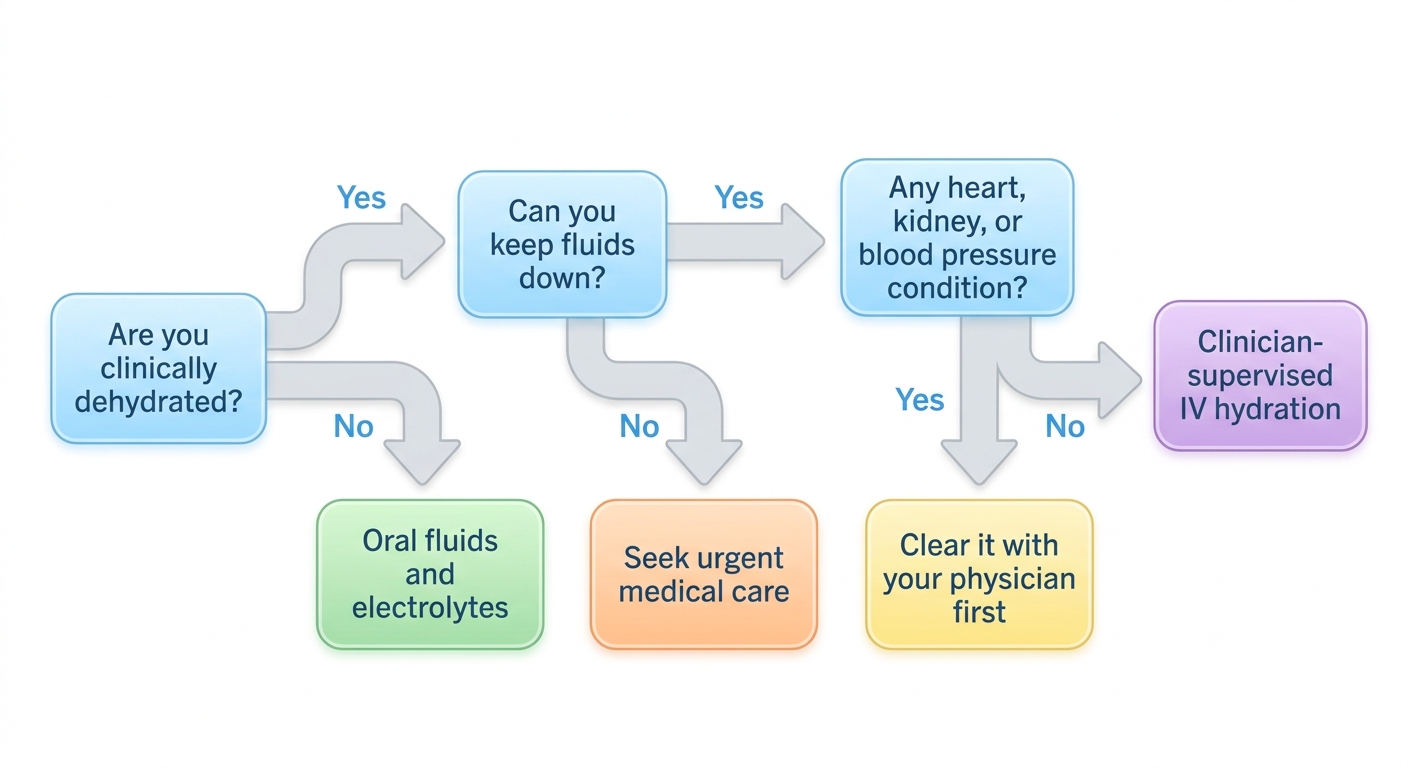
This is the part where supervision stops being a marketing word and starts being the actual product. A clinician who knows your history can tell you that a drip is a reasonable idea, that a different formulation fits better, or that you don't need one at all. That last answer is worth as much as the infusion. The case for medically supervised IV therapy in Boise rests almost entirely on that screening step.
Key takeaway: The question isn't whether saline is safe. It's whether you should be receiving extra fluid today — and only a clinician reviewing your history can answer that.
Searching IV Hydration Near Me in Boise: How the Options Compare
Your real choice isn't between twenty brand names. It's between three delivery models, and they differ most in supervision and in what happens if something goes sideways.
| Mobile / at-home service | Med-spa drip bar | Medically supervised clinic | |
|---|---|---|---|
| Who's present | Visiting nurse, typically alone | Varies by location | Licensed clinical staff on site |
| Health screening depth | Varies; often brief | Varies | Full history and vitals before treatment |
| Response to a reaction | Limited to what one clinician carries | Varies by staffing | On-site protocol and staff |
| Add-in customization | Set menu | Set menu | Clinician-guided selection |
| Convenience | Highest — they come to you | Walk-in friendly | Scheduled appointment |
| Typical cost position | Base price plus travel fee | Mid range | Mid to higher range |
Convenience is a legitimate factor. If you're too sick to drive, a mobile service solves a real problem. Just know what you're trading: a nurse in your living room has fewer resources than a clinic if you react badly.
What should you ask before booking?
Use this seven-question script on the phone. Any decent provider answers all seven without hesitating:
- Who places the IV — and what license do they hold?
- Is an RN, NP, or physician on site for the entire infusion?
- Who reviews my medical history, and when?
- Where are the fluids and additives sourced or compounded?
- What's your emergency protocol if I have a reaction?
- What's the total price, including every add-in and fee?
- Will you tell me if I don't need this?
That last one is the tell. A provider willing to turn away revenue is a provider making a clinical judgment. For a more detailed framework, the full guide to how to vet an IV clinic near you walks through each point.
What Does IV Hydration Cost Near You?
Expect to pay out of pocket. Wellness hydration is generally not considered medically necessary, so insurance rarely covers it. FSA and HSA eligibility depends on documentation and your plan — ask before you assume.
Pricing in the Boise area follows a predictable shape rather than a fixed number:
| Drip type | What's usually in it | Relative cost | Appointment length |
|---|---|---|---|
| Basic hydration | Saline or balanced electrolytes | Lowest tier | Short |
| Hydration + vitamin blend | Fluids plus B-complex, vitamin C, magnesium | Mid tier | Short |
| Specialty (glutathione, high-dose additives) | Fluids plus a targeted compound | Higher tier | Short to moderate |
| NAD+ | Infused slowly by design | Highest tier | Substantially longer |
What you're actually paying for breaks down into four things: the fluid and additives, the clinician's time, sterile single-use supplies, and monitoring while the bag runs. Mobile services typically layer a travel fee on top of the base price. Current per-drip pricing for each formulation is listed on the IV nutrition menu and pricing page.
Key takeaway: Compare total cost, not headline price — add-ins, travel fees, and gratuity expectations change the real number more than the base bag does.
Frequently Asked Questions
How long does an IV hydration session take?
A standard hydration bag is a short appointment — plan for intake, vitals, and the infusion itself. NAD+ drips are the exception and are scheduled much longer, because they're infused slowly to reduce the chest tightness and nausea some people experience at faster rates. Your clinic should give you an exact time estimate when you book.
How often can you safely get IV hydration?
Most clinicians treat wellness hydration as occasional, not routine, for healthy adults. More frequent infusions are generally reserved for documented deficiencies under medical supervision. More isn't better: your kidneys clear surplus water-soluble vitamins, and repeated unnecessary fluid loads carry risk for anyone with heart or kidney concerns.
Does IV hydration help a hangover?
It addresses the dehydration part of a hangover, which is why people say they feel better afterward. What it doesn't do is speed how fast your body clears alcohol or undo the inflammatory and sleep-deprivation components. Treat it as symptom relief with modest expectations, not a reset button — and individual responses vary.
Can IV hydration replace drinking water?
No. A single bag covers a fraction of a typical day's fluid needs, and its effect fades within a day or two. IV hydration is a correction tool for a specific problem. Daily hydration is still a habit built on what you drink and eat.
What's the difference between a quench IV and a Myers' cocktail?
Mostly the add-ins. A quench IV is a marketing name for a basic hydration bag — fluid plus a light electrolyte or vitamin blend, aimed at replacing volume. A Myers' cocktail is a specific, long-established vitamin and mineral combination layered into that same base fluid. The underlying saline or balanced electrolyte solution is often identical; what changes is what's mixed in and what you pay.
How soon will I feel anything after an IV?
If you were genuinely dehydrated, people often notice the difference before the bag finishes — less headache, less lightheadedness, a bit more clarity. If you were already well hydrated, you may notice very little beyond needing a bathroom. That's not a failed infusion. It's a reasonable sign you didn't need the fluid in the first place.
Does insurance cover IV hydration in Boise?
Usually not. Wellness hydration is generally treated as elective rather than medically necessary, so most people pay out of pocket. FSA and HSA cards sometimes work depending on your plan and whether a clinician documents a medical reason — confirm with both your plan administrator and the clinic before your appointment rather than at checkout.
Can I drive myself home after a hydration drip?
For a standard hydration or vitamin bag, most people drive themselves home without issue. Tell your clinician if you've felt faint during blood draws or IVs before, and sit for a few minutes after the line comes out. Longer or specialty infusions may come with different guidance, so ask when you book.
Summary: Booking a Hydration Appointment in Boise or Eagle
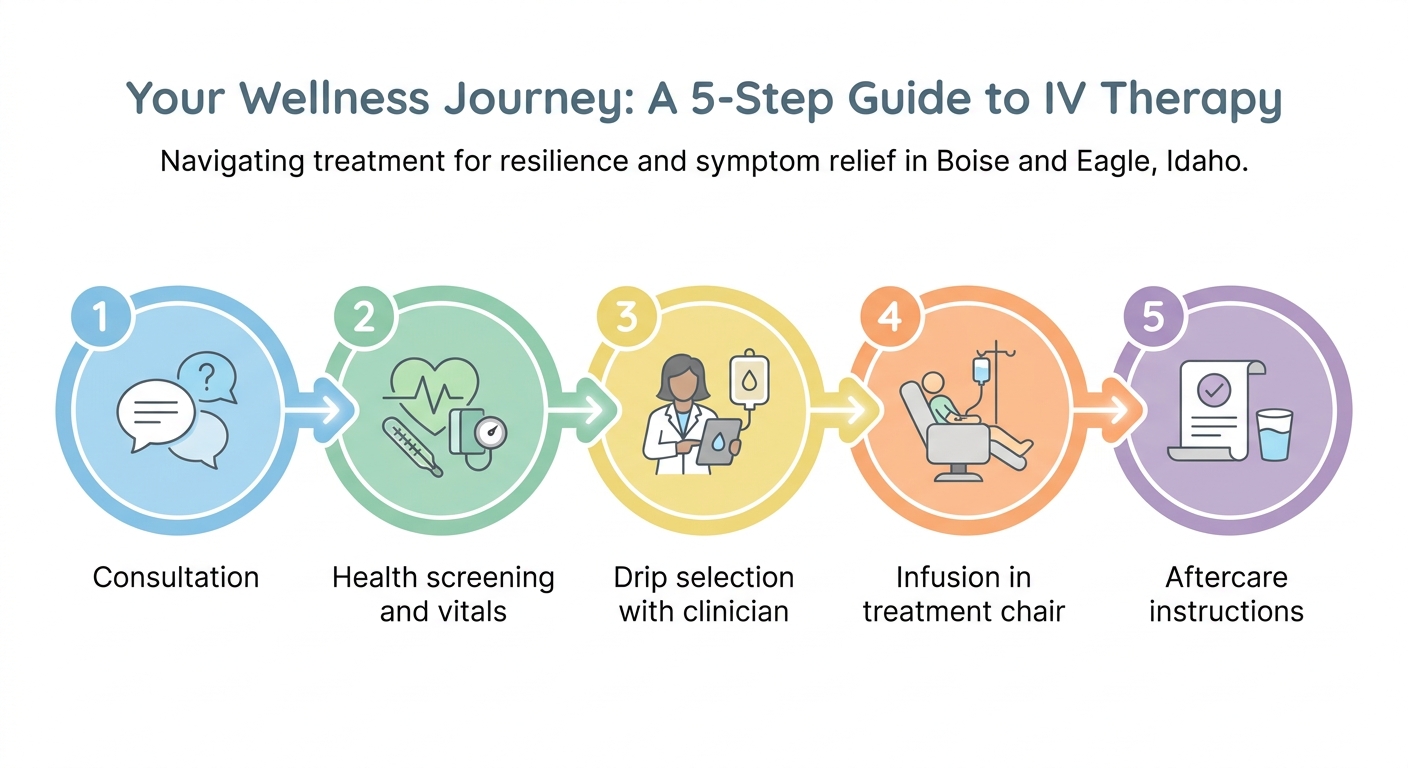
A first visit is straightforward. You'll give a brief health history, have your vitals taken, discuss which drip — if any — fits what's actually going on, spend the infusion time in a chair, and leave with aftercare instructions. The clinical conversation at the start is the part that matters most.
Zora Neuro Spa is a ketamine clinic serving Boise and Eagle that also offers clinician-guided IV nutrition therapy. The same standard applies across both: screen first, explain the options plainly, and say so when a treatment isn't the right fit.
If you've been searching for IV hydration near me and you're still unsure whether a drip makes sense for your situation, the right next step is a conversation, not a booking button. Bring your medication list, your health history, and what you're actually hoping to feel better about — those three things decide the answer. You can review the full drip menu on the IV nutrition menu and pricing page, or read more about what medically supervised IV therapy in Boise involves before you decide.
This article is general information, not medical advice. Discuss your individual health history with a licensed clinician before starting any IV therapy.