Ketamine-Assisted Therapy for Depression: Phase by Phase
Zora Neuro Spa Editorial · November 28, 2026

Depression that shrugs off two, three, or four different medications wears you down in a way that's hard to describe to anyone who hasn't lived it. Ketamine therapy for depression has become one of the most discussed options for people in that position — but most pages describe a single infusion, not the full arc of care around it. This guide walks through all three phases (preparation, dosing, and integration), who tends to qualify, and what to ask before you book anything in the Treasure Valley.
Quick Answer: How Does Ketamine-Assisted Therapy for Depression Work?
Ketamine-assisted therapy works in three phases. First, a preparation visit screens your medical and psychiatric history and sets expectations. Second, a monitored dosing session delivers a sub-anesthetic dose — far below surgical anesthesia levels — while a clinician tracks your vital signs. Third, integration sessions turn what surfaced during dosing into practical changes. The medicine is the doorway; the therapy is the walk through it. Here's what to expect across a full ketamine series.
TL;DR
- Ketamine-assisted psychotherapy is a three-phase model, not a one-off appointment — preparation, dosing, then integration. See the three phases compared side by side
- A standalone infusion delivers the biology; assisted psychotherapy adds the psychological scaffolding around it. Compare the two models and esketamine
- Ketamine acts on the glutamate system, a different pathway from the serotonin-focused antidepressants most people try first. Read why some depression resists SSRIs
- Candidacy is decided in a clinical consultation, with blood pressure, psychiatric history, and current medications all reviewed. Check the candidacy and caution list
- Integration is the phase clinics most often leave out — and the one that shapes what you carry forward. See integration practices for the week after dosing
In This Article
- What Is Ketamine-Assisted Psychotherapy, Exactly?
- Why Doesn't Depression Respond to Standard Antidepressants for Some People?
- What Are the Three Phases of Ketamine-Assisted Therapy?
- How Is Ketamine-Assisted Psychotherapy Different From a Standalone Infusion?
- Who Is a Good Candidate — and Who Isn't?
- How Long Do Results Last, and What Does Maintenance Look Like?
- What Should You Ask a Clinic Before Booking?
What Is Ketamine-Assisted Psychotherapy, Exactly?
Ketamine-assisted psychotherapy (KAP) is a treatment model that pairs a medically supervised sub-anesthetic dose of ketamine with structured therapy sessions before and after the dose. The medicine and the therapy are treated as one program, not two separate services.
Ketamine is an anesthetic and analgesic medication that blocks NMDA glutamate receptors in the brain, and it is used off-label in psychiatry at much lower doses than in surgery, according to the StatPearls clinical monograph on ketamine.
Treatment-resistant depression refers to depression in adults that has not responded adequately to antidepressant treatments already tried in the current episode — the population described in the FDA-approved prescribing information for esketamine nasal spray.
How is KAP different from a medication-only clinic visit?
The difference is what surrounds the dose. In a medication-only model, the clinical focus is the infusion itself: screening, vitals, the drug, recovery, and discharge. That model is legitimate and widely used — our own IV ketamine therapy in Eagle and Boise page explains how the infusion side works.
In an assisted psychotherapy model, a therapist is involved before and after dosing. The added work looks like this:
- Before — clarifying what you want to work on, and what you're afraid might come up.
- During or immediately after — a trained person present to hold the experience without steering it.
- After — sessions that translate insight into specific, small behavioral changes.
People often ask how does ketamine assisted psychotherapy work and expect a pharmacology answer. The honest answer is that it's half pharmacology and half process design. Which half your clinic emphasizes is the single biggest thing to ask about before booking.
Why Doesn't Depression Respond to Standard Antidepressants for Some People?
Because the first-line medications most people try act primarily on serotonin and related monoamine systems — and for some people, that isn't where the bottleneck sits. The National Institute of Mental Health notes that depression is treatable but that people may need to try more than one approach before finding what helps, in its overview of depression.
That's cold comfort when you're the one on your fourth prescription. It helps to know there's a mechanistic reason a different drug class is being studied at all.
What does the glutamate model actually propose?
Researchers studying ketamine focus on a different neurotransmitter system than SSRIs target. Ketamine acts as an NMDA receptor antagonist within the glutamate system, per the StatPearls monograph. Glutamate is the brain's main excitatory messenger, involved in learning and in forming new connections between neurons.
The leading hypothesis — still an area of active research, not settled fact — is roughly this:
- Chronic stress and prolonged depression are associated with weakened connections between neurons in mood-regulating brain regions.
- Serotonin-targeting medications may not directly address that structural piece.
- A drug acting on glutamate signaling may influence the brain's capacity to form new connections.
- If that capacity temporarily increases, the argument goes, therapy done during that period has more to work with.
Note the conditional language. Scientists describe this as a proposed mechanism, and individual responses differ. Nobody should promise you a specific outcome from a mechanism diagram.
What this framing does give you is a reason to stop reading your treatment history as personal failure. If you've tried multiple antidepressants without adequate relief, that's information about pathways — not about your effort or character.
Key takeaway: Trying a treatment that works through a different neurochemical pathway is a clinical strategy, not a last resort — and your prior medication history is part of the screening conversation, not a mark against you.
What Are the Three Phases of Ketamine-Assisted Therapy?
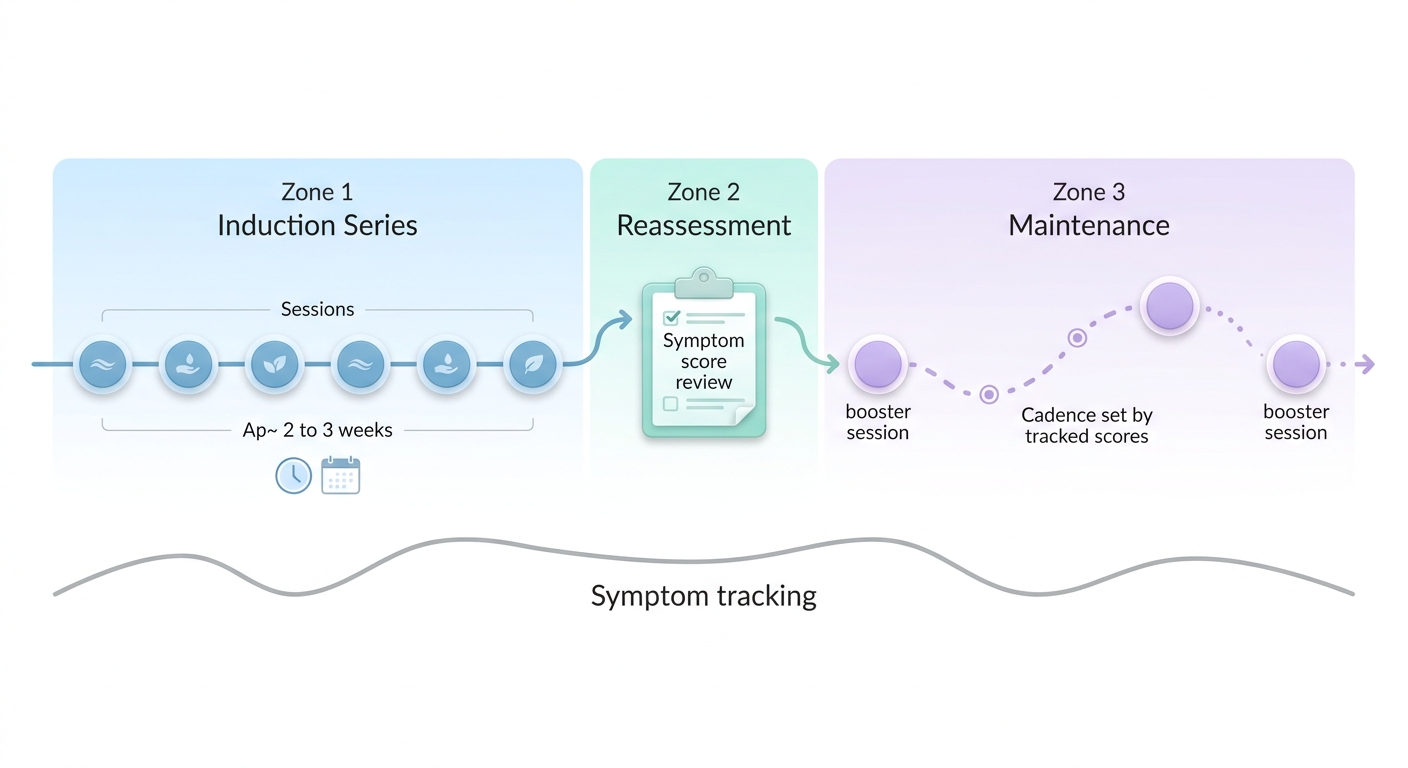
The three phases are preparation, dosing, and integration. Most clinics organize them around an induction series — commonly six infusions scheduled across roughly two to three weeks — with therapy touchpoints woven in before the first dose and after several of them.
Here's the bird's-eye view before we go section by section.
| Phase | Typical duration | Who's in the room | Goal | Risk if skipped |
|---|---|---|---|---|
| 1. Preparation | One visit, roughly 45–60 minutes | Prescriber and/or therapist | Medical screening, intention-setting, expectation calibration | Unscreened risks; arriving with no anchor for the session |
| 2. Dosing | Infusion within a longer monitored appointment | Clinician monitoring vitals; sitter or therapist as the model allows | Deliver a controlled sub-anesthetic dose safely | Unmonitored side effects; an experience nobody helps you frame |
| 3. Integration | One or more therapy sessions across the series | Therapist and patient | Turn insight into concrete daily changes | Insight fades into a vivid memory with no behavior change |
If you want the operational detail on the infusion side — arrival, monitoring, recovery — our guide to what to expect across a full ketamine series covers it step by step.
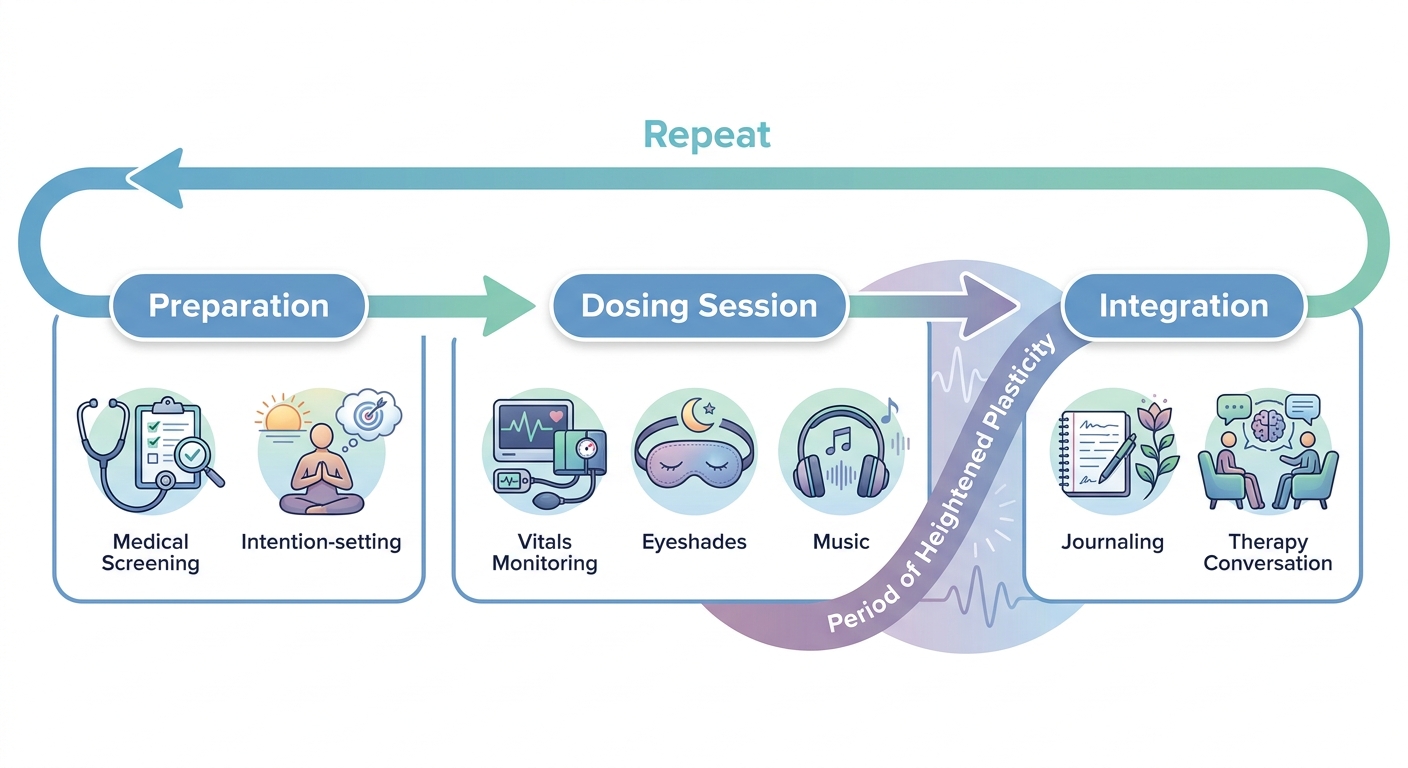
The phases aren't strictly linear. In a six-infusion series you cycle through dosing and integration repeatedly, with preparation revisited whenever something changes — a new medication, a rough week, a shift in what you're working on.
Phase 1 — What Happens During Preparation?
Preparation is a clinical conversation, usually 45 to 60 minutes, covering three things: whether the treatment is medically appropriate for you, what you want out of it, and what the sessions will actually be like.
The medical screening side typically includes blood pressure and cardiovascular review, because ketamine can raise blood pressure and heart rate, as StatPearls notes among its adverse effects. Your prescriber will also review psychiatric history — including any history of psychosis or unmanaged bipolar mania — and your full medication list.
Standardized symptom questionnaires like the PHQ-9 are commonly used at baseline so there's a number to compare against later, rather than relying on memory.
Bring these to your prep session:
- A complete medication list — including doses, supplements, and anything taken as needed.
- Your treatment history — which antidepressants you've tried, at what dose, for how long.
- Recent blood pressure readings, if you track them at home.
- A named goal — what would be different in your week if this helped?
- Your honest questions about dissociation, cost, and time commitment.
- Transportation plans for dosing days.
Preparation is also where a good clinic sets expectations down rather than up. That's a feature. You can start the process through our ketamine consultation request, which covers screening before anything is scheduled.
Phase 2 — What Does the Dosing Session Actually Involve?
A dosing session is a monitored medical appointment built around a slow infusion. Clinics commonly schedule roughly a 40-minute infusion inside a longer appointment window, with time before for vitals and settling in, and time after for recovery.
Most people are seated in a reclining chair. Eyeshades and curated music are common, because reducing outside input helps people stay with their own experience rather than the room.

What does the experience feel like?
Perceptual changes are expected. Ketamine can produce dissociation — altered perception of your body, time, or surroundings — along with drowsiness and, less commonly, nausea, per the StatPearls monograph. These effects are temporary and monitored by staff throughout.
Route matters, too, though not in the way marketing copy implies:
- IV — the medication enters the bloodstream directly, so the clinician controls the rate throughout.
- Intramuscular — a single injection; the clinician cannot slow it once given.
- Sublingual or oral — absorbed through tissue and processed by the digestive system and liver, so dosing is calculated differently.
These are mechanism differences, not a ranking. Which is appropriate for you is a prescriber's decision.
⚠️ Plan the day around the session. Arrange a ride home — do not plan to drive afterward. The FDA labeling for esketamine nasal spray instructs patients not to drive or operate machinery until the next day after restful sleep, per the prescribing information. Follow your clinic's specific fasting and transportation instructions.
Phase 3 — Why Is Integration the Part Most Clinics Skip?
Integration is skipped because it's the least billable hour in the program. An infusion is a discrete, chargeable procedure. A therapy conversation about what the infusion stirred up is harder to schedule, harder to bill, and easy to treat as optional.
Integration is the phase in which insights, images, and emotional shifts from a dosing session are examined in therapy and converted into specific changes in daily life. Without it, a session can end up as a vivid memory rather than a turning point.
The rationale rests on the plasticity hypothesis described earlier: if the brain is temporarily more receptive to forming new connections after a dose, that period is a strategic time to practice new patterns. Researchers are still characterizing how long that period lasts and how much it matters clinically, so treat it as a working model rather than a guarantee.
Practices for the week after a dosing session:
- Write within a day. Not a polished account — bullet fragments, images, single sentences.
- Protect sleep. Keep a consistent bedtime across the series.
- Pick one behavioral change. One walk, one text to a friend, one meal cooked.
- Schedule the therapy hour in advance, not "when I feel like it."
- Lower the stakes on the days around dosing — fewer obligations, softer expectations.
- Track your symptom score on the same scale used at baseline.
Integration sessions often use familiar therapy tools — behavioral activation, cognitive work, trauma-informed approaches — applied to the material the session surfaced. Nothing exotic. The timing is what's different.
For a closer look at the hour itself, see our companion piece on what a single ketamine-assisted psychotherapy session involves.
How Is Ketamine-Assisted Psychotherapy Different From a Standalone Infusion?
A standalone infusion provides the medication and the medical monitoring. Assisted psychotherapy provides those plus the structured therapy around them. Esketamine nasal spray is a third path, with its own FDA-regulated requirements.
| Model | Route | Therapist involved | Typical structure | Often a fit for |
|---|---|---|---|---|
| Standalone IV infusion | Intravenous | Not typically part of the package | Induction series plus boosters | People already working with an outside therapist |
| Ketamine-assisted psychotherapy | IV, IM, or sublingual, depending on the clinic | Yes — before and after dosing | Dosing sessions paired with therapy hours | People who want the medicine and the therapy coordinated |
| Esketamine nasal spray (SPRAVATO) | Nasal spray, self-administered under supervision | Not a labeled requirement | Dosing in a certified healthcare setting, taken with an oral antidepressant | People seeking an FDA-approved option with possible insurance coverage |
Esketamine has requirements the other two don't. It is available only through a restricted distribution program (a REMS), patients must be monitored by a healthcare provider for at least two hours after dosing, and the label carries boxed warnings covering sedation, dissociation, and potential for abuse and misuse, according to the FDA prescribing information.
The trade-offs people usually weigh:
- Cost and time — adding therapy hours adds both.
- Coverage — off-label IV ketamine is generally self-pay; the FDA-approved nasal spray is more often submitted to insurance with prior authorization.
- Continuity — if you already have a therapist you trust, a coordinated standalone infusion may make more sense than switching.
- Preference — some people want to process out loud; others want to sit quietly with it.
Our side-by-side breakdown of IV ketamine therapy in Eagle and Boise covers the infusion-specific details if that's the route you're weighing.
Key takeaway: None of these three models is universally better. The right one depends on your medical history, your insurance situation, whether you already have a therapist, and what a prescriber recommends after screening.
Who Is a Good Candidate — and Who Isn't?
Good candidates generally have moderate-to-severe depression that hasn't responded adequately to prior antidepressant treatment, stable blood pressure, no active psychosis, and the ability to attend a multi-week series with a ride home on dosing days.
That last item sounds mundane and derails more plans than anything clinical.
What does screening look for?
- Prior treatment history — the FDA labeling for esketamine frames treatment-resistant depression in adults who haven't responded adequately to antidepressant treatments in the current episode, per the prescribing information.
- Cardiovascular status — because blood pressure and heart rate can rise during treatment, as StatPearls describes.
- Psychiatric history — including bipolar disorder and any history of psychotic symptoms.
- Current medications — reviewed by your prescriber, never adjusted on your own.
- Substance use history — ketamine carries potential for abuse and misuse, which is why supervised settings are standard.
⚠️ Cautions and exclusions to discuss openly. The FDA label for esketamine lists contraindications including aneurysmal vascular disease, arteriovenous malformation, and a history of intracerebral hemorrhage, per the prescribing information. Uncontrolled hypertension, active substance use disorder, unmanaged bipolar mania, active psychosis, and pregnancy all require careful clinical review. Suitability is decided by a qualified prescriber in consultation — never by a website.
If you're screening yourself out because you've read something discouraging online, bring it to a consultation instead. Our page on ketamine for depression in Boise and Eagle outlines how candidacy is assessed locally, and plenty of people who assume they're disqualified turn out not to be — while others learn a different treatment is a better starting point. Both outcomes beat guessing.
How Long Do Results Last, and What Does Maintenance Look Like?
Duration varies substantially between individuals, and no clinic can promise you a timeline. What clinics can describe is the structure: an induction series first, a reassessment using the same symptom scale you started with, then a maintenance plan built around your tracked scores rather than a fixed calendar.
How is a maintenance schedule decided?
Not by a default interval. A reasonable clinic decides cadence using:
- Repeat symptom questionnaires at consistent intervals.
- Your own reporting about sleep, appetite, and daily functioning.
- Whether integration work is ongoing or has lapsed.
- Side effect tolerance across the series.
- Practical factors — cost, time off work, transportation.
Boosters are typically spaced further apart than induction sessions, and the interval is adjusted over time rather than fixed at the start.
One honest caveat about this whole section: ketamine therapy for depression is not usually positioned as a standalone cure. It's more often described by clinicians as one component alongside therapy, sleep, movement, social connection, and — for many people — a continuing oral antidepressant. Discontinuing other treatments is a prescriber conversation, not a solo decision.
For cost planning and insurance mechanics across a maintenance year, see our ketamine therapy cost and insurance FAQ. Results vary between individuals, and your plan should be built in consultation with your care team.
What Should You Ask a Clinic Before Booking?
Ask three core things: who will be in the room, whether integration therapy is included or billed separately, and how outcomes are measured. Clinics across Idaho vary widely on all three, and the differences rarely show up on a services page.
Eight questions worth asking — with the kind of answer you're looking for:
- Who administers the dose, and who stays in the room? You want a specific role and credential, not "our team."
- Is a licensed therapist involved before and after dosing? A clear yes or no, plus how many sessions.
- Is integration included in the price or billed separately? Get the number, not a range.
- What symptom scale do you use, and how often? A named instrument used at baseline and repeated.
- How is my blood pressure monitored during the session? Continuous or interval monitoring, described plainly.
- What happens if I don't respond to the series? A described next step — not a sales answer.
- How do you coordinate with my existing prescriber or therapist? Release of information, and who writes to whom.
- What are your transportation and aftercare requirements? Specific instructions, given before you book.
If you're comparing options across Boise, Eagle, Meridian, or Middleton, write the answers down as you call. Patterns emerge fast.
A clinic that bundles screening, dosing, and integration under one roof removes the coordination burden — no assembling a prescriber, a therapist, and a monitoring setup yourself, and no repeating your history three times. Our overview of ketamine clinic services in Boise and Eagle shows how that bundling works in practice.
Summary: Ketamine Therapy for Depression, Phase by Phase
Ketamine therapy for depression is best understood as a three-phase program rather than a procedure. Preparation determines whether it's appropriate and what you're working toward. The dosing session delivers a monitored sub-anesthetic dose. Integration converts what surfaced into changes you can actually live with.
The phase that gets cut is almost always the third one — and it's the one that shapes whether the series becomes a memory or a turning point. When you compare clinics in the Treasure Valley, compare on that, not on the infusion alone. Individual results vary, and suitability is determined through clinical consultation.
Frequently Asked Questions
Is ketamine-assisted psychotherapy covered by insurance?
IV ketamine for depression is generally self-pay, because it's used off-label for this purpose. Esketamine nasal spray is FDA-approved for treatment-resistant depression and is more often submitted to insurance with prior authorization. Many patients use HSA or FSA funds. Coverage varies by plan — verify with your insurer and review our ketamine therapy cost and insurance FAQ before booking.
How many sessions does it take before depression improves?
There's no guaranteed timeline, and responses differ between individuals. Clinics commonly plan an induction series of about six sessions across two to three weeks, then reassess using the same symptom questionnaire taken at baseline. That reassessment — not a single session — is when your prescriber discusses whether to continue, adjust, or try a different approach.
Can you stay on your antidepressant during ketamine therapy?
Usually yes. Many patients continue their oral antidepressant, and the FDA labeling for esketamine describes it being used together with an oral antidepressant, per the prescribing information. Some medications — including certain sedatives — may be reviewed or timed differently around dosing days. Never adjust anything yourself; all changes are prescriber-directed.
Does ketamine-assisted therapy work for anxiety and PTSD too?
The same three-phase structure is used off-label for anxiety and PTSD at many clinics, including ours. The evidence base for these uses is less established than for depression, so expect a prescriber to discuss it as an off-label option with individual results varying. Screening, monitoring, and integration requirements are the same.
What's the difference between dissociation and a bad reaction?
Dissociation is an expected, temporary change in how you perceive your body and surroundings, and it's a known effect of ketamine, as StatPearls describes. A concerning reaction looks different — sustained blood pressure elevation, vomiting, or escalating panic. That's precisely why sessions are monitored: staff manage these in real time. Tell your clinician immediately if something feels wrong.
Information about third-party platforms reflects publicly available details at the time of writing and may have changed. Please verify directly with the provider. See our Terms of Use for more.