Ketamine Side Effects in Kuna: Who Gets What, and Why
Zora Neuro Spa Editorial · November 4, 2026
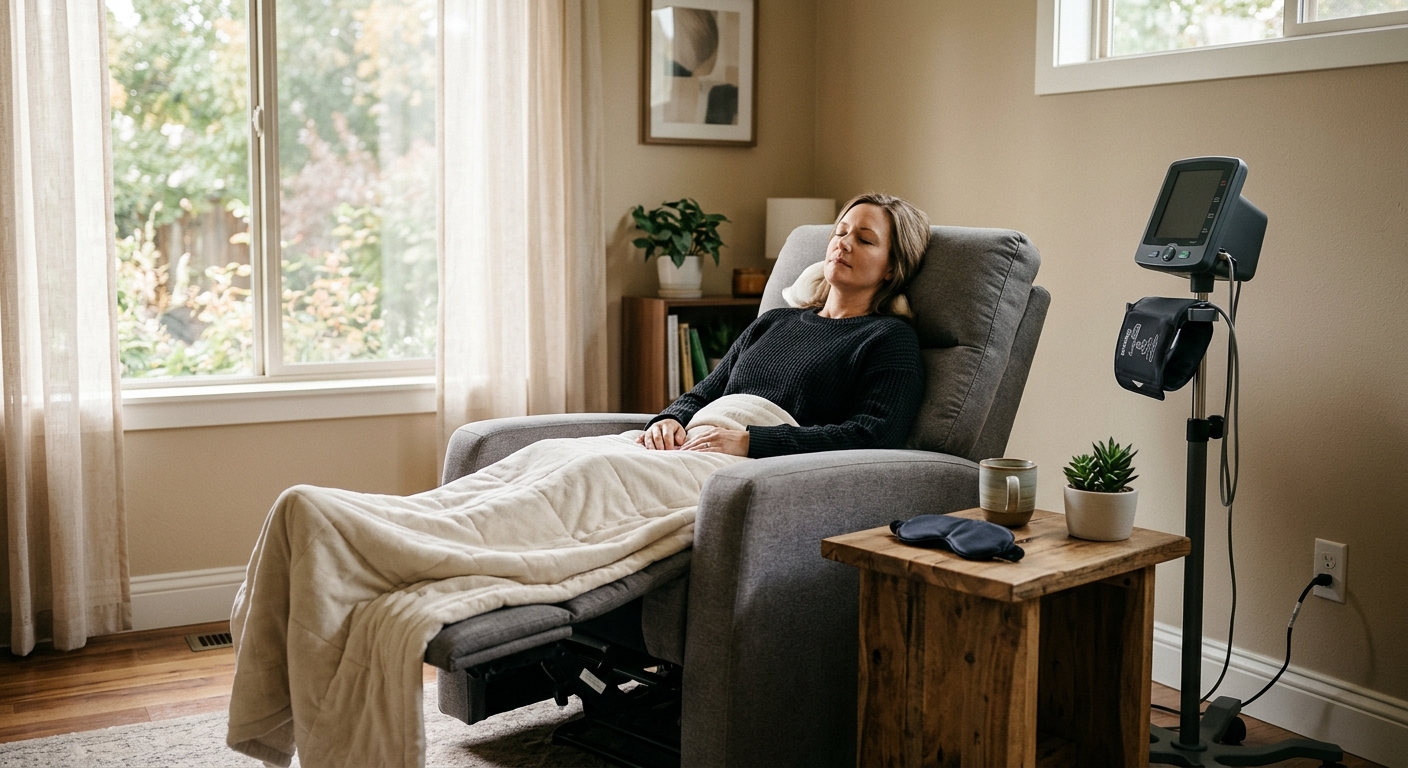
Ketamine's reputation for side effects comes mostly from recreational-dose headlines, not from what happens in a monitored clinic. If you live in Kuna and you're researching ketamine side effects before booking a consultation in the Treasure Valley, the question that actually matters isn't "what can happen?" — it's "what is likely to happen to me, and why?" This guide breaks down the personal variables that shape your experience, how IV and nasal spray differ, and how long each effect realistically lasts.
Quick Answer
At clinical doses, most ketamine side effects are short-lived: a dreamlike dissociated feeling, nausea, dizziness, and a temporary rise in blood pressure that typically settle within the monitoring window after dosing ends. Risk isn't uniform across patients. Dose per kilogram, infusion speed, baseline blood pressure, anxiety going in, and how many sessions you've had all shift what you feel. A commonly used subanesthetic protocol in depression research is 0.5 mg/kg infused over about 40 minutes, per the StatPearls ketamine monograph.
TL;DR
- Side effects are dose- and route-dependent, not random. The same drug produces a very different experience at a clinical infusion rate than at an anesthetic or recreational dose. See what ketamine actually causes
- Six personal variables explain most of the variation between two patients receiving the same milligram-per-kilogram dose. Review the risk factor breakdown
- IV and nasal spray have meaningfully different profiles, including different monitoring requirements. Compare IV infusion and esketamine side by side
- Effects sort into duration tiers — minutes, hours, and the rare category measured in months. Walk through the recovery timeline
- Bladder and cognitive concerns track with frequency and duration of exposure, which is why screening and spacing matter. Read what the serious risks involve
In This Article
- What Side Effects Does Ketamine Actually Cause?
- Which Personal Factors Change Your Risk?
- How Do IV Infusion and Nasal Spray Side Effects Differ?
- How Long Do Ketamine Side Effects Last?
- What Are the Rare but Serious Risks?
- How Can You Reduce Side Effects Before Your Session?
- What Should You Ask a Kuna-Area Clinic Before Booking?
What Side Effects Does Ketamine Actually Cause?
Documented effects fall into four categories: dissociative and perceptual, cardiovascular, gastrointestinal, and neurological. The StatPearls ketamine monograph describes adverse effects including emergence reactions, elevated blood pressure and heart rate, nausea and vomiting, and increased salivation.
Dissociation is a temporary altered sense of body, time, and surroundings — floaty, dreamlike, sometimes described as watching yourself from a short distance. It builds during the infusion and fades after it stops.
Emergence reaction refers to the confusion, vivid imagery, or agitation that can occur as the medication wears off and normal orientation returns.
Here's what the short government and consumer fact sheets tend to leave out: they list effects without explaining incidence or context. A page that mixes recreational exposure data with clinical dosing data will make a monitored 40-minute infusion sound like something it isn't. Dose, setting, and supervision change the picture entirely.
The common, expected effects at clinical doses include:
- Perceptual shifts — altered sense of time, visual drift, a sense of distance from the body
- Dizziness or lightheadedness — often most noticeable when first standing
- Nausea — among the most frequently reported and the most preventable
- Transient blood pressure and heart rate increase — the reason vitals are monitored throughout
- Grogginess or fatigue — a common reason patients need a ride home
- Blurred or doubled vision — usually brief
For a system-by-system walkthrough of how these effects present, our guide to ketamine side effects body system by body system goes deeper than this overview allows.
Key takeaway: The effect categories are well documented; what most sources skip is why two patients on the same dose have different sessions.
Which Personal Factors Change Your Risk?
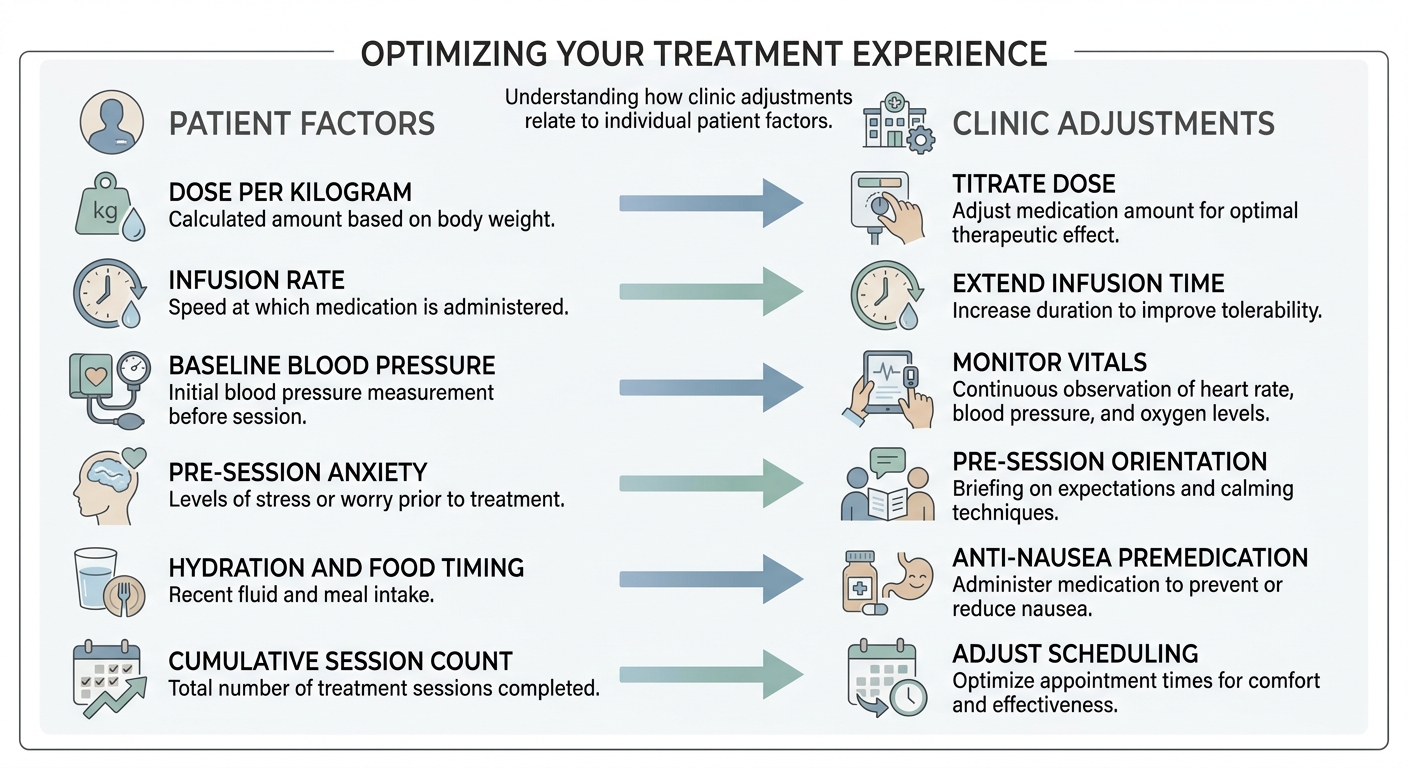
Six variables account for most of the person-to-person variation. Clinics can adjust several of them, which is the practical reason to raise your own risk factors during a consultation rather than waiting to see what happens.
| Factor | What it most influences | What a clinic can adjust |
|---|---|---|
| Dose per kilogram | Dissociation intensity, sedation depth | Start lower, titrate across sessions |
| Infusion rate | Speed of onset, nausea, how abrupt dissociation feels | Extend the drip time |
| Baseline blood pressure | Degree of cardiovascular rise during dosing | Screening, pre-session vitals, monitoring cadence |
| Pre-session anxiety and expectation | How distressing dissociation feels | Orientation, eye mask, music, staff presence |
| Hydration and food timing | Nausea, lightheadedness | Pre-session instructions, anti-nausea medication |
| Cumulative session count | Familiarity, tolerance of the experience | Scheduling and spacing |
Two of these deserve extra attention for Kuna-area readers.
Infusion rate is underrated. Slowing the delivery of the same total dose gives the body a gentler curve. Clinics commonly use this lever when a patient reports that a session felt too intense or nausea came on quickly.
Anxiety sensitivity shapes interpretation, not just intensity. Dissociation is neutral physiology. Whether it feels peaceful or alarming depends heavily on preparation, the room, and whether you know what's coming. Patients who are told exactly what to expect often describe the same sensations in far calmer language.
Blood pressure deserves its own note. The FDA prescribing information for esketamine nasal spray lists increases in blood pressure as a warning and names aneurysmal vascular disease, arteriovenous malformation, and a history of intracerebral hemorrhage as contraindications (SPRAVATO prescribing information). If you have cardiovascular history, that belongs in your intake paperwork — not as a footnote.
Protocol design matters as much as patient biology. Our breakdown of how clinics prevent ketamine side effects covers the monitoring side in detail.
Key takeaway: Most of your side effect profile is predictable from six variables, and a clinic can modify several of them before your first session.
How Do IV Infusion and Nasal Spray Side Effects Differ?
IV and intranasal delivery differ in how the medication enters the bloodstream, which changes the shape of the experience. An intravenous drip places the dose directly into circulation and can be slowed or stopped mid-session. The FDA label for esketamine nasal spray reports a mean absolute bioavailability of roughly 48% after nasal administration — absorption across a mucous membrane, which is inherently more variable than a vein (SPRAVATO prescribing information).
| Attribute | IV ketamine infusion | Esketamine nasal spray |
|---|---|---|
| Delivery control | Rate adjustable or stoppable mid-session | Fixed device doses, self-administered under supervision |
| Absorption | Direct into bloodstream | Approximately 48% bioavailability per FDA label |
| Commonly reported effects | Dissociation, dizziness, nausea, transient BP rise | Dissociation, dizziness, nausea, sedation, vertigo, altered taste |
| Post-dose monitoring | Clinic-determined observation period | At least 2 hours, required under the FDA REMS program |
| Driving same day | Not advised | Prohibited until the next day after restful sleep, per label |
| Regulatory framework | Off-label clinical use | FDA-approved with REMS requirements |
The FDA prescribing information lists dissociation, dizziness, nausea, sedation, vertigo, and headache among the adverse reactions reported most frequently in short-term trials — dissociation in roughly 41% of treated patients, dizziness around 29%, and nausea around 28%. Those are reported rates across a trial population, not a prediction for any individual.
The required two-hour observation period after nasal dosing isn't a formality. It exists because sedation and dissociation after intranasal administration follow a slower, less predictable curve than a controlled drip.
Patients considering IV ketamine therapy in Boise and Eagle often cite the controllability of the infusion as the deciding factor. If a session feels too intense at minute 15, the rate can change.
For a fuller route-by-route comparison including oral dosing, see IV vs nasal spray vs oral side effects. For trial-reported figures on the nasal spray specifically, our write-up on Spravato success rates and side effects by the numbers organizes the label data.
How Long Do Ketamine Side Effects Last?
Most clinical-dose effects resolve on the same day. The timeline below reflects the general pattern described in clinical literature; individual recovery varies, and your provider will set your own observation window.
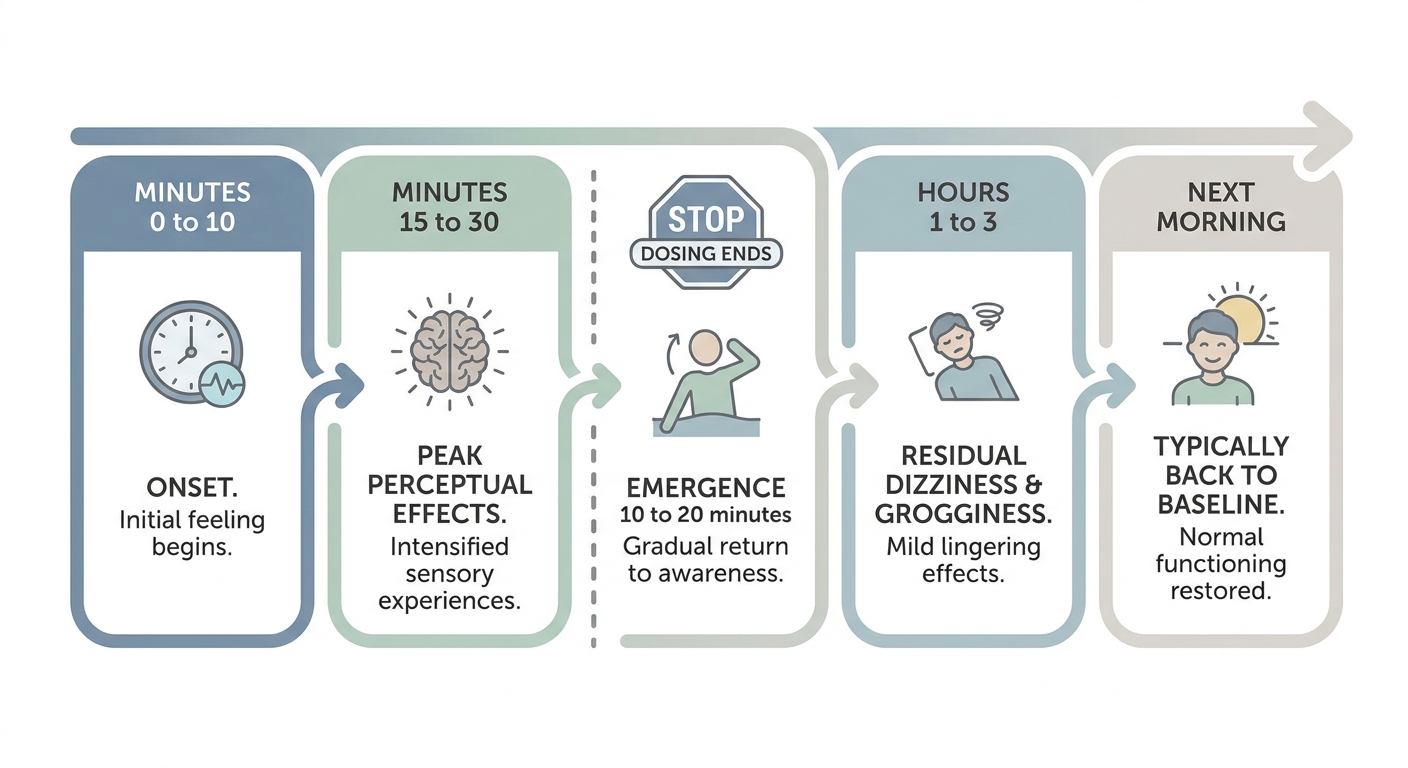
Emergence is the window after dosing ends when orientation, coordination, and normal perception return. Staff typically keep patients seated and monitored through this period.
Roughly how the tiers break down:
- Perceptual and dissociative effects — fade in the period shortly after dosing stops
- Dizziness, unsteadiness, grogginess — commonly a few hours
- Mild fatigue or headache — can linger into the evening or next morning
- Blood pressure and heart rate — typically return toward baseline during the monitoring period
Short-acting doesn't mean "fine to drive." The FDA label for the nasal spray instructs patients not to drive or operate machinery until the following day after restful sleep. Treating IV sessions the same way is the conservative, sensible approach.
Anything that persists past about 48 hours — ongoing confusion, visual disturbance, urinary symptoms, or unusual mood changes — warrants a call to your provider rather than a wait-and-see week. That distinction between transient and persistent is covered more thoroughly in our guide to what lasts minutes vs months.
What Are the Rare but Serious Risks?
Two risks deserve genuine attention, and both relate to frequency and duration of exposure rather than to a single supervised session.
Urinary and bladder effects. The FDA prescribing information for esketamine lists ulcerative or interstitial cystitis among its warnings, noting that cases have been reported in connection with ketamine misuse and abuse (SPRAVATO prescribing information). Symptoms to report include pain on urination, urinary frequency, and lower abdominal discomfort. The label directs clinicians to evaluate these symptoms if they appear.
Cognitive and abuse-related concerns. The same label addresses the potential for abuse and misuse, and the StatPearls monograph discusses adverse effects associated with ketamine use. Much of the alarming cognitive data in circulation comes from heavy, repeated, unsupervised exposure — a very different pattern from a spaced, physician-supervised series.
⚠️ Be cautious with any source that discusses recreational and clinical ketamine in the same breath without separating them. Frequency, dose, purity, and supervision are the variables that distinguish the two, and blending the data distorts the risk picture in both directions.
Two other screening-relevant issues:
- Blood pressure elevation — the reason cardiovascular history is reviewed before approval and vitals are checked during dosing
- Bipolar screening — clinicians assess mood disorder history before treatment; if you have a bipolar diagnosis or a family history of mania, discuss it explicitly at consultation
Our longer look at long-term effects of ketamine therapy covers how providers think about spacing and ongoing maintenance.
Key takeaway: The serious risks are real but exposure-dependent — which is exactly why screening, spacing, and honest symptom reporting matter more than worst-case headlines.
How Can You Reduce Side Effects Before Your Session?
Most of what makes a session comfortable happens before the IV goes in. A short preparation checklist handles the majority of preventable discomfort.

- Eat a light meal 3–4 hours before — not a full stomach, not an empty one
- Skip alcohol for at least 24 hours beforehand
- Arrange a driver — this is non-negotiable for the full day
- Bring your complete medication list, including supplements and any benzodiazepines, so your provider can review interactions
- Mention motion sickness history — patients prone to it often do better with anti-nausea medication given in advance
- Pack headphones and an eye mask — reducing visual and auditory input tends to make perceptual effects feel calmer
- Hydrate normally the day before, unless your clinic says otherwise
Expectation management belongs on that list too. Knowing that a floaty, detached feeling is the medication working as expected — not a warning sign — changes how the same sensation registers.
Our step-by-step guide to what to expect from your ketamine infusion walks through the full appointment from check-in to discharge.
What Should You Ask a Kuna-Area Clinic Before Booking?
Ask about monitoring, staffing, dose flexibility, and the plan if you react poorly. Kuna residents generally travel to Boise, Meridian, or Eagle for IV treatment, since dedicated infusion clinics cluster in the Treasure Valley core — a short drive worth making for the right setup.
Five questions and the answers you want to hear:
- "What vitals do you monitor, and how often?" — Look for continuous or frequent blood pressure, heart rate, and oxygen monitoring throughout dosing.
- "Who is in the room during my session?" — A licensed clinician should be present or immediately available for the entire appointment.
- "Can you adjust my dose or infusion rate mid-session?" — Yes should be the answer, with an explanation of how.
- "What happens if my blood pressure rises or I get nauseated?" — Expect a specific protocol, not a vague reassurance.
- "How do you screen for bladder, cardiac, and bipolar risk factors?" — A structured intake should cover all three before your first appointment.
Our comparison framework on how to choose a ketamine clinic in Boise expands each of these into a fuller vetting checklist.
Frequently Asked Questions
More practical answers live in our ketamine safety and process FAQ.
Can you drive after a ketamine infusion?
No — plan on not driving for the rest of the day. The FDA label for esketamine nasal spray instructs patients not to drive or operate machinery until the next day following restful sleep. The same caution is the standard approach after IV sessions. Arrange a ride before you book.
Do ketamine side effects get worse with more sessions?
Typically the opposite, in terms of how the experience feels. Many patients describe dissociation as less startling by the third or fourth session simply because it's familiar. Cumulative risks such as bladder symptoms are a separate, frequency-driven question your provider monitors over time.
Is nausea common during ketamine treatment?
Yes — nausea is among the more frequently reported effects, and it's also among the most preventable. Anti-nausea premedication is a routine part of many protocols, and timing your last meal correctly helps considerably. Tell your clinic if you get carsick or seasick easily.
Are ketamine side effects different for chronic pain patients than for depression patients?
Somewhat. Pain protocols often involve longer infusions and higher cumulative dosing, which can extend dissociation and next-day fatigue compared with a standard depression series. Our guide to ketamine infusion side effects for chronic pain patients covers those differences.
Summary
Ketamine side effects at clinical doses are mostly short-lived, largely predictable, and significantly modifiable. Dose per kilogram, infusion rate, baseline blood pressure, pre-session anxiety, hydration, and session count explain most of the variation between patients — and a clinic can adjust several of those before you ever sit in the chair. IV and nasal spray differ in control and monitoring requirements, not in whether they're worth considering. The risks that genuinely deserve attention, including bladder and cognitive concerns, track with frequency and exposure, which is why screening and honest symptom reporting matter. Results and experiences vary between individuals, and suitability is determined in a clinical consultation.
Information about third-party platforms reflects publicly available details at the time of writing and may have changed. Please verify directly with the provider. See our Terms of Use for more.