Ketamine Side Effects Nobody Warned You About
Zora Neuro Spa Editorial · October 31, 2026

Most people researching ketamine therapy have read the clinical fact sheets and still feel like something is missing. The lists name the effects but rarely say how long they last, how route changes them, or where the real line sits between a normal infusion day and a problem. This guide answers the six questions patients in Boise and Eagle ask most about ketamine side effects, in plain language, with sources you can check.
Quick Answer
Ketamine side effects are the short-term physical and perceptual changes that follow a dose of ketamine — most commonly dissociation (a temporary feeling of detachment from your body or surroundings), dizziness, nausea, sedation and a brief rise in blood pressure. In monitored clinic settings, these are dose-dependent and fade during the supervised recovery period rather than lasting for days. The serious long-term concern people have read about — bladder damage — has been reported in the medical literature, most often in connection with frequent, high-dose use outside a monitored clinical setting (StatPearls). Clinics manage the rest with screening, weight-based dosing and vital-sign monitoring.
TL;DR
- Acute effects peak during the infusion and ease off during monitored recovery, not over the following week. See the hour-by-hour timeline
- Nausea and a transient blood pressure rise are the two effects clinics actively plan for and manage. See how clinics prevent them
- Ketamine-related bladder injury is tied to cumulative exposure and frequency, which is why clinical series and daily recreational use are not comparable. Read the bladder risk breakdown
- Spravato (esketamine) nasal spray carries FDA-required in-clinic observation and a no-driving rule for the rest of the day. See the Spravato-specific effects
- The route you take changes the side effect profile, not just the dose. Compare IV, nasal and oral
In This Article
Here's where we're headed — jump to whatever you came for.
- What Are the Most Common Ketamine Side Effects?
- How Long Do Ketamine Side Effects Last?
- Does Ketamine Cause Bladder Problems?
- How Do Side Effects Differ by Route: IV, Nasal Spray, or Oral?
- What Side Effects Are Specific to Spravato Nasal Spray?
- Which Side Effects Should You Call Your Clinic About?
- How Do Clinics Keep Side Effects Small in the First Place?
- Do Side Effects Change Over a Full Treatment Series?
What Are the Most Common Ketamine Side Effects?
The effects reported most often are dissociation, dizziness, nausea or vomiting, sedation, and a temporary rise in blood pressure and heart rate. The clinical monograph on ketamine in StatPearls describes this cluster of psychological and cardiovascular effects as characteristic of the drug, and notes they are dose-related.
Dissociation is a temporary sense of separation from your body, your thoughts, or the room around you. It is the effect that surprises first-time patients most, and it is also the one that typically feels least alarming once a clinician has described it in advance.
| Effect | How often it's reported | Usual onset | Usual resolution |
|---|---|---|---|
| Dissociation | Very common | Within minutes of dosing | As the dose wears off |
| Dizziness / unsteadiness | Very common | During dosing | During monitored recovery |
| Nausea or vomiting | Common | Mid-session onward | Often prevented with pre-medication |
| Blood pressure / heart rate rise | Common | During dosing | Returns toward baseline after |
| Headache or grogginess | Reported by some | Late session or after | Same day |
A few things worth knowing that the short fact sheets skip:
- Nausea is largely preventable. Many clinics give an anti-nausea medication before the infusion starts rather than waiting for symptoms.
- Blood pressure changes are expected, not surprising. That is precisely why a cuff stays on you throughout.
- Set and setting matter. A quiet room, an eye mask and a clinician who has explained dissociation in advance change how the same dose feels.
- Effects are individual. Two people at the same weight-based dose can have genuinely different experiences.
If you want the operational detail, our guide to how clinics monitor and prevent side effects walks through the monitoring stack step by step.
Key takeaway: The common effects are perceptual and cardiovascular, they track with dose, and most of them are anticipated and managed rather than discovered mid-session.
How Long Do Ketamine Side Effects Last?
Short answer: the acute effects are tied to the dose being in your system, and they ease during the supervised recovery window rather than stretching across days. Ketamine has a short duration of action at sub-anesthetic doses, as described in the StatPearls pharmacology review, which is why clinics build a recovery period into the appointment instead of sending you straight out the door.
A commonly described protocol for depression uses a low, weight-based dose delivered slowly by IV, as described in the StatPearls pharmacology review. Using that as the anchor, here is how a treatment day usually unfolds:
- During the infusion — dissociation, floating or dreamlike perception, dizziness, possible nausea. Vitals are checked throughout.
- Recovery period after the drip stops — perceptual effects recede, unsteadiness fades, staff confirm you are oriented and stable before discharge.
- The rest of that day — tiredness, mild headache or a "wrung out" feeling are frequently described. You do not drive.
- Next morning — most people report feeling normal after a night of sleep and resume usual activity.
- The following week — no ongoing side effects are expected from a single standard session.
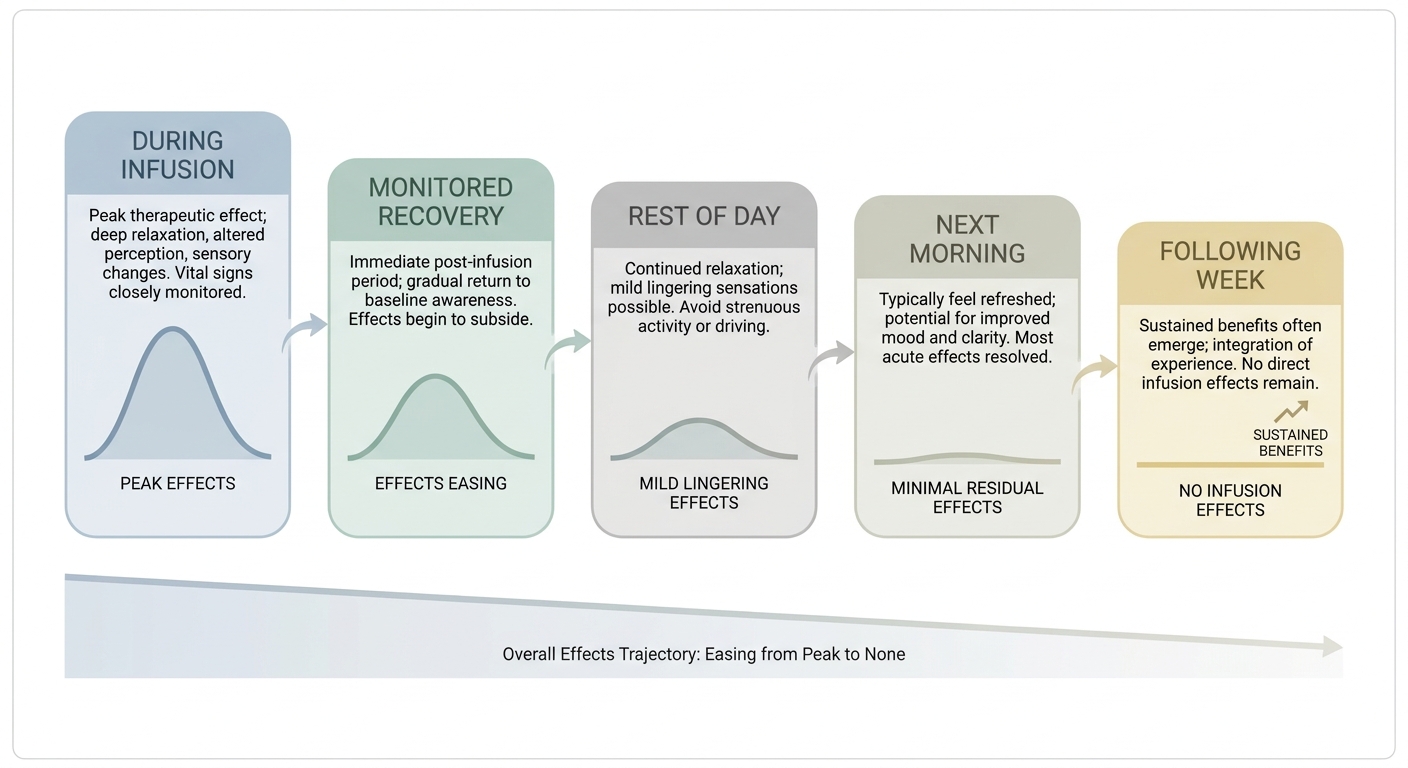
Two honest caveats. First, "how long do ketamine side effects last" is partly a question about you — age, hydration, anxiety level and other medications all shape the day. Second, anything that persists into the next morning deserves a phone call rather than a wait-and-see.
For a closer look at which effects are measured in minutes and which belong to a longer conversation, see our breakdown of what lasts minutes versus months.
Does Ketamine Cause Bladder Problems?
This is the question the brief fact sheets handle worst, so here is the straight version. Ketamine-induced cystitis is inflammation and injury to the bladder lining associated with ketamine exposure. It appears in the medical literature as a recognized complication, and StatPearls lists urinary and bladder toxicity among ketamine's documented adverse effects.
The part that gets lost in headlines is context. The published cases cluster around heavy, frequent, unsupervised use — repeated dosing over long stretches, often daily, at amounts far beyond a clinical protocol. Cumulative exposure and frequency are the drivers, not the existence of the molecule.
That distinction matters because the two patterns are not remotely alike:
| Monitored clinical series | Frequent unsupervised use | |
|---|---|---|
| Dose | Low, calculated by body weight | Self-determined, often escalating |
| Frequency | Spaced sessions on a plan | Daily or near-daily |
| Oversight | Clinician present, vitals tracked | None |
| Cumulative exposure | Limited and documented | Large and unrecorded |
Symptoms worth knowing regardless of which category you are in:
- Pain or burning when passing urine
- Needing to urinate more often or more urgently
- Lower abdominal or pelvic discomfort
- Blood in the urine
⚠️ Report urinary symptoms early. Urinary changes during or after a ketamine course are not something to wait out. Tell your prescriber at the first sign — early reporting is what allows dosing to be adjusted or paused before anything progresses.
If you have only ever seen ketamine discussed in the context of misuse, our comparison of clinic dose versus street dose lays out exactly how far apart the two exposure patterns sit.
One more practical note: bladder risk is a reason to be honest with your clinic about any past or current recreational use. It changes the screening conversation and the monitoring plan — it does not automatically rule you out.
How Do Side Effects Differ by Route: IV, Nasal Spray, or Oral?
Route changes how much drug reaches your bloodstream and how fast, and that shapes the side effect profile. StatPearls notes that ketamine's bioavailability — the share of a dose that reaches circulation — is highest by the intravenous route and substantially lower by intranasal and oral routes, which is why the same nominal amount behaves very differently depending on how it is given.
| Route | Bioavailability (per StatPearls) | Distinctive side effects | Monitoring |
|---|---|---|---|
| IV infusion | Highest — the full dose enters circulation | Most predictable dissociation and blood pressure response; rate can be slowed mid-session | In-clinic, continuous vitals |
| Intranasal esketamine (Spravato) | Substantially lower than IV | Nasal discomfort, altered taste, throat irritation, plus dissociation and sedation | In-clinic, FDA-required observation |
| Oral / sublingual | Lowest of the three | More GI upset; less predictable peak effect | Varies by program |
The practical implications:
- IV is the most controllable. Because the dose is delivered on a curve the clinician sets, an infusion can be slowed if dissociation feels like too much.
- Nasal adds local effects. Irritation and taste disturbance are specific to spraying a drug into your nose, and they are not a sign something has gone wrong.
- Oral is the least predictable. Lower and more variable absorption means the same dose can feel different session to session.
Spravato (esketamine) is the only nasal form approved by the FDA for its labeled psychiatric indication, and its prescribing information sets out specific administration and monitoring requirements. For a side-by-side at greater depth, see our comparison of IV vs nasal spray vs oral side effects.
What Side Effects Are Specific to Spravato Nasal Spray?
The esketamine label names dissociation, dizziness, nausea, sedation, vertigo, decreased sensitivity to touch, anxiety, lethargy, vomiting, feeling drunk and increased blood pressure among the most commonly reported adverse reactions (FDA prescribing information). Nasal-specific complaints — nasal discomfort, throat irritation and a lingering taste — come with the delivery method itself.
Because of sedation and dissociation, esketamine is not a take-home medication. Per the FDA label:
- It is self-administered under direct supervision of a healthcare provider in a certified setting.
- Patients are monitored for at least two hours after dosing, including blood pressure checks.
- It is available only through a restricted program under a Risk Evaluation and Mitigation Strategy (REMS).
- You do not drive or operate machinery until the next day following restful sleep.
The label also lists contraindications, including aneurysmal vascular disease, arteriovenous malformation and a history of intracerebral hemorrhage — which is exactly why the screening appointment asks about vascular history rather than just mood symptoms.
Key takeaway: Spravato's side effect profile is not mysteriously different from IV ketamine, but the federal observation and no-driving rules are specific, non-negotiable, and should shape how you plan the day.
Our deeper look at esketamine benefits and side effects covers what the label does and does not establish.
Which Side Effects Should You Call Your Clinic About?
Call if something is new, escalating, or still present 24 hours after your session. That one rule covers most situations. Here is the concrete checklist:
- Urinary pain, burning or urgency that does not resolve quickly
- Home blood pressure readings staying elevated after your clinic told you what range to watch
- Confusion, slurred speech or disorientation the next morning
- Nausea or vomiting preventing you from keeping fluids down
- Worsening mood, hopelessness or suicidal thinking at any point
- Chest pain, severe headache or vision changes — treat these as urgent medical care, not a callback
⚠️ If you are in crisis, do not wait for a clinic callback. Call or text 988 to reach the Suicide & Crisis Lifeline, or go to the nearest emergency department. Depression can worsen for reasons unrelated to treatment, and the National Institute of Mental Health is clear that worsening symptoms warrant prompt attention.
Before your first session, ask your clinic three questions: who do I call after hours, what number, and what should I write down? Having a simple record of timing, severity and duration turns a vague "I felt off" into something a clinician can act on. Our guide to what to track at home after an infusion gives you a ready-made list.
How Do Clinics Keep Side Effects Small in the First Place?
Four things do most of the work: careful screening, weight-based dosing, continuous monitoring and anti-nausea pre-medication. None of it is exotic — it is just applied consistently, which is the entire difference between a managed side effect and a frightening one.
The usual sequence looks like this:
- Intake and screening — medical history, psychiatric history, current medications, substance use, vascular risk factors.
- Baseline vitals — blood pressure and heart rate recorded before anything is given.
- Dose calculated by body weight — not a flat dose for everyone.
- Pre-medication for nausea where appropriate.
- Continuous monitoring during dosing — blood pressure cuff, pulse oximetry, a clinician in reach.
- Supervised recovery — you are not discharged until vitals and orientation are confirmed.
- Follow-up check-in — so anything that showed up at home gets captured.
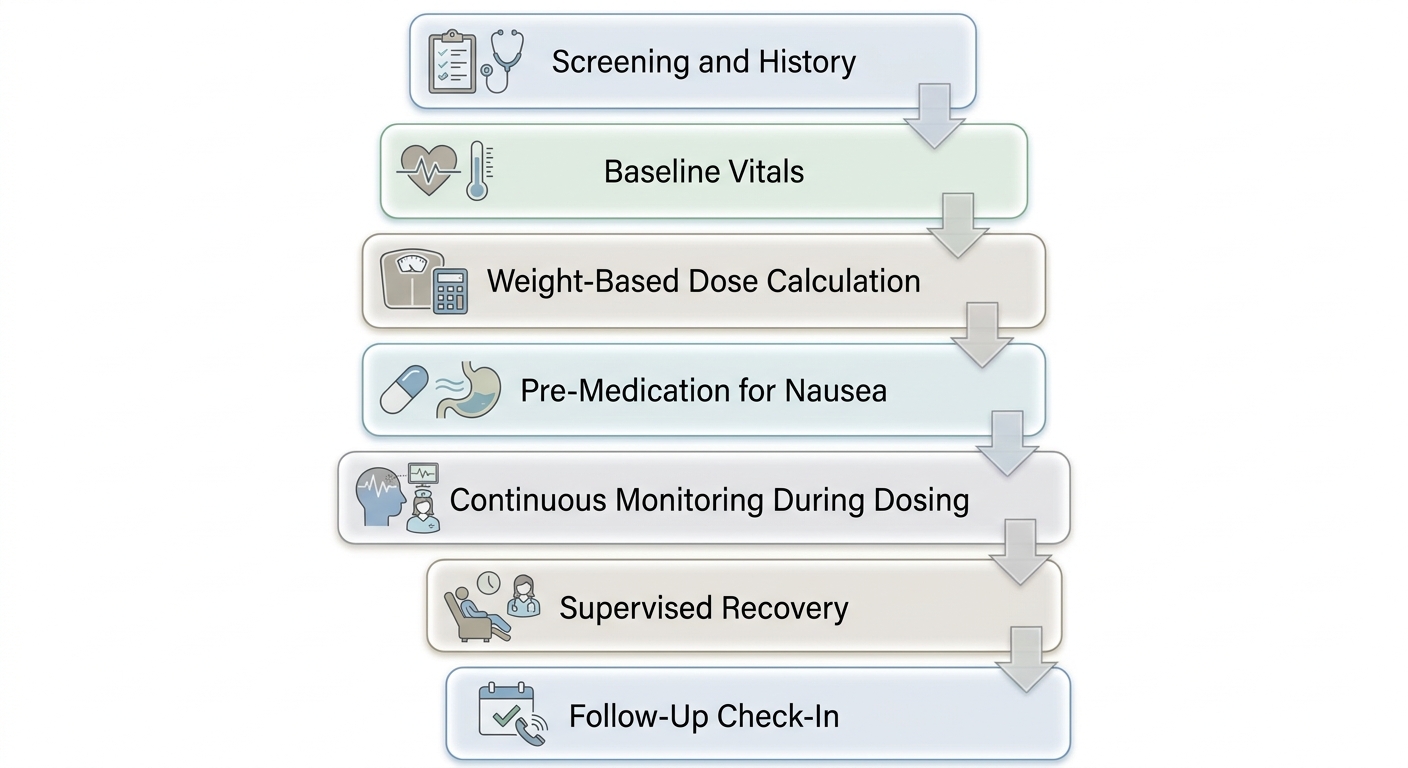
Where unsupervised or at-home protocols differ is structural. Remove the clinician from the room and you remove the baseline vitals, the mid-session dose adjustment, the monitored recovery and the person who notices your blood pressure before you do. That is not a judgment about any individual program — it is simply a list of steps that are physically impossible without staff present.
This is the burden a monitored setting takes off you. IV ketamine therapy in Boise and Eagle at our Eagle clinic is built around that sequence, so the monitoring is handled while your only job is to rest.
Key takeaway: Most ketamine infusion side effects are anticipated in advance and managed in real time; the structure of the appointment is the safety feature.
Do Side Effects Change Over a Full Treatment Series?
Some patients find later sessions feel more familiar than the first, since they already know what to expect. — not necessarily milder chemically, but easier because they know what dissociation feels like and are no longer bracing against it. Familiarity with the setting, the staff and the sensations changes the subjective experience of the same protocol.
Two things to hold separately:
- Session-level effects — dissociation, dizziness, nausea. These reset with each appointment and are managed each time.
- Cumulative considerations — urinary and bladder health, which relate to total lifetime exposure rather than any single session.
That second category is the reason maintenance sessions are spaced out rather than stacked, and the reason your clinician keeps a record of every dose you have received. Spacing is a deliberate way of keeping cumulative exposure low while continuing care.
Our review of side effects after six months of treatment covers what longer-term monitoring actually involves.

Summary
Ketamine side effects fall into two very different buckets. The first — dissociation, dizziness, nausea, a brief blood pressure rise — is short-lived, dose-dependent and largely managed inside the appointment. The second — bladder and urinary injury — is a cumulative-exposure concern documented mainly with frequent, unsupervised, high-dose use, and it is the reason clinics space sessions and track every dose. Route matters too: IV, nasal esketamine and oral forms each carry their own profile, and Spravato adds FDA-required observation and a next-day driving rule. The right question is never "is ketamine therapy risky" in the abstract, but "which of these apply to my history, at my dose, on my schedule."
Frequently Asked Questions
More practical detail lives in our ketamine safety and process FAQ.
Can you drive after a ketamine infusion?
No. Arrange a ride home and plan not to drive until the following day. For Spravato, this is explicit in the FDA prescribing information, which instructs patients not to drive or operate machinery until the next day after a restful night's sleep. Most IV ketamine clinics apply the same rule, because sedation and altered perception can outlast the obvious effects.
Does ketamine therapy cause addiction or cravings?
Ketamine is a federally controlled substance, and its scheduling reflects potential for misuse when access is unsupervised. Clinic-administered protocols are structurally different: spaced sessions, a fixed dose, a clinician present, and no take-home supply. A history of substance use disorder is a screening conversation rather than an automatic disqualifier — be upfront about it so your plan accounts for it.
Are ketamine side effects worse than antidepressant side effects?
They are different in shape rather than simply worse. Ketamine's effects tend to be noticeable but confined to treatment days. Daily antidepressants are associated with a different pattern — ongoing, lower-grade effects that persist for as long as you take them. Which trade-off suits you is a personal and clinical decision. Our look at antidepressant side effects worth weighing covers that comparison.
Can ketamine make depression or anxiety worse?
Some patients describe a temporary dip in mood in the day or two after a session. Any worsening of suicidal thinking is a reason to contact your provider immediately or call 988. Screening for bipolar disorder matters before starting, and symptom changes should be reported rather than ridden out — NIMH emphasizes prompt attention when depression symptoms worsen.
Who should not get ketamine therapy?
Standard exclusions discussed at screening include uncontrolled high blood pressure, certain vascular conditions, active psychosis and pregnancy. The esketamine label specifically contraindicates aneurysmal vascular disease, arteriovenous malformation and a history of intracerebral hemorrhage. Suitability is decided in a clinical consultation, and a single screening visit usually resolves the question.
Information about third-party platforms reflects publicly available details at the time of writing and may have changed. Please verify directly with the provider. See our Terms of Use for more.